From 1644 and 1674 there was no official national supply of small change. Instead local tradesmen and town corporations took on this role by privately issuing halfpenny and farthing tokens. In general they could only be used locally and could be refused. The system was based on trust and on barter.
The Victorian historian, William Boyne, surmised that “King Charles considered it beneath his dignity to issue coins in any metal baser than silver.” And the price of silver had risen to such an extent that one pounds worth of silver was too little to divide into farthings.
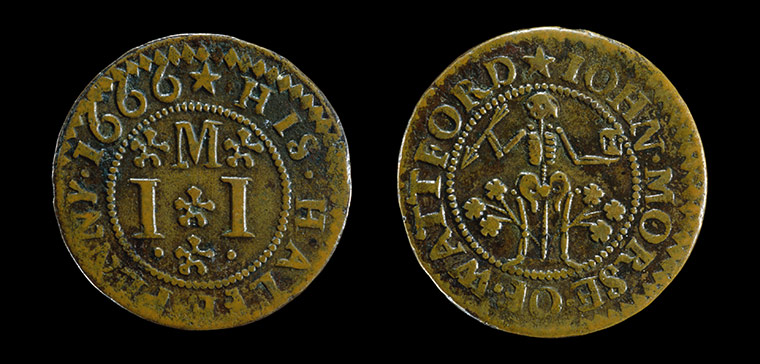
The designs commonly featured the initials of the issuer, the arms of a company such as the Grocers or Mercers, or something connected with the issuer's trade.
The design is unusual. The skeletal figure of Death, mors in Latin, is a pun and refers to the name of the issuer, John Morse
Photograph: British Museum
The Museum of London has 2,000 unique examples in its collection. Many of them found by mudlarks scouring the banks of the river Thames.
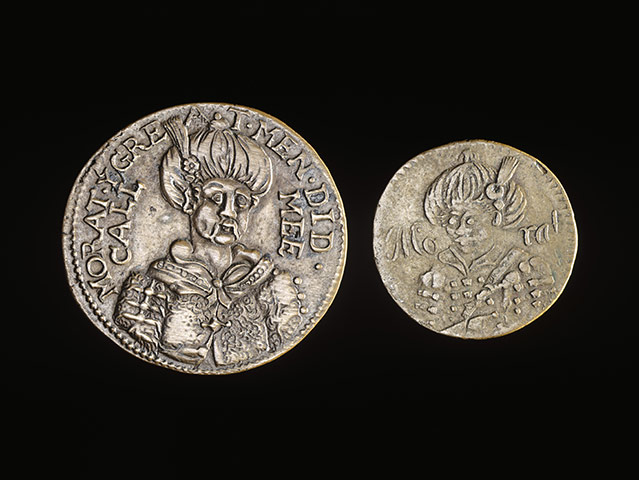
Above are two tokens from coffee houses in Exchange Alley. Both feature a Turk's head. One reads: “Morat Y Great Men Did Mee Call” and carries a full-faced bust of Sultan Murath.
The Kings Intellingencer, a weekly newspaper published in 1662 cites a new coffee house in Exchange Alley called The Great Turk and Mercurius Publicus, March 19, 1662-63 carries an advert for a coffee house in exchange alley with the words ‘Morat the Great’
Photograph: Museum of London
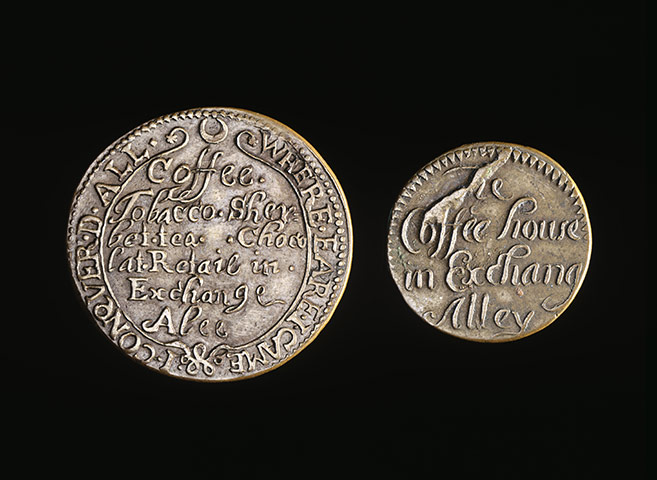
Coffee houses, butchers, bakers and candlestick makers issued their own token coin. Each a miniature work of art, many displayed the name of the trader, or an advertisement for the goods on sale. Without them trade during that period would have been curtailed and the poor without coins. While gentry folk were able to operate on credit, traders tokens enabled shop keepers to do business with everybody else.
The inscription here reads: 'Coffee Tobacco Sherbet tea and Chocolat retail'd in Exchange Ally'
Photograph: Museum of London
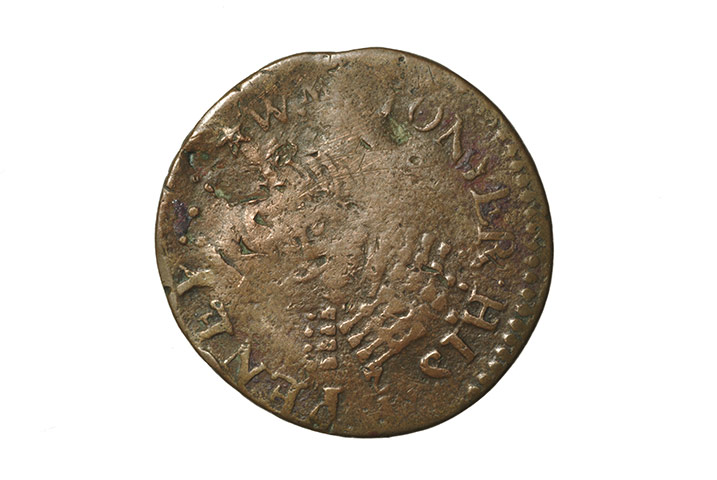
It is likely that the tokens were bartered – that the coin from the coffee house could be spent elsewhere - the Victorian historian William Boyne, in his 1889 book on trade tokens, says that traders had drawers with many compartments to separate the assortment of tokens.
This halfpenny token is one of the small coins issued by tradespeople in the years that followed the beheading of Charles I. This was a period of civil unrest when small change was in short supply. William, whose name appears on this side, was the proprietor of a coffee house and the Turk's head indicates that he sold Turkish coffee. The other side of the coin gives the location of his premises 'Against the French Church in Threadneedle Street'.
Photograph: Museum of London
In his report the council of state in 1651 Thomas Violet argued that: “experience hath sufficiently proved in all ages that small money is so needful to the poorer sort that all nations have endeavoured to have it.”
“Many are deprived of alms for want of farthings and halfpennies, for many would give a farthing who are not disposed to give a penny or a twopence, or to lose time in staying to change money where they may contract a noisesome smell or the disease of the poor”, he said.
Violet told the court that copper coins were in common usage overseas, and he went into detail about the great profit to be made from issuing low denomination coinage.
The King was finally persuaded and in 1672 he issued a decree forbidding the production of tokens. It was agreed that the crown would issue its own halfpennies and farthings in copper. Each farthing coin had the weight of a farthing's worth of copper.
Photograph: Shrewsbury Museums Service
Images from the Darwin Country website at www.darwincountry.org
Photograph: Shrewsbury Museums Service
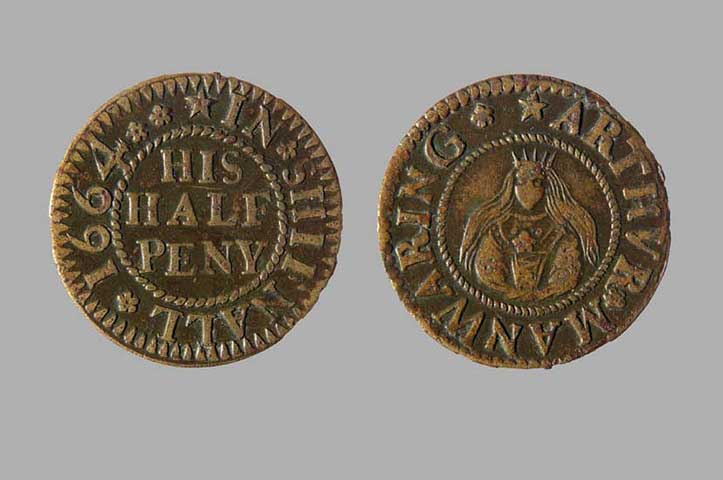
Image from the Darwin Country website at www.darwincountry.org
Photograph: Shrewsbury Museums Service
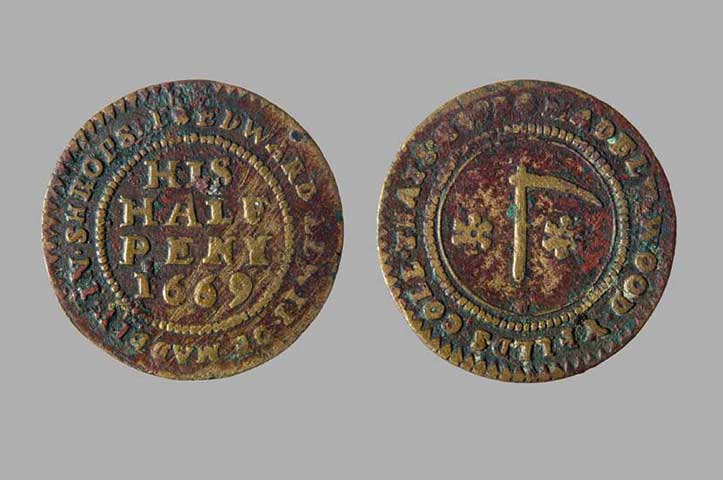
Images from the Darwin Country website at www.darwincountry.org
Photograph: Shrewsbury Museum & Art Gallery
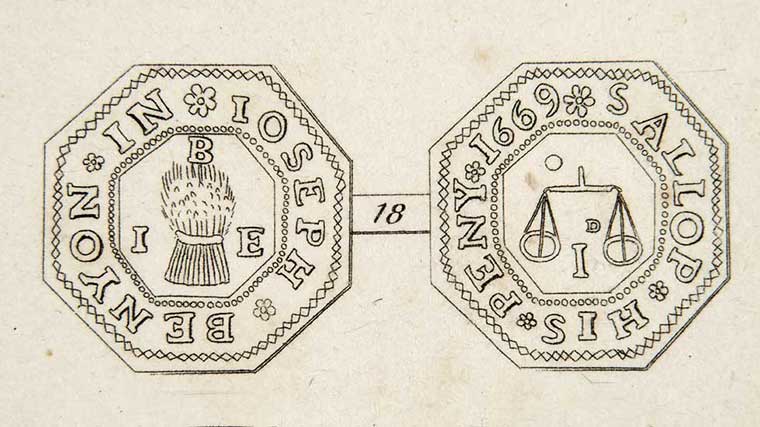
Downloaded with permission from the Darwin Country website at www.darwincountry.org
Photograph: Shrewbury Museum & Art Gallery
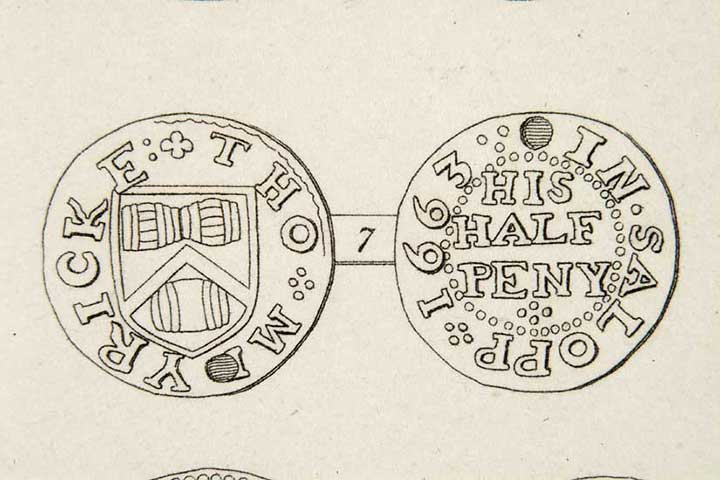
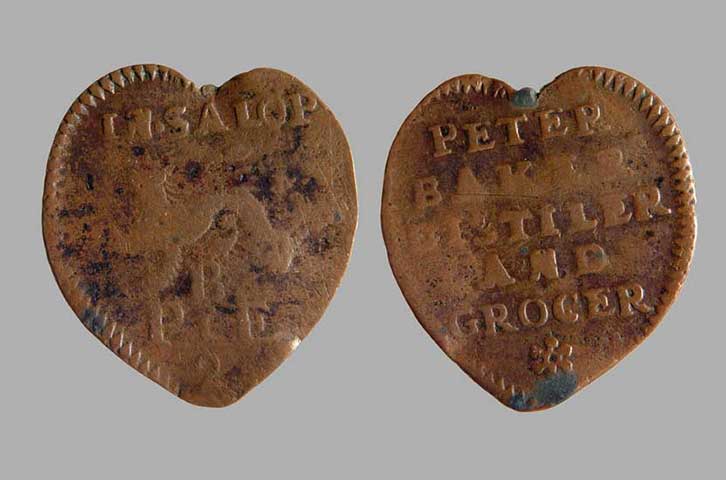
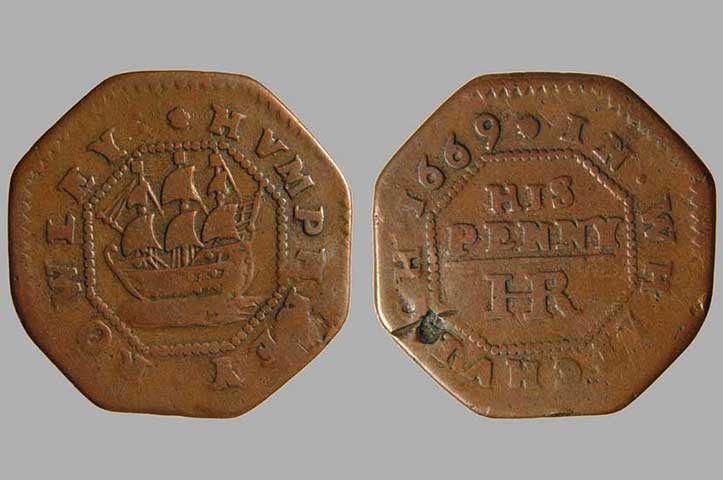
The inscriptions read: "THO: MEYRICKE", and "IN SALOP 1663", "HIS HALF PENY".
Downloaded with permission from the Darwin Country website at www.darwincountry.org
Photograph: Shrewbury Museum & Art Gallery (Shropshire Museum Service)
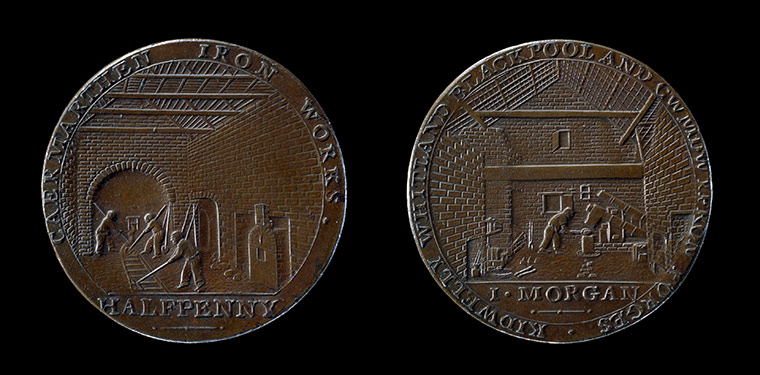
This copper halfpenny token was issued by the Carmarthen Iron Works, South Wales in the 1790s. The unofficial token pennies and halfpennies issued by local industrialists, merchants and bankers were used to pay wages to workers. The local shops in which these tokens were spent were often owned by the same industrialists who had issued the tokens.
Photograph: British Museum
Photograph: British Museum