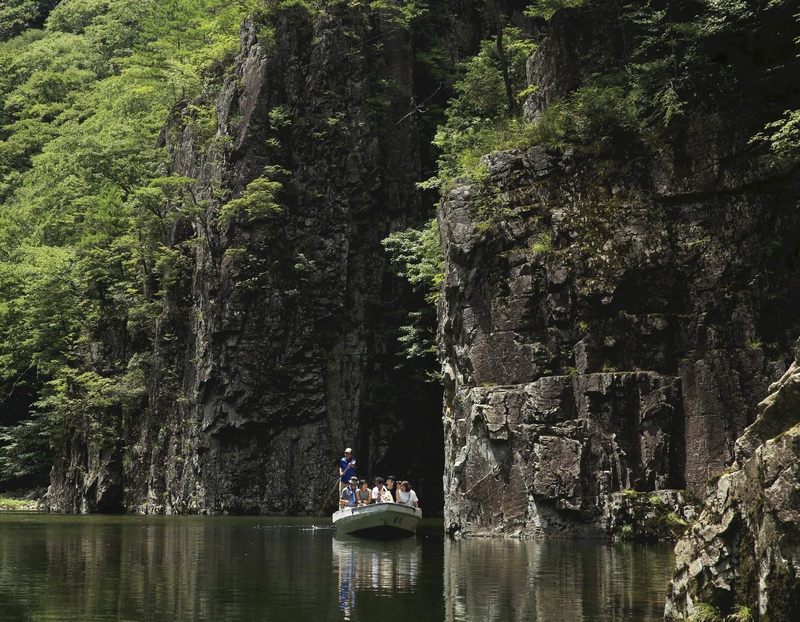
AKI-OTACHO, Hiroshima -- A ravine with towering sides, exposed rock faces and perfectly clear water -- as I walked along the riverside path and the chirping of birds filled the air, a scene reminiscent of a landscape painting spread before me.
The Sandankyo gorge is a designated "special scenic spot" tucked away deep in the Chugoku mountain range in Aki-Otacho. The 16-kilometer-long gorge has been featured in overseas travel magazines, which has resulted in a growing number of foreign tourists adding a visit to the area to their itineraries.
'Found' 100 years ago
Japanese-style hotels, restaurants and souvenir shops line the gorge's main entrance. Passing through and stepping out onto the promenade that follows the Shibakigawa river, lush trees provide a shady respite from the sun. All around were rocks covered in green moss, and small purple flowers of the perennial iwatabako plant were blooming.
The picturesque charm of the gorge first became known about 100 years ago. Nanpo Kuma (1876-1943), a photographer from Hiroshima, was walking through the mountains seeking landscapes to capture on film and was moved by the stunning scenery he found.
In the final years of the Taisho era (1912-1926) and the early years of the Showa era (1926-1989), Kuma explored far up the gorge and took photos that revealed the area's beauty. The area was surveyed and measured, paths were built, and newspaper reporters were invited to participate in tours that explored the gorge. The outside world soon became aware of the previously hidden attractions.
The gorge's Japanese name -- which means a "three-step gorge" -- comes from the fact that three rivers surrounded by three mountains carved out the gorge, and that the terrain is split into three "steps" by two waterfalls. In 1925, the area was named a national place of scenic beauty, and in 1953, it was designated as an especially important and special place of scenic beauty.
High praise from abroad
After walking for about two kilometers along an undulating route that offers views of some distinctive rocks, including the mountain-shaped Horai-iwa rock and the tall, towerlike To-iwa rock, I arrived at the boat landing and departure spot.
Using only a bamboo pole, 26-year-old boatman Katsunori Imai expertly steered the small boat up the river. Before long, the Kurobuchi black pool stretched out before us, as sheer cliffs of blackish rock dozens of meters high rose up on both sides like huge folding screens stretching for about 200 meters. Schools of small fish swam around the sparkling green water of the pool, which is about six meters at its deepest point.
On the opposite bank stands Kurobuchi-so, a small rest house where visitors can eat light meals including grilled and salted yamame trout. A group of foreigners just happened to be taking a break there when I arrived.
In 2015, the French travel magazine "Blue Guide" awarded Sandankyo and Itsukushima Shrine, a World Heritage site in Miyajima, Hiroshima Prefecture, its highest ranking of three stars. Since then, the number of European tourists to Sandankyo has reportedly been increasing.
"On weekdays, we have more foreign visitors than Japanese," said Imai. "Sometimes it's a struggle when I can't understand what they're saying, but we get by through gestures. It's a nice problem to have."
Perfect spot to unwind
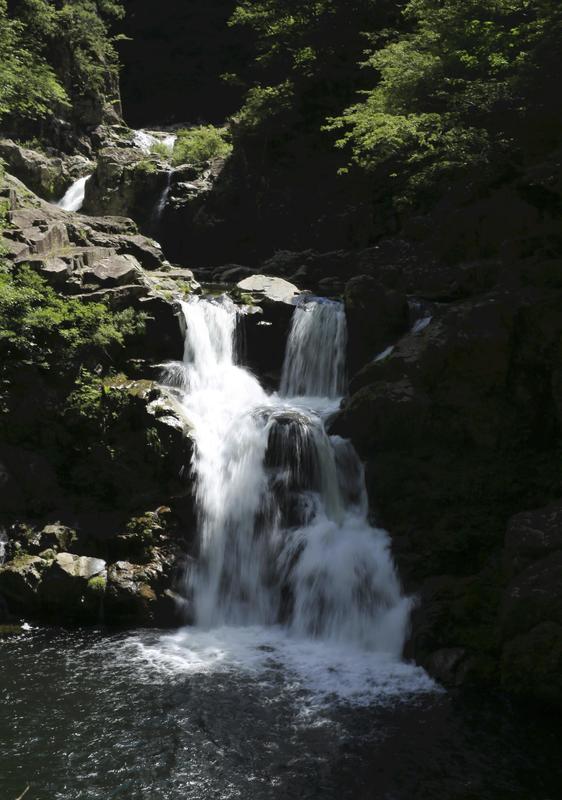
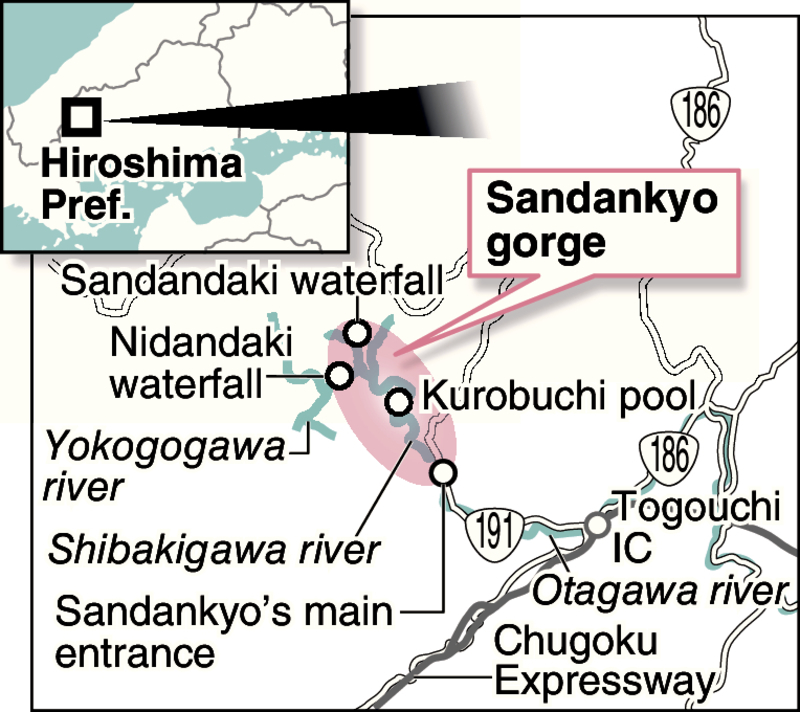
About 30 minutes' drive north from the main entrance is the Mizunashi entrance, which is further upstream from the Kurobuchi pool. The hiking route can be accessed from this entrance, too. I walked for about 30 minutes along the Shibakigawa river until I reached the Sandandaki three-tiered waterfall that pours over a rugged 30-meter drop.
Down the Yokogogawa river, which meets the Shibakigawa river, is Sarutobi, a point where 20-meter-high walls of rock stand just a few meters apart. Heading upstream from this spot -- whose Japanese name derives from the suggestion that a monkey could jump across the narrow gap -- I reached Nidandaki, a two-tiered waterfall that now actually has only one tier because torrential rain in 1988 collapsed the other.
"This is a secluded spot that people can easily reach from the urban areas of Hiroshima," said guide Toshinori Kihara, 44. "Many visitors say they feel refreshed after seeing scenery that goes way beyond their imagination."
To get to the Sandankyo gorge's main entrance, you need to take an express bus from the Hiroshima Bus Center and get off at Sandankyo bus stop. It is a 75-minute ride. By car, the entrance is a 10-minute drive from the Togouchi Interchange on the Chugoku Expressway.
The course from the entrance and including the Kurobuchi pool, Sarutobi, Nidandaki waterfall, Sandandaki waterfall and other spots takes around five hours (including using a bus). On Saturdays, Sundays, national holidays and during the season when the autumn foliage is at its finest (late October to late November), a fee-charging bus runs between the main and Mizunashi entrances.
Read more from The Japan News at https://japannews.yomiuri.co.jp/