An advisory body to UNESCO informed the government on Friday that it has recommended that the hidden Christian cultural sites in Nagasaki and Kumamoto prefectures be added to the World Heritage list, according to government officials.
The Paris-based International Council on Monuments and Sites (ICOMOS) made the recommendation. It also recommended the postponement of World Heritage registration for a natural property in Kagoshima and Okinawa prefectures consisting of Amami-Oshima island, Tokunoshima island, the northern part of Okinawa Island and Iriomotejima island. ICOMOS wants the government to review its explanation about why those should be registered.
Once the Hidden Christian Sites in the Nagasaki Region are registered, they will be the 18th cultural heritage site in Japan to join the World Heritage list.
An official decision on their registration is expected to be made at a meeting of the World Heritage Committee in Bahrain from June 24 to July 4.
The Christian sites are mainly places where communities of Christians secretly practiced their faith, even when the religion was banned in Japan from the 17th to 19th centuries.
The Cultural Affairs Agency initially planned to have churches and Christian-related sites in Nagasaki Prefecture and the surrounding area registered in 2016. That would have comprised mostly modern church architecture.
However, ICOMOS sought to change the focus to the history of hidden Christians during a period of suppression against their religion. The agency then retracted its recommendation in February 2016, and made a revised recommendation last year after receiving advice from ICOMOS.
The International Union for Conservation of Nature, a Swiss-based advisory body on natural heritage to the World Heritage Committee, recommended postponing the registration of the Kagoshima-Okinawa property as natural heritage. The Environment Ministry proposed that it be the nation's fifth natural heritage site, following the Shirakami mountain range, which straddles Aomori and Akita prefectures; Yakushima island in Kagoshima Prefecture; Shiretoko in Hokkaido; and the Ogasawara Islands in Tokyo.
Hideo Hattori, a professor emeritus of Kyushu University, serves as chairman of the Nagasaki world heritage academic council examining the government's statement of recommendation for the hidden Christian sites. "Hidden religious practices were apparently made possible for a long period of time due to tolerance of religions in Japan, despite the suppression of Christianity," he said.
"Political power can't fully control the human mind. This is indeed the lesson learned from Christian-related sites. I welcome the recommendation for their registration," said Hattori, who is an expert on Japanese medieval history.
The Yomiuri Shimbun
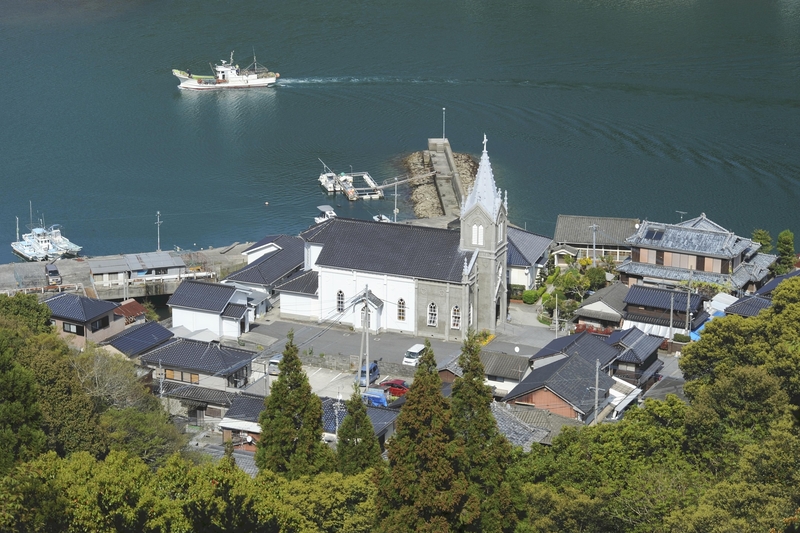
Sakitsu Village, which is part of the Christian-related property recommended to be registered as a World Heritage site, is seen in Amakusa, Kumamoto Prefecture, on April 3. Sakitsu Church is in the center.
Read more from The Japan News at https://japannews.yomiuri.co.jp/