In Sompot Chidgasornpongse's 9 Temples To Heaven, a Buddhist monk advises a family of merit-makers to visit his temple's gleaming new modern building. When the family expresses concern over the steep climb, a challenge to their elderly member, the monk beams: "Your mother can take the elevator to the top floor. You can fast-track her straight to heaven."
Merit, mortality, karmic balance and the socio-political intricacies of institutional faith -- these are some of the themes explored in 9 Temples To Heaven, a Thai film making its world premiere today in the Directors' Fortnight section of the Cannes Film Festival.
Sompot, known for his experimental and documentary films, ventures into fiction filmmaking with a story about a family whose multi-generational members ride around in a van to make merit at nine temples, a spiritual excursion that will supposedly bring blessings upon their ailing matriarch.
Along the way, the day-trippers' conflicting attitudes towards life, death and belief systems reveal the cracks that every family -- with members spanning from Boomers to Gen Alpha -- is likely to have experienced.
The subject matter in 9 Temples To Heaven is very culturally specific: even simple terms like tam boon or kraud nam -- making merit and water-pouring ritual -- carry a religious depth and psychological resonance rooted in Buddhism and the merit-making economy that English translation can never capture.
No Thai would need elaboration on the weighty auspiciousness of the number "9" in the title, but it's likely to be lost on non-Thai audiences. And yet the film has a transcendental strength in its portrait of family dynamics and of the authentic, de-exoticised infrastructure of faith.
Sompot, who has worked for over two decades as an assistant director to Apichatpong Weerasethakul and spent nine years working on this film, also finds his own rhythm of serenity, showing humility and confidence in equal measure. 9 Temples To Heaven is partly supported by funding from the Thai Ministry of Culture that was initiated last year.
The following is an excerpt of an interview with the director.
Almost the entire film consists of a family visiting several temples to make merit. It's so simple and familiar. Is the film based on any personal experience?
My family are devout Buddhists. Dhamma-dhammo as we say. We always go to temples to make merit, so I wrote the film with my own family in mind. In the film, the grandmother is at the centre, but my real grandmother has already passed away. What I wanted to do here is to make a film with genuine Thai spirit. Will non-Thai audiences get everything? I wasn't thinking about that at first, but when we started looking for funding and needed to apply to international funding organisations, I realised they didn't understand many simple concepts like the Thai meaning of boon or how karma works. That involved a lot of explanation to get funding.
Is it also possible to find a deeper layer of understanding given the film's portrayals of Buddhism and its role in Thai life?
I wanted to make an honest family drama. But yes, there's a way to read into the historical-political context. This might get lost among audiences who are not familiar with Thai history or culture, but I hope that the way I portray religious rituals and repeat them several times will give structure to the film and sketch a broad idea behind it. Performing rituals can be universal too.
Temples are a pillar of Thai life and also the most visible cliché and visual stereotype of what Thailand is. However, what struck me is how you film temples. They give off a different vibe, a kind of tranquillity and beauty that's not self-evident.
Filming temples posed the same challenge as when I was filming trains in my documentary Railway Sleepers [a 2016 film about Thai trains as an analogy to Thai modernity]. How do I not romanticise temples? When you film a train or a temple, it's borderline tourism promotion. But I set out not to make a propaganda film about Buddhism, so I had to find a way to do this. So, we consciously tried not to give a shimmering, holy aura to the structure. We looked for angles that wouldn't highlight the extravagant details typical of Thai temples, but at the same time, we acknowledged their beauty and captured that too. And the monks, we framed to appear like ordinary humans.
You have a French cinematographer. How did you work with him to achieve the look of the film?
The cinematographer is Jonathan Ricquebourg. He loves Asian films and we understood each other when we discussed the idea of avoiding temple clichés and making the film look like the everyday life of a group of people.
You're known as a documentary filmmaker. Why did you choose to tell this story as fiction instead of documentary?
I kept thinking why do I have to write a screenplay when I can just go out right now and shoot real people at temples documentary-style? So I had to adjust my mentality quite a lot! Making fiction, however, means I can communicate the idea I have about faith and family more precisely. Still, some of the dialogue in the film came from real life. So, I think I wanted to make a fiction with a documentary spirit -- not in structure or form, but in the way that the plot is loose and slightly drifting like when the characters keep making unexpected stops along the trip.
What about directing the actors? That's another aspect where fiction differs from documentary.
I've had experience working with Apichatpong Weerasethakul and my job then involved casting actors for his films, working with them on the set and telling them what to do. So, working with actors is a process I'm familiar with. Apichatpong likes to work with non-professional actors and so do I in this film.
Are you a religious person?
My house is full of Buddhist books. They're everywhere and I grew up with them. But as I grew older, I read them not through a religious eye but a spiritual perspective. I have also read books about Zen and Taoism. So, I see religion without seeing the superstitious side of it. I don't believe in the concept of merit-making. I don't oppose or resist it, but I don't believe in the logic of merit score -- that you'll go to heaven when you make donations or offerings. There's a conflict there, so in the film, I split myself into two characters, one who believes and one who doesn't.
What Do You Seek In The Dark?
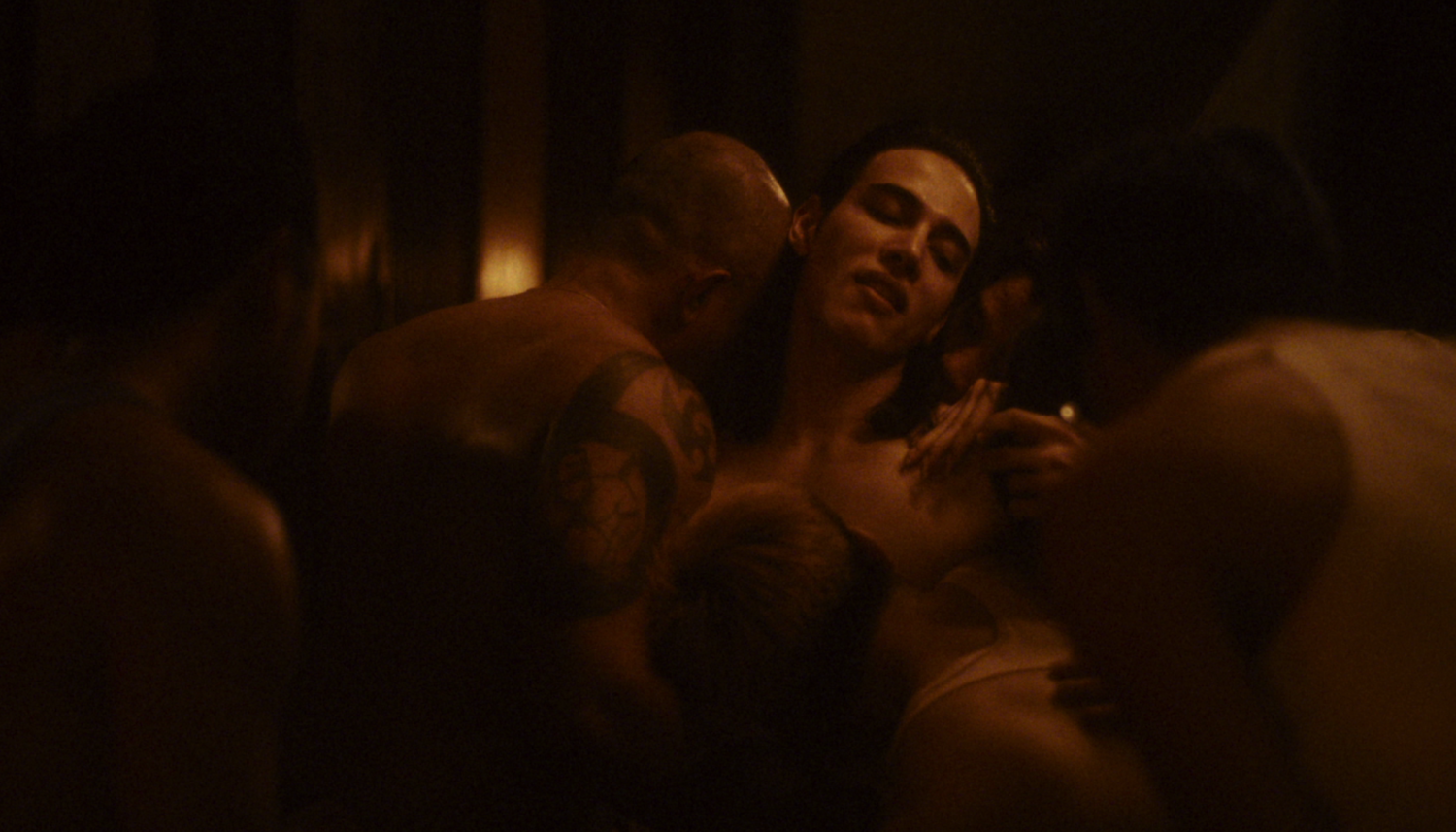
Another Thai film premiering at Cannes today is the short What Do You Seek In The Dark?, Tossaphon Riantong's 19-minute queer surrealist film is showing in the Critics' Week, a parallel section championing new voices in global cinema.
Set almost entirely inside a dim, sex-dripping cavern of a seedy second-run cinema, the film centres on a young man on a cruise whose desire finally consumes him.
What Do You Seek In The Dark? plunges the character into the subconscious terrain nurtured by the flickers of old movies (the 1922 Nosferatu, for instance) and erotic yearning. Spectatorship and voyeurism conflate and confuse, as the act of seeing, watching and touching become inseparable. The half-ruined interior of the cinema house becomes a chamber of nightmare, or a neurotic internal organ awaiting total destruction.
Tossaphon is best known as a screenwriter who co-wrote several hits both for the big screen and television, as such Bad Genius The Series, I Promise You The Moon, I Told Sunset About You, Ghost Lab and many more. But he has directed several short films since the early 2010s.
What Do You Seek In The Dark?, the first Thai short film to be picked for the Critics' Week section, is a culmination of his passion and endeavours in the short filmmaking arena.