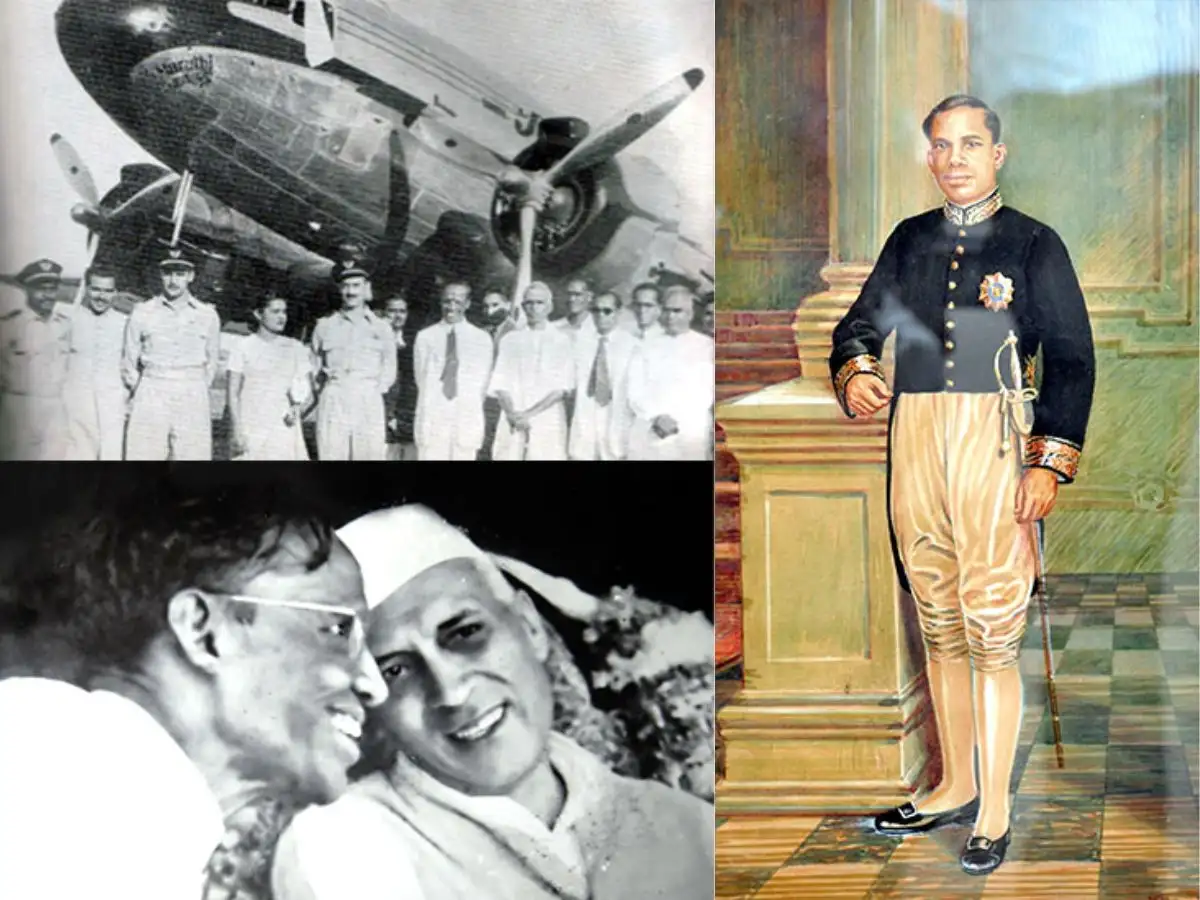
When India was going through one of its most difficult periods after Partition, an industrialist from Tamil Nadu used his private airline not to expand his business, but to help people caught in the humanitarian crisis. Dr RM Alagappa Chettiar, who built a vast business empire across industries, offered his aircraft for refugee rescue operations and later donated 300 acres of land and funds to help establish a major scientific institution in the country. His life ended at just 48, but his contributions to education, aviation and public service continue to influence generations.
Born on April 6, 1909, in Kottaiyur, Sivaganga district, in the Chettinad region of Tamil Nadu, Dr Ramanathan Muthiah Alagappa Chettiar rose from a small town background to become one of India’s leading industrialists and philanthropists.
Unlike many businessmen of his time, Alagappa Chettiar saw wealth as a responsibility. He invested his success back into society through education, scientific development and national service.
From law student to business leader
Dr Alagappa Chettiar completed his M.A. in Literature from Presidency College, Madras, and later qualified as a Barrister at Law from Temple, England.
Although he had the qualifications to practise law, he chose a different path and entered the world of business. His entrepreneurial journey began in 1937 with the establishment of Cochin Textiles.
Over the years, he built a diversified business network that included textile mills, rubber plantations in Malaya, tin mines in Burma, insurance, hotels, cinema and aviation.
His business interests expanded across countries, but he remained closely connected to Karaikudi and the Chettinad region, where he focused on creating opportunities for people.
The industrialist who used his airline during Partition
Alagappa Chettiar had a deep interest in aviation. While in London in the early 1940s, he earned his pilot’s licence at Croydon.
In 1947, when India witnessed the chaos of Partition and millions of people were forced to leave their homes, Alagappa stepped forward through Jupiter Airways, one of India’s early private airlines.
He offered his aircraft to the government for relief operations. His planes helped transport refugees from Pakistan to India and also carried Indian Army personnel, equipment and essential supplies during a critical period for the newly independent nation.
His decision reflected his belief that businesses should support the country during moments of crisis.
The 300-acre donation that changed Karaikudi’s future
While aviation brought him national attention, education remained one of Alagappa Chettiar’s biggest missions.
He believed that building institutions was the best way to create long-term change. His contributions helped establish and support several educational centres, including:
✓ AC College of Technology (AC Tech), Chennai
✓ Schools in Chennai and Karaikudi
✓ Engineering colleges and polytechnics
✓ Alagappa University, Karaikudi
✓ Alagappa Nursing College, Karaikudi
One of his most significant contributions came when he donated 300 acres of land and Rs 15 lakh to the Government of India. The donation played a key role in bringing the Central Electrochemical Research Institute (CECRI) to Karaikudi, transforming the town into an important centre for scientific research. The then Prime Minister of India Jawahar Lal Nahru called him socialist capitalist.
“The magnificent gift of 300 acres of land and fifteen lakhs of rupees by Dr. Alagappa Chettiar helped the Government of India to select Karaikudi as the seat of Electro Chemical Research Institute.” Dr. S. Radhakrishnan, President of India
A simple idea that influenced Tamil Nadu’s midday meal movement
Alagappa Chettiar’s social contributions were not limited to large donations. He also focused on everyday needs of students and communities.
He made arrangements to provide free meals to students and people in need in Karaikudi. When Tamil Nadu leader K Kamaraj witnessed the initiative during a visit, he was inspired by the idea.
The concept later influenced the state’s midday meal programme, which became an important effort to improve children’s nutrition and school participation.
Honours, sacrifice and a legacy beyond business
For his contributions, Alagappa Chettiar received several recognitions. He was awarded an honorary D.Litt. by Annamalai University in 1943 and an honorary LL.D. by the University of Madras in 1944.
He was knighted by the British Crown in 1946 at the age of 37. After India gained Independence, he gave up the title.
In 1957, he was honoured with the Padma Bhushan by the Government of India.
Dr RM Alagappa Chettiar passed away in 1957 at the age of 48. However, the institutions he built continued his vision. Generations of students, scientists, engineers and professionals have benefited from his contributions.
His story remains that of an industrialist who measured success not only by the wealth he created, but by what he gave back to the nation.