He's 23, unemployed and spends his days in his home in Kyoto, immersed in online games. Joining online games that allow numerous participants, he can be engrossed for as many as 14 hours a day. For more than five years now, he's been living a life in which there is no demarcation between night and day.
This kind of "gaming disorder" involving total absorption in computer games, and the serious disruption it brings to daily life, is becoming a prevalent social problem -- so much so that the World Health Organization has made moves to officially recognize it as a disease.
On the flip side of this phenomenon, the popularity of "electronic sports," better known as "esports," is growing unabated.
Gaming has been following a two-track path -- one positive and one negative.
Calling it a disease
The Kyoto gamer once went to an elite combined junior high and high school, but is currently jobless. "I'd like to at least contribute some money to the household," he said, but he spends all of his time planted in front of the computer, as if driven by some feeling of obligation.
He's currently seeing a mental health professional, and has started a program that will help him cut down on his playing time.
In the latest revision of its International Classification of Diseases announced in June, the WHO classified the symptoms of the disorder. These include an inability to control the frequency or time spent playing and putting priority on gaming ahead of other interests and daily activities, that continue for at least a year, and other noticeable disruptions to school, employment or other important areas.
In Japan, estimates say 930,000 junior high and high schoolers -- a whopping one in seven -- are suspected of being "internet dependent," including those hooked on games. The criteria used in the calculation, however, differ from the WHO definition, so the full extent of the problem remains a mystery.
Starting treatment
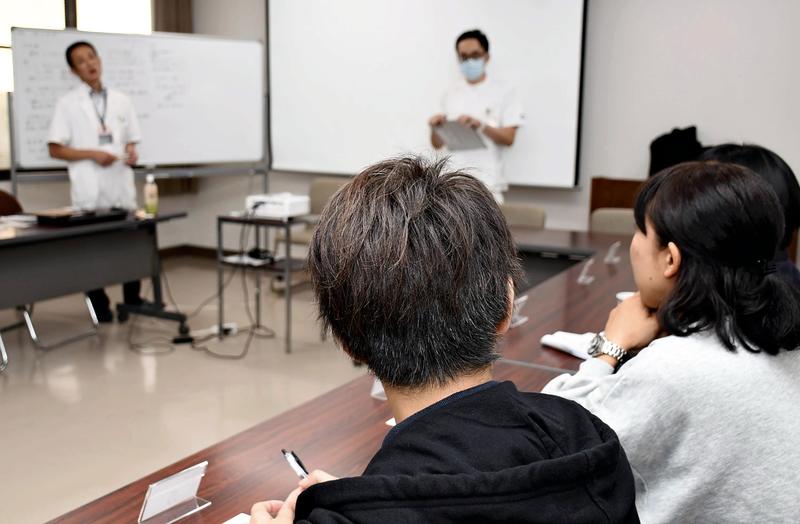
There are some health care facilities that have begun seeing patients. The Kurihama Medical and Addiction Center located in Yokosuka, Kanagawa Prefecture, sees about 200 new patients annually for internet addiction on an outpatient basis. Most of them suffer from game addiction, and are in their teens or 20s. The center is part of the National Hospital Organization, and provides counseling or psychological therapy.
At a support group meeting held at the center in late October for the families of patients, the comments from parents conveyed their agony.
"In this day and age, it's just not possible to take away their computer or smartphone," said one. Another said, "[My child] started going to a language school and seemed to be getting better, but had a relapse. It seems every day is two steps back for every three steps forward."
In popular online games, we can find fundamental human desires, such as competition, gaining the approval of strangers or collecting items. The addiction is said to easily stem from structural issues.
"It's not something that can be resolved in the home alone," said hospital director Susumu Higuchi. "Even treatment in the hospital is groping in the dark. Schools, governments and others have to look for countermeasures as society as a whole."
The lure of esports
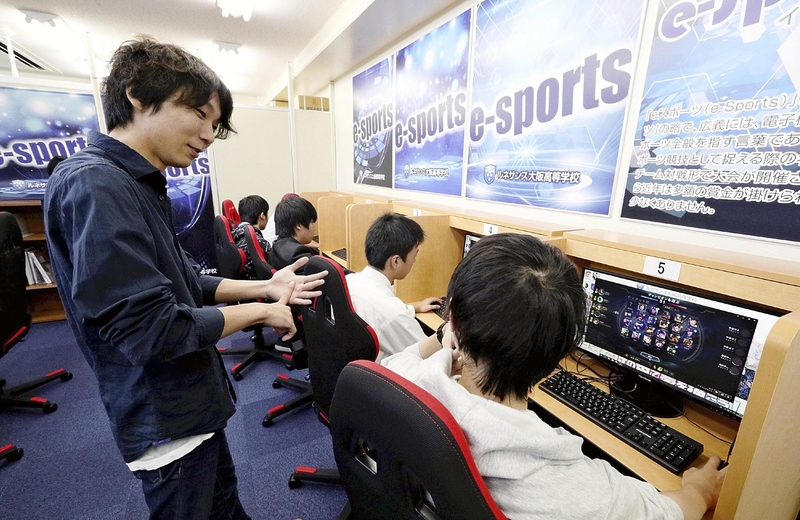
Conversely, there is the esports sector in which games become competitive. Nationally, there are already over 100 professional gamers, and movements have started to create an environment for making it a field of academics.
Renaissance Osaka High School, a correspondence school based in Osaka, started an esports course in the current school year. There are 13 students aged from 15 to 17 with dreams of becoming professional gamers, and dozens more are expected to enroll next year. The students go to school for classes twice a week, and receive lessons while playing actual games that are events at esports meets. On class days, they play for about 10 hours, while some spend as much as 18 hours when they come on their own or on a holiday.
"I play for long hours, but I can stop when I want to," said first-year student Daigo Takasu, as he sat in a classroom lined with computers. "I'm not addicted." He has increased his gaming hours as he prepares for a qualifying tournament for an internet competition to be held in late December.
While in junior high school, Takasu, now 15, never felt a part of school life and shut himself up in his home, where he played games incessantly. But things changed when he started playing esports at high school. "At junior high school, it was a way to escape from reality," he said. "But polishing my strategy and skills with friends and working to make it to the national meets, it has really become fun."
At the high school, time is used to put together a course load that takes into consideration a path toward setting and achieving goals, including finding a job. "[As esports] continues spreading, if you have a stake in society or have a concrete goal, you can turn 'overdoing it' into 'an effort,'" said Kazuhiko Fukuda, head of the school's corporate marketing division. "Instead of setting limits, it's more important to teach them how to handle it as a part of life."
Read more from The Japan News at https://japannews.yomiuri.co.jp/