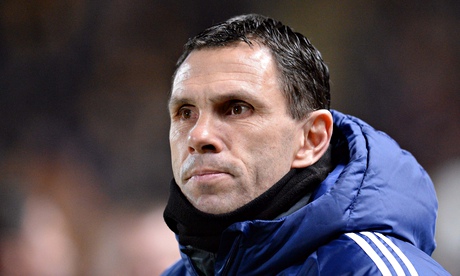
A storm is gathering at Sunderland with Gus Poyet standing right at the centre. The fear on Wearside is that it will hit the Stadium of Light on Saturday afternoon when Aston Villa’s visit threatens to bring an unfortunate confluence of events to a head.
Should Tim Sherwood’s side win, Poyet’s future will again be subjected to scrutiny while discontent in the stands could well tip from resigned disgruntlement to rebellion.
To a casual observer, Sunderland’s position, sitting 16th and four points above the bottom three, looks, if not exactly comfortable, hardly disastrous. Yet while a series of draws has left Poyet’s players within touching distance of mid-table their inability to win games – they have celebrated four league victories this season – threatens to suck them into the relegation vortex.
A manager knows he has problems once March arrives and his team have won only twice at home in the Premier League and his joint top scorers have four goals apiece. When one of that pair is suspended from the club and on police bail as investigations continue into allegations he had sex with an underage girl, the word crisis no longer seems an exaggeration.
If Adam Johnson’s exclusion from the club while Durham constabulary continue their inquiries deprives Poyet of arguably his side’s most creative outlet, Lee Cattermole’s absence from both the Villa game and the trip to West Ham United the following weekend is equally damaging.
With Cattermole – so often Sunderland’s best player – serving a two-game ban after being booked for the 10th time this season, Sherwood will sense opportunity. In the home enforcer’s absence Sherwood will expect Ashley Westwood and Fabian Delph to dictate midfield as Villa – one place and one point behind Sunderland – aim to climb the table.
How different it would be if Sunderland found scoring as easy as accumulating yellow cards. The 85 they have collected has helped send them plunging to the bottom of the Fair Play League but this position is not just down to Poyet’s players. Fair play positions are calculated in five categories: the number of red and yellow cards clocked up; positive play (namely a lack of time wasting and general attacking intent); respect towards opponents; respect towards referees; and the behaviour of team officials. Sunderland have scored particularly badly in the last of these, with Poyet and his assistants, Mauricio Taricco and Charlie Oatway, as well as the goalkeeping coach, Andy Beasley, infamous for their targeting of match officials and provocation of the opposition.
Things reached a nadir during a somewhat flattering 1-1 draw at Hull City last week when, after being banished to the stand after kicking over a tray of drinks bottles on the touchline, Poyet wandered over to Steve Bruce and, after initially making as if to shake the Hull manager’s hand said something that prompted an uncharacteristically charged reaction from one of his Wearside predecessors. Bruce, who had to be restrained by a linesman, tried to make light of it but admitted that Poyet’s words were “not very pleasant”. Back on the pitch, the away team became liable for an automatic £25,000 Football Association fine after accruing six bookings.
Refusing to apologise, the Uruguayan said he “regretted nothing”, which did little to dispel the image of a man seemingly close to breaking point. Always volatile, the former Brighton manager has, at various times this season, blamed Sunderland’s travails on his players, the director of football, Lee Congerton, the fans (he said they were “living in the past” and craved “kick and rush football” but later published an open, conciliatory, letter on the club’s website begging for their support) and in the north-east press.
Only Poyet, though, can explain why he fielded four central midfielders at the KC Stadium and began with Patrick van Aanholt, a pacy attacking left-back who is now his best available crosser of the ball, on the bench.
Maybe he was making a political point to a board he feels has not backed him adequately in the transfer market and does not permit him sufficient overall autonomy. Or perhaps Sunderland’s 8-0 thrashing at Southampton in October scarred their head coach so badly Poyet has simply lost his attacking nerve.
The latter theory arguably explains the team’s recent record of only one win in 11 games and the chalking up of eight goalless draws this season. A mere 12 league goals have been scored at home while the total draw tally stands at 14.
Before travelling to Hull Poyet said he had been forced to abandon, at least temporarily, his attempt to create a “brand Sunderland” by imbuing the team with a Spanish-style short-passing, ultra-patient, possession-based game.
Acknowledging this vision was not working, he announced a dramatic U-turn, indicating pragmatism would be the order of the day between now and May. “We need to forget about identity and special shape,” he said. “We just need to win games – somehow.”
When in October 2013, Ellis Short, Sunderland’s owner opted to replace Paolo Di Canio with Poyet rather than the then available Steve McClaren eyebrows were raised in certain quarters.
Initially the team’s run to the League Cup final followed by a near-miraculous escape from relegation – not to mention some convincing wins against local rivals Newcastle United – vindicated Short’s judgment.
Even so, by the time the clocks went forward, it was becoming apparent Di Canio’s successor was high maintenance with the owner having to talk him out of quitting following a 5-1 April thrashing at Spurs.
If a mutual parting of the ways this summer appears an increasing possibility, there seems little boardroom appetite for making an imminent change. Unless, of course, Villa, Sherwood and Saturday’s expected 40,000-plus crowd conspire to force Short’s hand.