The New South Wales premier, Chris Minns, has recalled parliament this week to rush through legislation created in response to the Bondi beach terror attack, in which 15 people were killed.
The changes, which cover gun control, hate speech and protest restrictions, have been controversially put together into a single bill: the terrorism and other legislation amendment bill.
The NSW Liberals voted with Labor to pass the bill in the lower house on Monday night and it is expected to pass the upper house on Tuesday.
The Nationals, who have criticised the impact that tighter gun restrictions would have on farmers, opposed the legislation on Monday night and said the changes do not address antisemitism.
Meanwhile, the Greens have described an attempt to restrict protests for up to three months after a terrorist incident as “the most draconian, authoritarian anti-protest laws this country has ever seen”.
Here is what is being proposed and what might change.
Gun control
The bill introduces the most significant changes to NSW’s firearms laws since the Port Arthur massacre in 1996, when the current Firearms Act was legislated.
It would restrict the number of firearms for people with recreational licences from no limit to four, and 10 for those using weapons for commercial purposes, including farming or pest control, as well as for sports and target shooters.
The NSW Nationals leader, Gurmesh Singh, announced on Monday that his party would oppose the bill, saying it imposed “arbitrary limits” on farmers and regional businesses and “the tools they need to do their jobs”.
On Monday night, the Nationals – who have supported changes to hate speech and protest laws – sought unsuccessfully to have the bill sent to a parliamentary committee and to remove caps for farmers. The Liberals have not sought to amend the government’s gun control changes, while the Greens have indicated their support and called for further restrictions.
The government’s changes would reduce the length of a general term for a firearms licence from five to two years, and require licence holders to be Australian citizens.
They would also remove an exemption allowing an unlicensed person to use a firearm at a shooting range while under the supervision of a licensed person, or during a firearms safety training course. They would require someone to be a member of a shooting club for most licence categories in NSW.
The bill would also recategorise straight-pull, pump-action and button- or lever-release firearms, which includes the weapons allegedly used in the Bondi beach attack, to category C under NSW’s licence scheme, which means they would be “prohibited except for official purposes”, such as farming or pest control.
The changes would completely ban belt-loaded magazines, of the kind also allegedly used during last Sunday’s attack.
The changes would give the power to police to refuse a licence on the basis of “criminal intelligence or other criminal information” that a person is a risk to public safety.
It would remove the right for appeals against licence decisions to the NSW Civil and Administrative Tribunal.
Display of terrorist symbols
Under an amendment to the Crimes Act, the public display of prohibited terrorist organisation symbols, including the Islamic State flag, would be banned, with a maximum penalty of two years’ imprisonment, a $22,000 fine or both.
The NSW attorney general, Michael Daley, has said this would include other symbols of terrorist organisations listed by the federal government, including al-Qaida, Hamas, Hezbollah, al-Shabaab, Boko Haram and others from “around the world”.
The shadow attorney general, Alister Henskens, described the change as an “incredibly weak response to the need for proper laws to outlaw terrorist symbols”, such as the Islamic State flag that the police allege the Bondi gunmen allegedly had in the back seat of their car.
On Monday, the Liberals brought an amendment to increase the maximum sentence to five years’ imprisonment, and give the police minister the power to designate organisations as terrorist, but this was rejected.
Anne Twomey, a professor of constitutional law at the University of Sydney, said the legislation was “virtually the same” as a commonwealth law introduced in 2024, but does not contain the need to connect the offence to a particular harm to a person or group.
“That would presumably make it easier to prosecute,” she said.
Protest laws
New police powers would allow officers to direct protesters to remove face coverings if they suspect a person has committed or is likely to commit an offence, with penalties of up to a year in jail for those who refuse.
But the most controversial element would create a power for the police commissioner to make a “public assembly restriction declaration” after a declared terrorist incident, restricting public assemblies in “a specified area”.
A declaration would have to be made within 14 days, but could extended on a rolling basis for up to 90 days. It would not apply to industrial action.
In order to come within such a declaration assemblies would have to be “likely to cause a reasonable person to fear for their safety or pose a risk to community safety”, and must be approved by the police minister.
The government has claimed the powers are “not designed to stop quiet reflection, prayer or peaceful gatherings”.
Rather than prohibiting protests outright, it would mean protests would not be authorised under NSW’s form 1 system, which protects protesters from prosecution for offences such as obstructing traffic. Police would have the power to move on protesters who engage in this conduct.
Twomey said because the changes focused on the authorisation of public assemblies, rather than banning assemblies outright, they were less vulnerable to constitutional challenge.
“If you enact legislation concerning such sensitive and complex things, and you do it so quickly that there’s been no scrutiny, you’re far more likely to have it challenged.”
The legislation has been designed to retrospectively apply to protests after the recent Bondi attack – which has been declared a terrorist incident – if it is passed in time.
On Monday, the Liberals brought an unsuccessful amendment to make all public assemblies unlawful under a declaration, with a $1,000 fine for those who participate in a protest and a penalty of five years’ imprisonment “for those who organise divisive public assemblies”.
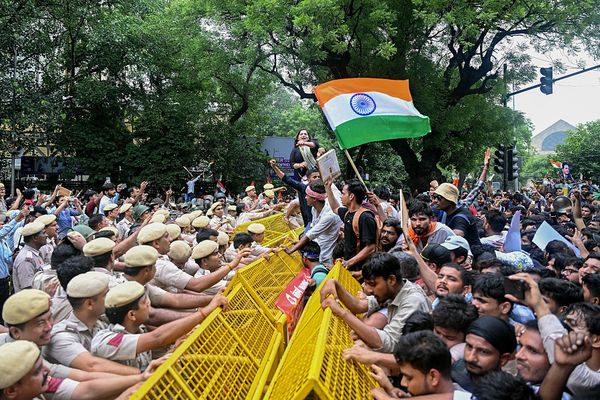
But many have seen the government’s changes as already granting the power to effectively ban protests. On Monday afternoon, a group gathered at Sydney’s town hall to demonstrate against the restrictions.
The NSW Greens, who abstained from the final vote in the lower house on Monday, have criticised the protest laws. Their justice spokesperson, Sue Higginson, has described the changes as “the most draconian, authoritarian anti-protest laws this country has ever seen”.
Higginson, who spoke in support of a constitutional challenge to the laws on Tuesday, said the Greens would seek to split the protest laws from the rest of the bill in the upper house, but may be forced to abstain again in the final vote.
The laws would be subject to a two-year review by the police minister. The NSW Council for Civil Liberties president, Timothy Roberts, told Guardian Australia the laws showed a “surprising lack of transparency”.
“Two years is far too long a delay for a review given the extraordinary nature of the powers and this incursion on our democratic freedoms,” he said.