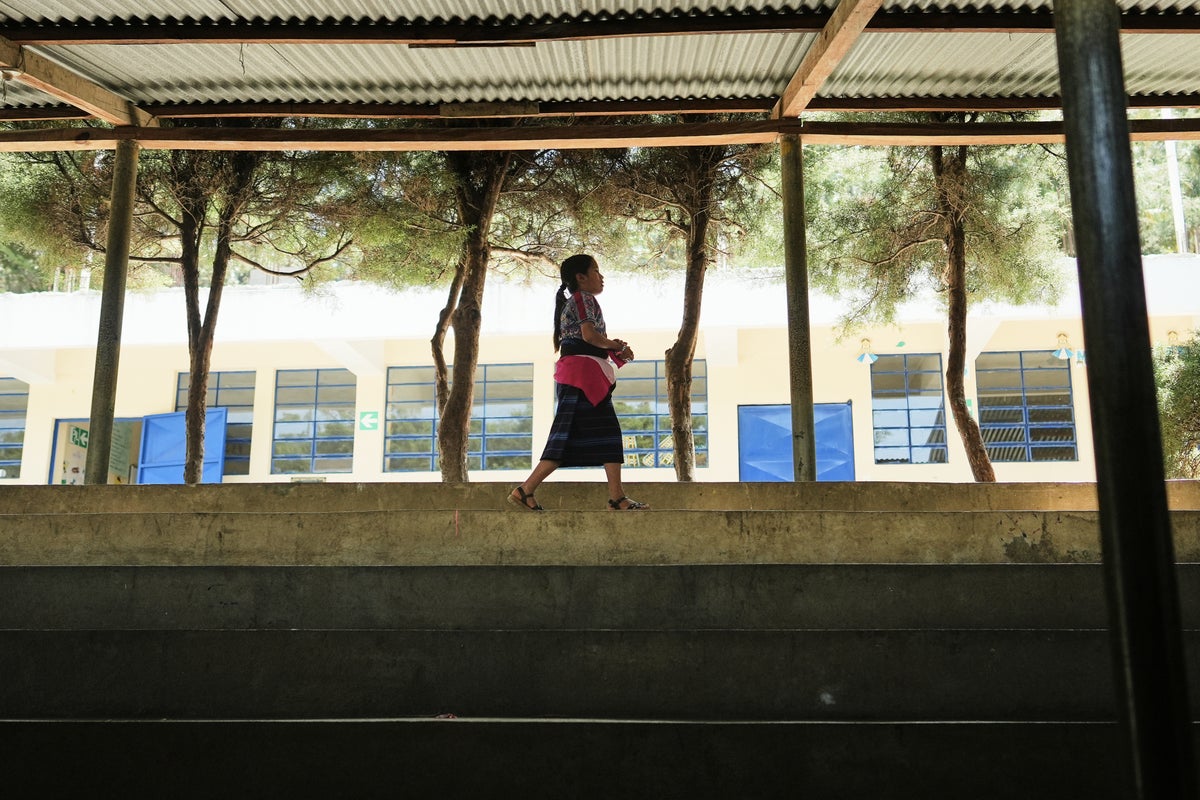
At a school in Guatemala’s western highlands, children’s shyness melted away as they clapped and sang along with the words of a song in their Kaqchikel language.
Ninety-seven percent of the school’s more than 250 students speak Kaqchikel — one of 22 Mayan languages spoken in Guatemala — and instruction is given in that language and Spanish.
Singer-songwriter Sara Curruchich had them at the edge of their seats Thursday when she began singing in Kaqchikel.
“When we come to the communities and people in (their) language, there is an instantaneous connection, we recognize ourselves in the word,” she said, recalling that when she was a child she did not listen to songs in Kaqchikel.
Curruchich’s performance was part of an event organized at the school to celebrate and conserve Indigenous languages in advance of International Mother Language Day on Saturday.
In addition to Curruchich’s songs, children took turns reading a Kaqchikel translation of “What Makes Us Human,” by Victor Santos, a story about valuing the mother tongue and how it connect people to earlier generations. It was published in collaboration with UNESCO, the publishing house Cholsamaj and the Mayan Language Preservation Project.
“What we want is that the language does not disappear, because with it would disappear a cosmovision, wisdom, all of the connection with our ancestors,” said Gerson Mux, executive director of Cholsamaj.
He said they are prioritizing translations into the 22 Mayan languages spoken in Guatemala, but especially the four most in danger of disappearing: Itza’, Uspantek, Mopan and Chorti.
Curruchich said “we hope the kids will also adopt them, not out of obligation, but with a lot of love.”
“That’s how they become the guardians of our languages, ensuring that what our grandmothers and grandfathers cherished as our identity and roots prevails,” she said.
According to the Academy of Mayan Languages, a 2018 census showed that a little more than 6.4 million Guatemalans — about one third of the population — spoke a Mayan language, Xinca or Garifuna.
Cristina Puerta, chief of UNESCO Publications, said in an email that “we decided to promote this illustrated book because it conveys the simple yet powerful idea that language is the very essence of what defines us as human beings.”
The hope is that the project will raise awareness among “younger generations of Mayan language speakers about the linguistic richness they inherit and the need to mobilize others to preserve it.”
Olympics visitors are invited beyond the Duomo to Milan's other stunning churches
Jurors deliberations to start in trial over killings of 4 men as they slept on NYC streets
Guardians pitchers Emmanuel Clase and Luis Ortiz fight pitch-rigging case as spring training starts
The Trump tariffs most affected after Supreme Court ruling
Trump ‘ashamed’ at Supreme Court ‘fools’ over ‘disloyal’ ruling against his tariffs
Kash Patel’s girlfriend sings National Anthem before Hegseth anti-abortion speech