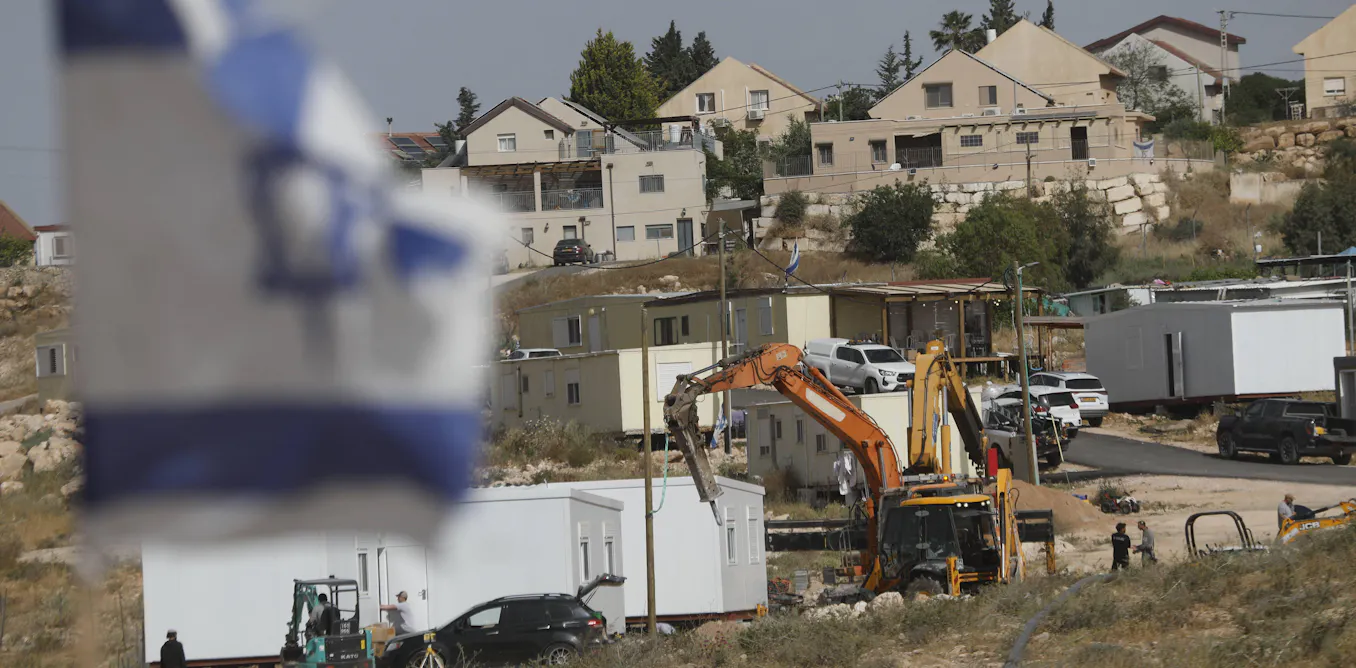
A big increase in violence on the West Bank has prompted the EU to issue sanctions on several individuals and groups that allegedly organise and finance illegal Israeli settlements in the Palestinian territory.
Under the 1993 Oslo accords between Israel and the Palestine Liberation Organization (PLO), the West Bank and Gaza were designated as Palestinian territories under a mixed schedule of Israeli and Palestinian jurisdictions. The intention, however, was always for Palestinians to eventually gain full control of all three areas as part of a future state.
But while official Israeli settlements were mainly dismantled, illegal settlements continued with the knowledge – and often the tacit permission – of Israel’s governments over the years.
After a very narrow electoral victory in November 2022, Benjamin Netanyahu turned to extreme Zionist parties to be able to form a government.
The result was arguably the most rightwing government in Israel’s history, including two extreme pro-settler ministers: minister of finance, Bezalel Smotrich, and national security minister, Itamar Ben-Gvir. Both have frequently sought to undermine Palestinian security and enable further settlements on the West Bank.
In February 2026, Israel’s security cabinet approved measures transferring administrative powers in the West Bank from the military to government ministries. What had previously been a de facto annexation moved a step closer to being formalised.
‘Where is our Hebron?’
These political developments would not have been possible without the support of an ideology which grew in strength during Israel’s conflicts of the 1960s and ’70s. The 1967 and 1973 wars, known as the Six-Day War and Yom Kippur War respectively, polarised Israeli society and paved the way for the emergence of a new religious and messianic wave that strengthened the link between the Israel of the Old Testament and modern Israeli identity.
This was a historical connection that had already been cultivated by secular Zionists who had settled in the region in the first half of the 20th century – although they stripped it of its religious dimension. David Ben-Gurion, Israel’s first prime minister, wrote in his book Memoirs in 1970: “We wanted to create a new life consonant with our oldest traditions as a people […] So we were prepared for blood on our hands in the name of autonomy, self-determination and self-defense.”
In 1967, Nathan Alterman and Moshe Shamir – both figures associated with leftwing Zionist intellectual circles – founded the The Whole Land of Israel movement (Ha-Tenuah Lemaan Eretz Yisrael Ha-Shlemah). This was an extra-parliamentary initiative bringing together supporters from across the political spectrum.
Presenting themselves as continuous with classical Zionism, its members argued that settlement policy had been central to Jewish migration since the British Mandate in Palestine. They insisted it was essential to Israel’s security.
Read more: How Israel’s history has shaped the way it wages war
The core idea was to extend Israeli territorial sovereignty over all lands belonging, in biblical tradition, to the Jewish people. This was meant to restore the splendour of an ancient Jewish golden age as described in the stories about kings David and Solomon in the Hebrew Bible.
At the same time, the messianic theology of ultranationalist rabbi Zvi Yehuda Kook began to gain influence. For Kook, Jewish exile and return to the promised land were stages in a divinely guided process leading towards the restoration of ancient Israel. Return was seen as a prerequisite for the coming of the messiah. In 1967, Kook addressed his students, declaring:
Where is our Hebron [the biblical name for the Palestinian city of Al-Khalil] – have we forgotten it? And where is our Shechem [now Palestinian Nablus] – have we forgotten it? And where is our Jericho [now Palestinian Tell es-Sultan] – have we forgotten it? Where is […] every portion of the four cubits of the Lord’s land? Have we the right to relinquish even a single millimetre of them? Heaven forbid!
From this perspective, the West Bank – referred to in biblical terminology as Judea and Samaria – was central to the affirmation of Jewish identity in the Promised Land.
Bloc of the faithful
This ideological current developed into Gush Emunim (“Bloc of the faithful”), founded the year after the 1973 war, which became the first politically recognised settler movement in Israel. Gush Emunim framed a narrative incorporating both Zionism and security, which appealed to secular and religious Israelis.
The political opposition to the Labour government of the time — the rightwing bloc led by Menachem Begin and his Likud party — capitalised on this both electorally and politically. Begin’s government, elected in 1977, strongly supported the movement’s agenda, and implemented policies aimed to reestablish Israel’s biblical borders.
As early as the end of 1977, his minister of agriculture Ariel Sharon proposed to the Knesset a plan for the expansion of new settlements in the West Bank.
In the early 1980s, the goverment facilitated the creation of the Yesha Council. This describes itself as an “umbrella organisation of all the local authorities […] to promote Israeli communities in Judea, Samaria and the Jordan Valley as the heart of the Bible Land and the birthplace of the Jewish people and its heritage”.
Gush Emunim was dissolved in 1984 due to links with the terrorist Jewish Underground (machteret), which was implicated in various armed attacks on Arabs, several assassinations and a plot to blow up one of Islam’s holistest sites, the Al-Aqsa mosque in Jerusalem. But its ideology persisted among settler groups, and gained renewed strength after the Hamas massacre in 2023.
Before the Hamas attack on Israel, settler groups had primarily focused on the occupation of territory in the West Bank. But as Israel has since increased its military operations in Gaza, Syria, Lebanon and Iran, they have expanded their ambitions to additional territories. A new movement, Uri Tzafon (“Awaken, oh north”), was founded with the aim of settling southern Lebanon.
Settler movements have also undertaken actions aimed at organising the “Judaization” of Gaza. According to Daniella Weiss, a former secretary of Gush Emunim and now the spokesperson for the Nachala settlement movement: “Jewish settlement in Gaza is a very difficult step and demands a lot of work. You have to influence the leftists, the government, the nations of the world using the magic system: Zionism. […] And this will bring light instead of darkness.”
In a conference backed by the Likud party in October 2024, Weiss – who was one of the individuals sanctioned by the EU – pledged that “Arabs will disappear from Gaza”. She later told Louis Theroux in his BBC documentary The Settlers that there is “a very strong support from very prominent and wealthy Jews in the US”, and that she receives messages from people “who want to join the groups to settle Gaza”.
Two years after Gush Emunim was founded, Israel’s then-prime minister Yitzhak Rabin – who would go on to sign the Oslo accords with PLO leader Yasser Arafat in 1993 – gave an interview in which he warned that the group’s ideology was “a cancer” eating at Israeli democracy. His agreement with the PLO aimed to cut that cancer out of Israel’s body politic. Three decades later, it has come back with a vengeance.
This article was originally published on The Conversation. Read the original article.