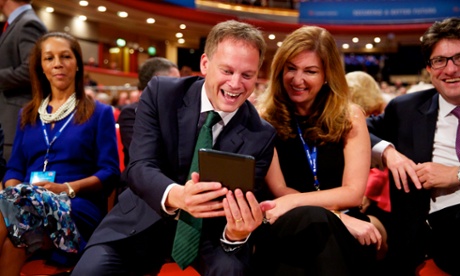
Grant Shapps is the chairman of the Conservative party – the party currently fighting to stay in government ahead of May’s British general election.
But that’s not why Shapps finds himself in the news on Wednesday. He finds himself in the news because he – or someone acting on his behalf – has been accused of making edits to his own Wikipedia page, as well as the entries of Tory rivals and political opponents. Wikipedia has blocked a user account on suspicions of “sock-puppetry” – setting up a fake online identity for the purpose of misleading or distorting information.
Shapps has denied the accusations, and has claimed the story is probably the invention of his political opponents, the Labour party.
It’s not the first time Shapps has been in the spotlight over his identity.
He came under fire in 2012 for holding a job as an internet marketing guru under the name “Michael Green”; he was photographed sporting a name badge of his pseudonymous alter ego at a US internet conference in 2003.
The services offered by Green’s online businesses have been criticised as being at the murkier end of online marketeering. Among the tactics espoused by Green include how to trick people into following you on Twitter, how to “scrape” content from other websites to make money from Google advertising, and how to make money out of something that sounds suspiciously like a pyramid scheme.
He also published a series of self-help ebooks, the last of which, Stinking Rich 3, promised tips on how to get wealthy online, and was described by Shapps/Green as “a great internet marketing product”.
Shapps has repeatedly stated that Michael Green was simply a “pen name” for his online business. He claimed that he stopped being Michael Green once he became a member of parliament, and even threatened to sue a constituent who claimed an overlap between the two lives on Facebook. After it emerged these two lives did indeed overlap, Shapps said he had “over firmly” denied he had continued working as Green.

Michael Green/Grant Shapps’s internet business is hard to find now, since most traces of it have been removed from the web.
Shapps has previously denied making earlier forays into the murky world of sock-puppetry. Earlier Wikipedia edits traced to his constituency office removed references to Michael Green and, for good measure, added information about Shapps’s charity work.
He claimed he had been hacked when he was accused of impersonating Liberal Democrats online to discredit a rival.
Political rivals have made the most of Shapps’s discomfort. The Lib Dem leader Nick Clegg – who has been in coalition government with Shapps’s Conservatives for the past five years – jokingly suggested that the Wikipedia edit could have been made by “someone else. Michael Green, for instance.”
The chairman’s difficulties have not escaped the attention of social media, either. Twitter users have been suggesting other Wikipedia edits that could not be traced back to the Tory chairman:
Grant Shapps co-ordinated a 2 million man march in Washington campaigning for the rights of alter-egos #WikiShappsFacts
— Shahid Dharamsi (@ShahidDharamsi) April 22, 2015
Grant Shapps helped put Ogdenville, Brockway and North Haverbrook on the map #WikiShappsFacts pic.twitter.com/CkYFmHz1gb
— Ste (@Shaker_Chizzle) April 22, 2015
His full name is Grant Shappi Khorsandi #WikiShappsFacts
— David Baddiel (@Baddiel) April 22, 2015
Grant Shapps' successful record label, Virgin, grew into a multi-billion business empire. #WikiShappsFacts
— Stephen Coltrane (@sjcoltrane) April 22, 2015