
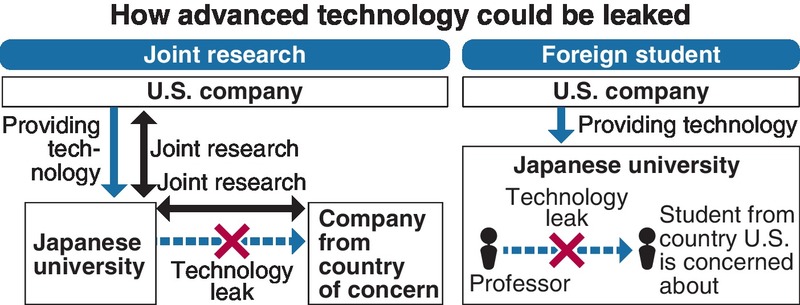
The Economy, Trade and Industry Ministry plans to strengthen its monitoring system to prevent cutting-edge technology from the United States from being leaked to other countries such as China via Japanese universities.
The system would apply to fields such as artificial intelligence, robotics and biotechnology.
The government plans by the summer to revise guidelines for managing technology at universities based on the Foreign Exchange and Foreign Trade Law (see below), which regulates technology exports, with the aim of bolstering safeguards against leaks via joint research projects with Chinese companies or other entities.
Due to concerns over China, the United States has indicated a policy to make 14 fields of advanced technology including AI subject to export restrictions. The Japanese government is trying to align itself with U.S. policy.
Japanese universities are increasing the amount of joint research they conduct with foreign companies and government institutes.
A survey by the Education, Culture, Sports, Science and Technology Ministry found that 1,061 universities nationwide conducted 351 joint research projects with foreign companies and other entities in fiscal 2017, an increase of 86 projects from the 265 conducted in fiscal 2013.
Research funding has also increased from 1.16 billion yen (10.5 million dollar) in fiscal 2013 to 1.73 billion yen in fiscal 2017.
As Japanese universities deepen their ties with foreign companies, the amount of joint research carried out with Chinese companies such as telecommunications giant Huawei Technologies Co. appears to have increased.
Given these circumstances, the trade ministry is concerned about Japanese universities that conduct joint research with American universities, companies or government institutes, and are also involved in research projects with Chinese companies.
If a Japanese company provides technology received from the United States to a company from another country, it could be sanctioned by the U.S. government, even if it does so unintentionally. The same goes for giving technology to foreign students.
The United States has a regulatory regime for preventing U.S. cutting-edge technology from spreading to other countries that allows it to sanction even foreign universities and businesses.
In the revised guidelines, the trade ministry intends to provide specific examples of how advanced technology could be leaked when joint research projects are being carried out with multiple countries or when foreign students are involved.
The ministry also intends to provide examples of effective monitoring systems, how to screen the demarcation of technology transfers and other details to encourage universities to take action.
The current guidelines are mainly intended to cover technology regulated by the foreign trade law that could be used for military purposes, such as radar, sensors and semiconductors.
To respond to the strengthening of regulations by the United States, the scope of technologies that universities should monitor is likely to expand.
However, some analysts are calling for a balanced approach, due to concerns that if monitoring becomes too strict it could weaken universities and stymie advanced research in Japan.
-- Foreign Exchange and Foreign Trade Law
This law prohibits the provision of technologies that could be used for military purposes to foreign companies and other entities without government approval. Violations can be punished by fines of up to 30 million yen for individuals, and up to 1 billion yen for corporations.
Read more from The Japan News at https://japannews.yomiuri.co.jp/



