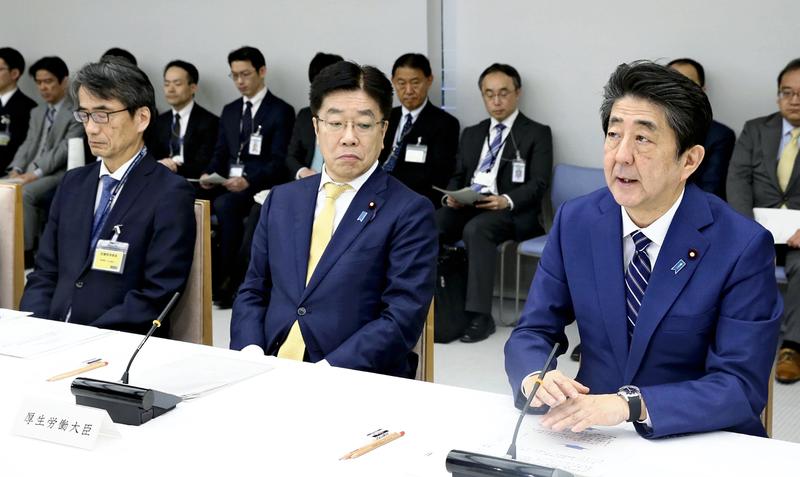
The government has decided on a basic policy for addressing the new coronavirus, and has launched efforts to slow the increase in infections and suppress the size of the epidemic.
The government, swamped by the hundreds of infections on the Diamond Princess cruise ship, is desperate to get back on track after being criticized for being slow to implement measures to prevent the virus from spreading within the country.
Ruling parties critical
"From the viewpoint of securing domestic medical resources, we will shift [quarantine] operations in line with measures to prevent the spread of infections and systems for providing medical care," the government stipulated in its basic policy, indicating the focus of its response to the coronavirus would move from Japan's shores to inside the country.
"The government has been responding by taking measures to stay ahead of the issue. This is the basic policy," Chief Cabinet Secretary Yoshihide Suga said at a press conference Tuesday.
However, some members of the ruling parties have complained that the government has "been too slow to turn its eyes to the domestic situation," as one mid-level Liberal Democratic Party member put it.
The Health, Labor and Welfare Ministry confirmed and announced the first domestic infection from the virus on Jan. 16. However, the government subsequently focused on five charter flights to bring back Japanese citizens from Wuhan, China, beginning on Jan. 28, and on quarantining the Diamond Princess, which arrived at Yokohama Port on Feb. 3.
At the time, a government official said the virus "had low virulence and was not very infectious. If Japanese medical institutions are involved, it probably won't be deadly."
Assuming cases will rise
On Feb. 13, a Japanese woman in her 80s became the first person to die from the virus in Japan. This sent the sense of crisis in the administration soaring, and the next day Prime Minister Shinzo Abe announced the establishment of an expert council.
Nevertheless, Health, Labor and Welfare Minister Katsunobu Kato only announced late on Feb. 19, after passengers on the cruise ship who had tested negative had started disembarking, that a basic policy would be formulated.
"Once the charter flights and the cruise ship were somewhat taken care of, we realized infections were popping up in various parts of the country," a senior health ministry official said.
The Constitutional Democratic Party of Japan and other opposition parties have ramped up their criticism that "the entire response has been one step behind."
The government's basic policy is not only to address the current situation, but also to assume there will be a major increase in the number of infections and to take an aggressive stance, such as by having regular medical institutions accept patients.
The government has emphasized the goal of the basic policy is to "minimize the social and economic impacts."
A high-level government official said, "The real moment of truth is whether we can prevent it from affecting the Tokyo Olympics this summer and the Japanese economy.
Disrupting clusters
Based on expert opinions, the basic policy states that now is a crucial time to prevent a major increase in infections.
The transmission routes of some domestic patients are unclear. While some group infections have occurred, they have so far been small. There is an urgent need to find ways to keep these from expanding.
The basic policy calls small groups of infected people "clusters" and focuses on finding them quickly and stopping them from exploding.
"The worst-case scenario is if a chain reaction starts. The countermeasures are focused on stopping this," said Shigeru Omi, a former director of the World Health Organization's Regional Office for the Western Pacific and vice chair of the government's expert panel on infectious diseases.
One of the clusters identified domestically involved infections that spread during a party on a pleasure boat in Tokyo. According to the Tokyo metropolitan government, 16 people have been infected since a male taxi driver in his 70s tested positive on Feb. 13. The pleasure boat is seen as the source of the infections.
A male doctor in his 50s employed by Saiseikai Arida Hospital in Wakayama Prefecture was also found to be infected on Feb. 13. The infection may have then spread to almost 10 colleagues, family members, inpatients and others.
The health ministry set up a special task force on Tuesday to help local governments where clusters have been confirmed. In addition to dispatching experts, the teams will collect and analyze data on the infections.
The goal is to prevent one cluster from creating others.
Read more from The Japan News at https://japannews.yomiuri.co.jp/