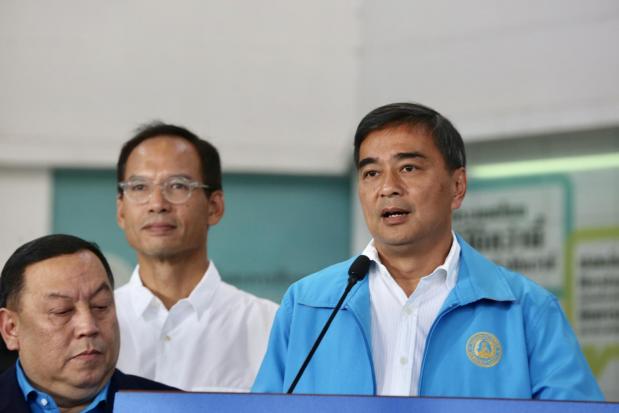
When Abhisit Vejjajiva stepped down as leader of the Democrat Party over its failure to retain most of its constituency seats in the March 24 election, some critics went as far as to call on him to give up his party-list seat to take responsibility for the party's worst election defeat.
On the last leg of the election campaign, as pressure mounted on the party to choose between the Pheu Thai Party or the Palang Pracharath Party (PPRP), the veteran politician reaffirmed his opposition towards Gen Prayut Chan-o-cha returning as prime minister.
In fact, a short video clip emerged, complete with an accompanying question asking "Is it clear now?" -- a seeming jab at the party's seeming inability to choose between the two opposing camps.
The ensuing poll results provided a loud and clear answer to the question. Mr Abhisit took the fall for the party's poor election performance.
Despite quitting the leadership, for some critics, his resignation simply was not enough to repair the damage to the party's reputation.
At that time, several political observers viewed the calls for him to also relinquish his MP seat as "lacking political sense".
Two months later, his decision to quit as party leader appeared to be the right move. Anything less, such as Mr Abhisit's "half-hearted" attempt to convince the party to assume the role of an independent opposition, ready to provide checks-and-balances and support what is deemed to serve the public interest, simply would not be enough.
Mr Abhisit's resignation as an MP came less than 24 hours after the party's meeting on Tuesday voted 61 to 16 to join forces with the PPRP-led coalition government and back Gen Prayut to be prime minister.
He announced his resignation ahead of a joint-sitting of the House of Representatives and the Senate to select a prime minister on Wednesday, in which Gen Prayut was chosen as Thailand's 30th prime minister with 500 votes to 244 and three abstentions.
At the press conference, the former Democrat leader went to great lengths to explain why he did what he did.
A proposal was reportedly floated to allow Mr Abhisit to not comply with the party's resolution, thus freeing him from having to vote for Gen Prayut against his will, or to cast his vote as he wished and thus defying the party's stance.
Mr Abhisit dismissed this option at the press conference, saying that it was not the party's job to save his dignity.
At least five members of the Democrat Party, known as the "New Dems" quit after the party decided to form a coalition government with the PPRP. They were Parit "Itim" Wacharasindhu, Tanat Thanakitamnuay, Parit Ratanakul Serirengrit, Nattika Loweera, and Tadchon Klinchamni.
However, several observers did not think Mr Abhisit would stand down as MP. They believed he would not turn his back on the party as there was a lot more he could do as an MP.
Mr Abhisit's decision to relinquish his seat won even more respect and support from his fans and admiration from netizens on social media, many of whom expressed their hopes of seeing him return to political glory.
At the party's headquarters on Wednesday, staff were reportedly in tears when Mr Abhisit appeared, prompting senior members to try to liven up the mood by saying Mr Abhisit is still a party member, and that he can drop by any time.
Securing votes and scoring points
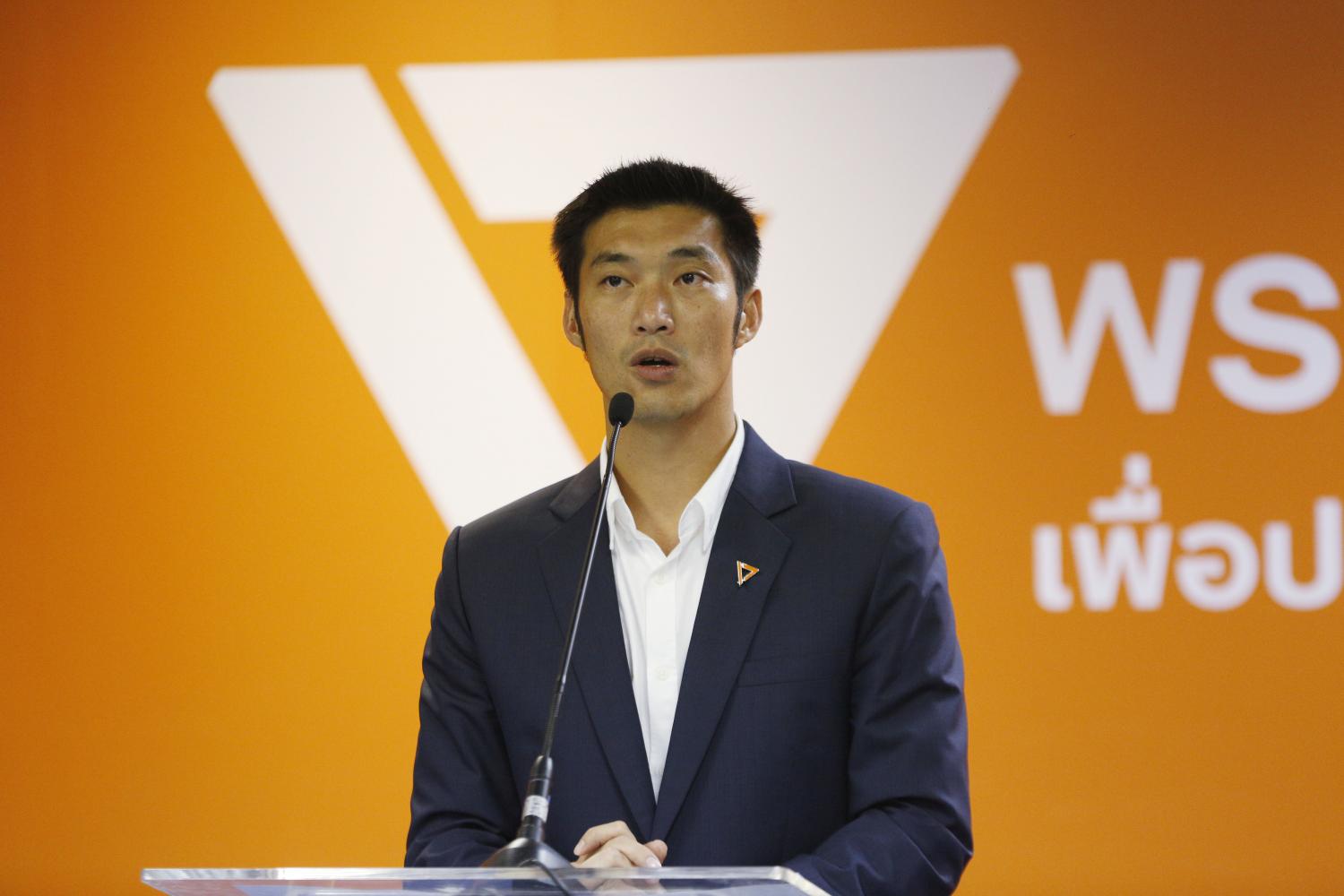
The Future Forward Party (FFP) was trying to score political points ahead of this week's prime ministerial vote. However, it didn't go as planned, according to critics.
The vote for the new prime minister, which as predicted installed Gen Prayut Chan-o-cha again, was the most crucial of any vote taken in this parliament to date. Prior to that, the parliament president, Senate speaker and their deputies were elected by their respective parliamentarians.
The legislative branch had its leader and deputies and so did the Senate. In the wee hours of Thursday morning, Gen Prayut sailed back into office with 500 members of both chambers rallying behind him.
His only competition was FFP leader Thanathorn Juangroongruangkit who, according to political experts, had a near-zero chance of defeating Gen Prayut, given the overwhelming support from the hand-picked 250-member Senate.
But before the crucial joint-sitting on Wednesday, Mr Thanathorn had a few tricks up his sleeve in an apparent attempt to undermine the move to solidify support for Gen Prayut's quest to remain in power, according to critics.
Mr Thanathorn had publicly called on the Democrat Party to take the democratic high ground by not backing Gen Prayut's return as prime minister.
Political experts said the FFP leader might have thought it was the most opportune time to "nudge" the Democrat Party into deciding to swing to the so-called "independent opposition" side and pull the plug on the PPRP's government formation bid.
The PPRP could not afford to lose the Democrats, as they held the key as to whether the next government would be led by the PPRP or not. However, it emerged a majority of Democrat executives and MPs had resolved to be part of the PPRP-led government.
After the FFP's attempt to convince the Democrats not to jump into bed with the PPRP proved futile, the party laid its trump card.
At a party press conference early this week, the FFP announced that several of its MPs had allegedly been approached and offered fat cheques to switch sides to the PPRP camp.
However, the FFP stopped short of seeking the prosecution of whoever made the offer.
This left critics puzzled as to why the FFP did not go all out and try and nail the offenders for alleged MP-buying while it obviously had the upper hand.
The critics said the apparent display of cold feet could have been because the party did not have enough evidence.
They thought one way to find out if any evidence existed was for someone to take the FFP to court on the grounds that the party's accusation could just be a ruse. If the court accepted the case, the party would have to produce the evidence to defend itself.
PPRP may renege on seat promises
The rumour mill has gone into overdrive that the Palang Pracharath Party (PPRP) may be preparing to take back some key cabinet seats it had earlier promised its coalition allies after Gen Prayut Chan-o-cha won a parliamentary vote to remain as prime minister on Wednesday.
The Bhumjaithai Party is among the coalition parties which could suffer from a possible redistribution of cabinet posts as the Transport Ministry portfolio which the party had been promised by the PPRP, as part of a deal for it to join the government, might be wrested from its grasp, a PPRP source said.
The source added that the Bhumjaithai might have to settle for the Education Ministry which the PPRP would offer instead.
The source said that the PPRP's Sam Mitr (Three Allies) wanted to take control of the Transport Ministry from the Bhumjaithai after Siripong Angkasakulkiat, a Bhumjaithai MP for Si Sa Ket, decided to abstain from voting for Prime Minister Prayut Chan-o-cha during the joint sitting of parliament on Wednesday.
The Si Sa Ket MP was the only House member from the pro-Prayut faction, which includes his Bhumjaithai Party, at the meeting at the TOT auditorium to break ranks by not supporting Gen Prayut as prime minister despite his party's earlier agreement.
The vote was conducted by roll call and Mr Siripong said "abstain'' when his name was called by a parliament secretariat official to say whether he would support Gen Prayut to be prime minister or not on Wednesday.
His abstention triggered brief uproar among the faction of lawmakers supporting Gen Prayut, led by the PPRP. He was later seen covering his face and crying in his seat.
The 41-year-old lawmaker said that he had told voters during the election campaign that he would support Bhumjaithai leader Anutin Charnvirakul to become prime minister.
When pressed further by people in his constituency what he would do if Mr Anutin was not nominated, he told them he would vote for no one.
"I have to honour my word. Nothing other than that," he explained and hoped that his rebellious vote "would be his last".
The source said that the incident showed that Bhumjaithai failed to honour its agreement and it also demonstrated party leader Anutin Charnvirakul's inability to control his MPs.
Mr Anutin explained that this was how democracy works. Mr Anutin insisted he could not blame or punish Mr Siripong because the party had merely sought cooperation from, and not ordered, its MPs to elect Gen Prayut as premier.
Although some party members asked Mr Anutin to expel Mr Siripong from the party for defying the party's stance, Mr Anutin insisted Mr Siripong had every right to do what he did.
But the PPRP had still found the Bhumjaithai's explanation hard to stomach, the source said.