Tomorrow, as Christmas shoppers enter the last lap of a marathon which began nearly a month ago on Black Friday, there will also be welcome evidence of the nation’s more spiritual side.
After what organisers described as a “fantastic response”, Radio 3 will announce the winner of a competition for a new carol. Earlier in the year, composers professional and amateur were invited to write a setting of the poem Can It Be True? by Susan Hill. The judging panel, which included the master of the Queen’s music, Judith Weir, and choral conductor David Hill, will choose from a shortlist of six.
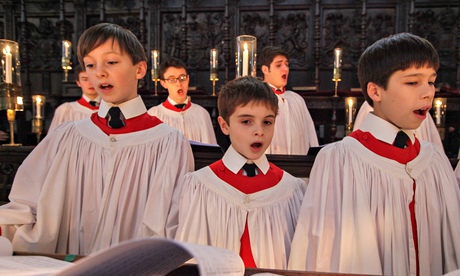
A couple of days later, on Christmas Eve, the choir of King’s College, Cambridge will continue its long tradition of performing new work in its service of nine lessons and carols, broadcast to millions around the world.
The appetite for all things choral is not limited to carols. While traditional Christian belief is on the wane, sacred music is enjoying a spectacular renaissance as secular society goes in search of both inspiration and consolation.
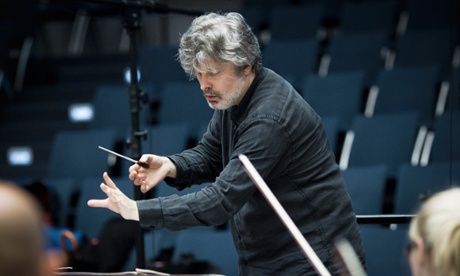
James MacMillan, a major choral composer, whose St Luke Passion has just received its British premiere in Birmingham, has been closely involved in a remarkable project to commission a substantial body of work, inspired by the former pope, Benedict XVI, who emphasised the potency of liturgical music and the need to keep it refreshed. According to Benedict: “Sacred polyphony constitutes a heritage that should be preserved with care, kept alive and made better known, for the benefit not only of the scholars and specialists but of the ecclesiastical community as a whole. An authentic updating of sacred music can take place only in the lineage of the great tradition of the past, of Gregorian chant and of sacred polyphony.”
MacMillan is not alone in answering the call of the pope emeritus. Investment banker and arts patron John Studzinski’s Genesis Foundation is supporting a series of new works from composers including MacMillan, Roxanna Panufnik, Will Todd, Tarik O’Regan and Roderick Williams, all in association with The Sixteen, one of the nation’s most accomplished vocal ensembles, whose annual choral pilgrimages sell out nationwide.
Their latest endeavours have produced three new Stabat Maters, one of the most powerful poetic expressions in the liturgy. MacMillan worked alongside Studzinski and The Sixteen’s director, Harry Christophers, to choose three composers from different cultures to interpret the sorrow of Mary at the foot of the cross, arguing that these 13th-century words can help a 21st-century listener draw closer to the agonies of modern mothers, whose children are the innocent victims of political and religious ideology.
In a recent interview Studzinski said: “I believe this is a big swing moment from an age of materialism to an age of the spiritual. There may be a decline in churchgoing, but how many people pray and meditate and listen to spiritual music? I think faith is a bedrock term that implies an ethos and comes from within. That can only become stronger as people have concerns about the stability of the world, the coldness of technology or the gap between rich and poor. You can move people very deeply with spiritual music, and people want to be moved.”
Someone who understands this is Bob Chilcott, a composer whose accessible compositions have done much to encourage the upsurge in singing in Britain today. Next year marks the 300th anniversary of the Three Choirs Festival and new work from Chilcott will feature among new commissions to be sung in Hereford cathedral. His St John Passion received its premiere last year and will be performed at Wells cathedral in March.
“I was fortunate to sing the Evangelist role in both the great Passions of Bach a number of times,” said Chilcott. “I also remember, as a boy chorister in King’s College, Cambridge, singing the simpler Renaissance versions of the Passion chanted by the dean and chaplain of the chapel in holy week.
“It is the austerity, the agony and ultimately the grace of the story that inspired me to write the piece, to be performed in a magnificent building where this same story has been commemorated for almost a thousand years.”
Chilcott has written all manner of works for choirs great and small and among his most moving is The Bethlehem Star, a profound setting of words by Gerard Manley Hopkins, written in response to the murder of Alan Greaves, the Sheffield organist attacked on his way to play for midnight mass in 2012 and now a permanent part of many church choir repertoires.
This Christmas, King’s College has commissioned the Swiss composer Carl Rütti to write them a carol, a form he believes to be quintessentially English.
“What is a carol?” asks Rütti. “It sounds so simple. But isn’t it the extreme blend of expressing the most mysterious fact of our religion in the simplicity of a children’s song? It is a real balancing act to do justice to both. And writing for King’s College choir and the great organ of the chapel is more than a challenge; it is heaven. In our German language, we use the same word for English and angelic: Englisch.”