With the start of his second term, Chinese President Xi Jinping announced his goal of realizing "socialist modernization" by 2035. What would such a country look like?
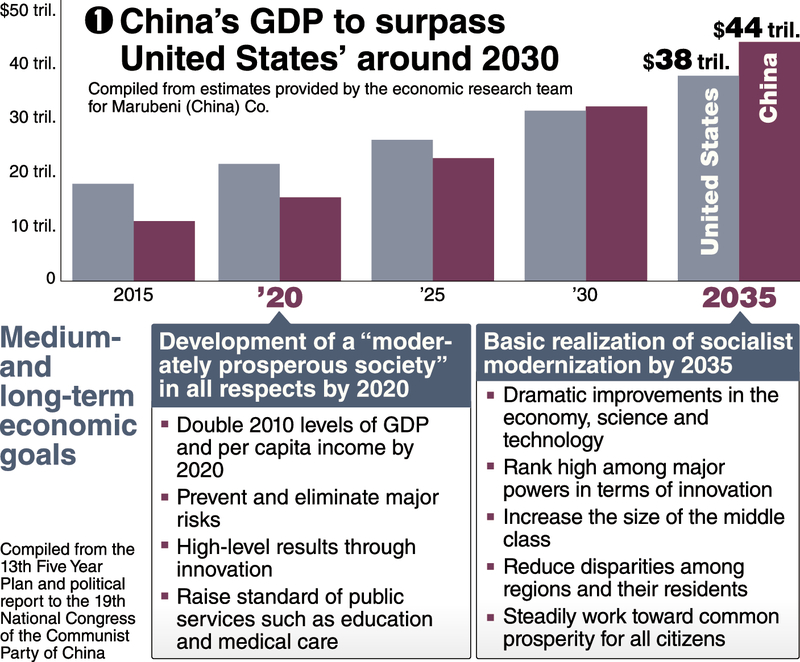
"In 2035, China will hold a 30 percent share of the global gross domestic product, [roughly twice what it has now]. Former President Hu Jintao's term was the age of the moderately prosperous society. The next goal is common prosperity, and from 2020, China will enter the age of common prosperity."
Last November, on the heels of the inauguration of the second Xi administration, Hu Angang, a professor at Tsinghua University and one of the brains behind the administration, referred to these ambitious prospects before reporters at the Japan National Press Club in Tokyo.
At the 19th National Congress of the Communist Party of China last October, Xi explained the main economic goals of his "socialist modernization" as follows (see chart 1):
1) China's economic and technological strength will have increased significantly, and the nation will have become a global leader in innovation.
2) The size of the middle-income group will have grown considerably, and disparities in development between urban and rural areas, and between regions, and disparities in living standards will have been reduced significantly.
However, these goals did not include concrete numbers. Some of the details will likely be hammered out at the meeting of the National People's Congress, which opens on March 5, and at the general assembly of the Central Committee of the Communist Party of China this autumn.
U.S., China 'to trade places'
The 21st Century Business Herald, a Chinese newspaper, reported the following predictions from Zhu Baoliang, chief economist at the State Information Center: As of 2016, China had the second largest economy in the world, but its per capita GDP was limited to 8,113 dollars. This will rise to over 10,000 dollars in 2020, and then 12,000, dollars the high-income nation level, in 2023, before reaching over 20,000 dollars in 2035.
This would mean China could avoid the "middle income trap," in which an economy stagnates at the nation's middle-income level for an extended time, leaving it unable to join the ranks of developed countries.
According to the paper, Xu Hongcai, senior economist of the China Center for International Economic Exchanges, has concluded that China will surpass the United States as the world's largest economy as early as around 2027. As for the reversal of the United States and China in GDP, there is a prediction in Japan, too, that it will occur around 2030 (see chart 1).
Xu also believes that China will progress from a manufacturing power to a great manufacturing power by 2025, becoming a world leader in fields such as aviation and space, high-speed railways and nuclear power generation.
According to Hu Angang, China will hold a 20-25 percent share of global research and development spending in 2035. Given the large amount that it plans to invest in development in these fields, it is virtually assured that China will achieve a certain level of technological advancement.
IMF to relocate?
If China's economic growth continues, there is a chance that the International Monetary Fund (IMF) could move its headquarters from Washington to Beijing in 10 years.
At a symposium in Washington last July, IMF managing director Christine Lagarde expressed such thoughts, which seemed to anticipate Xu's analysis.
This is because the IMF articles of agreement states that the headquarters will be located in the country that contributes the most funds, and countries' contributions closely follow the size of their economies. Since its establishment in 1945, the headquarters has been in Washington, D.C., in the United States, the largest economic power in the world.
The Xi administration also has the lofty goal of becoming a "great modern socialist country" by the middle of this century. It seems to be aiming to reach the level of a superpower rivaling the United States.
A wave of aging
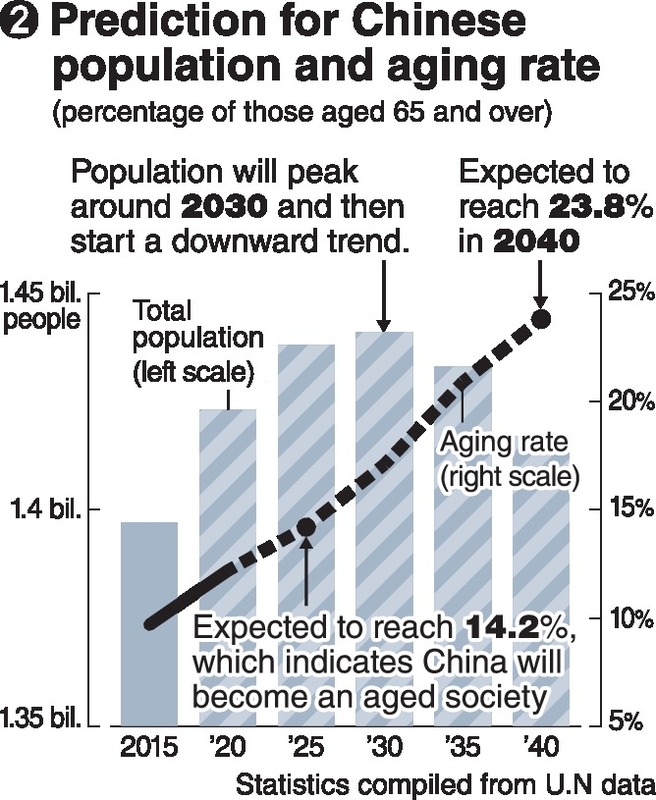
However, some in the international community have a cautious opinion, with a source in trade and commerce saying, "It is unclear whether China can develop in the way this administration wants from 2035 onward." This is because an aging population will have ended the "demographic bonus" (see below) that drives China's economic growth. Around 2034, the working-age population will no longer be over twice the population of the elderly and children, and the effect of a "demographic onus," which suppresses growth, will increase.
This would be a fear of the administration -- that China will get old before it gets rich. There is a prediction that China will become an aged society (with the elderly making up 14.2 percent of the population) in 2025, and a super-aged society (21 percent) in 2036 (see chart 2).
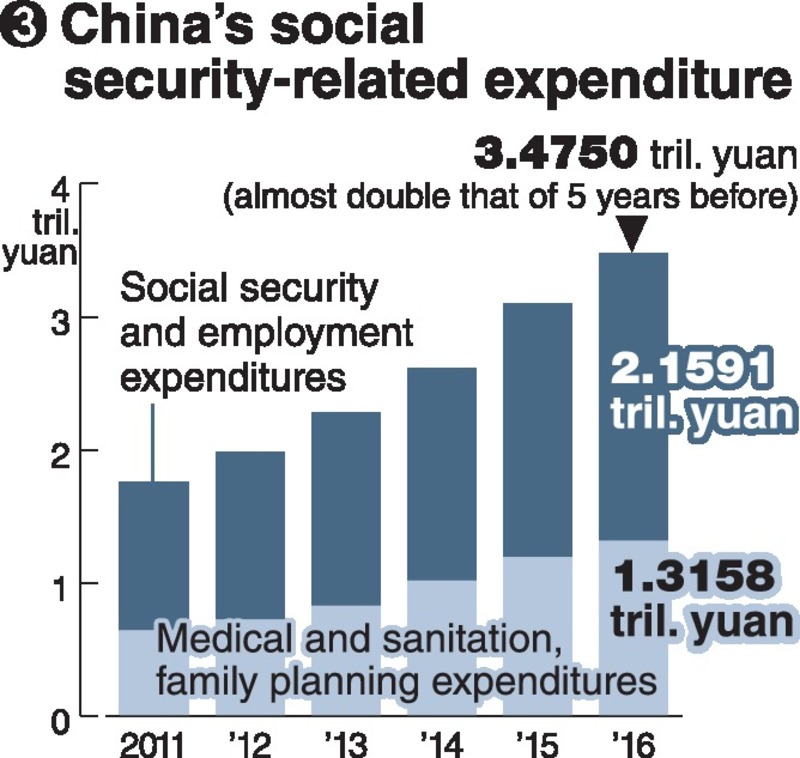
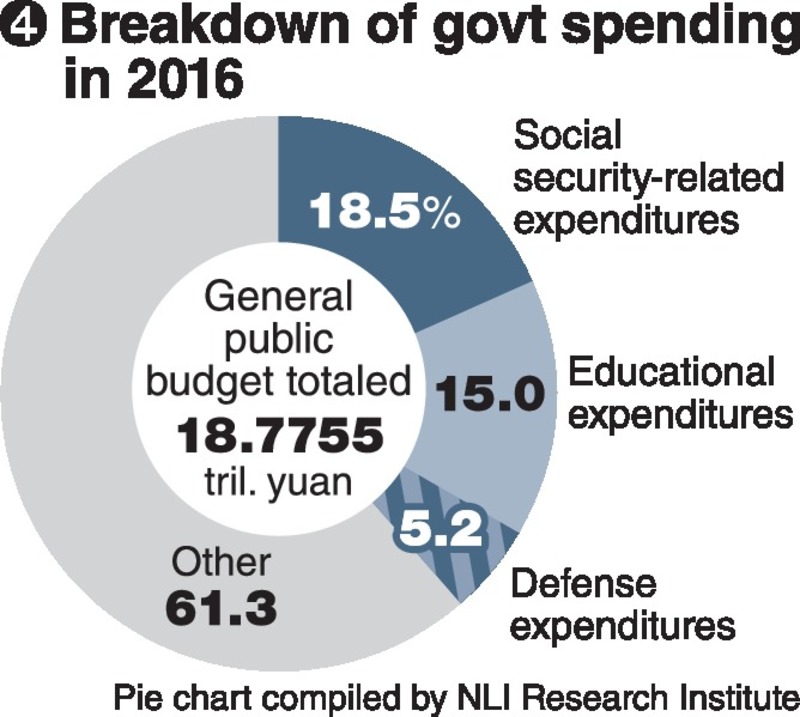
According to Yuki Katayama, a researcher of the Insurance Research Department at NLI Research Institute, China is aiming to provide universal health care and pensions by 2020, and is currently building a social security system. Katayama said: "Currently, social security-related expenditures [see charts 3 and 4] make up 20 percent of government spending, and they could probably tolerate an increase to 30 percent in the future. But they would move toward keeping spending as low as possible."
Katayama believes China will likely adopt a combined public-private system, which incorporates private health insurance, something in between the government-run Japanese system and the privately run American system.
The gaps between urban and rural areas, which have long been a challenge, are said to be shrinking. But the fact that the top 10 percent of the people hold about 70 percent of the wealth is a concern. Unless such systems as inheritance tax and fixed property tax are properly run and a redistribution of income is implemented by reducing the power of vested interests, the goal of reducing disparities is unlikely to be realized.
Fears of tightened regulations
It is vital to remember that this "socialist modernization" is meant to modernize the nation and society, while still maintaining a single-party system under the control of the Communist Party. The administration will likely use any means in tightening control if it protects the single-party system.
Some actions conspicuously impede the development of the market economy. Since last year, the administration has increased pressure on foreign companies to set up Communist Party cells, aiming to reflect party policies in business. German chambers of industry and commerce have expressed concern about this, issuing a statement saying that such measures might cause German companies to retreat from the Chinese market.
Internet regulation is also growing more serious. Since last year, the administration has even been cracking down on virtual private networks, which are frequently used by foreign nationals and foreign companies, including Japanese businesses.
If these sorts of coercive measures continue to be taken, it will likely cast doubt on the goal of significant economic growth. The Xi administration has insisted that China is "the world's biggest democratic state," even as it crushes domestic dissent.
In 2035, at the age of 82, Xi will see for himself how China's modernization turns out.
-- Demographic bonus
A period when the working age population (15-64 years old) continually increases, or the proportion of the dependent population (children and the elderly) continually decreases. It can also refer to a period when the working-age population is over twice the population of children and the elderly. This results in a positive cycle in which an abundant workforce encourages economic growth through increased spending and tax revenue. A demographic onus, on the other hand, is a situation in which the elderly population increases, causing social security costs to balloon and placing a burden on public finances and economic growth.
Read more from The Japan News at https://japannews.yomiuri.co.jp/