
Imagine for a moment that you’re walking down the street, exercising at the gym, or riding on public transport when a bespectacled stranger stops you for a chat. Everything seems fine if a bit weird, until you realize that their glasses are fitted with a small, barely noticeable camera.
Whether for content or blackmail, they are filming you with their smart glasses, loaded with the latest artificial intelligence software, without your consent. How would you react? If you were a New York subway rider, you might break the creep’s glasses and get lauded as a folk hero both in the real world and online for pushing back against privacy-ignoring, content-creating ‘glassholes.’
Privacy is at a premium these days, and it is being eroded every single day. Now, going about your day in public is no longer as safe as it was, all thanks to the spread of the most cutting-edge smart glasses, loaded to the gills with controversial augmented reality and AI facial recognition features.
Some users are playing with the gray area surrounding privacy for the sake of content. Others are using the glasses for blackmail. And tech companies, after getting caught quietly adding potentially immoral and unethical features, are furious that the spotlight is on them. But the fight for privacy isn’t lost just yet.
Smart glasses are turning ordinary people into unwilling participants in someone else’s content
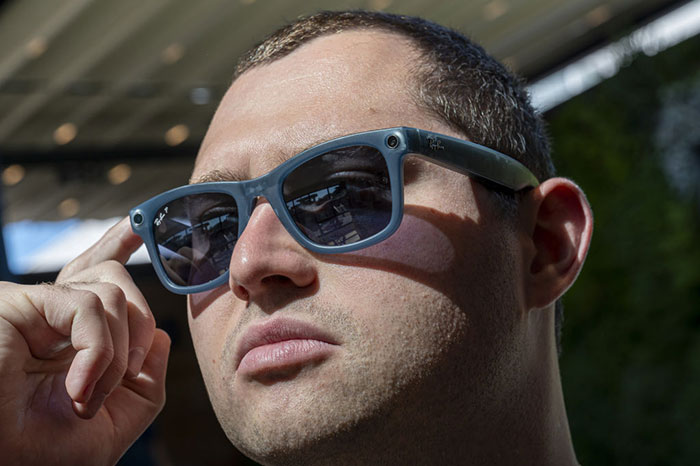
Image credits: Bloomberg / Getty Images (not the actual photo)
The latest generation of smart glasses has made secretly recording strangers easier than ever before
Meta’s new Ray-Ban smart glasses are already mired in controversy. And yet, despite this, their popularity is absolutely booming. Meta’s new product is currently the most popular on the market, making up over 80% of all AI or smart-glasses sales.
Researchers predict that as many as a whopping 100 million people will buy a pair of smart glasses over the next few years, which will drastically alter how you interact with people in the street. Even Meta’s chief executive, Mark Zuckerberg, called the glasses “some of the fastest-growing consumer electronics in history.”
The glasses feature an unobtrusive camera in the frames, small speakers in the arms, and lenses that can show the wearer some information. Meanwhile, users can start recording videos or take photos by casually touching the frames.
What’s more, the glasses feature an LED light. It activates when someone captures content. Meanwhile, the product also features tamper detection technology to prevent wearers from covering that light. And yet, if it’s sunny or you’re in a bright setting, you might not always notice that someone’s recording light is on. Sadly, the people being filmed have no control over what will happen with those recordings.
Some content creators are using their glasses to record pranks. If only that were the worst issue! The BBC reports that men wearing smart glasses are approaching women in various settings—leaving the beach, at the gym, in shops, standing outside—and asking them questions or picking them up, all the while filming them. These women often don’t know that they’re being filmed and have not agreed to it.
Later, some smart-glasses users upload these videos online. One woman opened up to the BBC about how a person secretly recorded her and posted it online. When she asked him to remove it, he told her that it was “a paid service.”
Meanwhile, Belgian broadcaster RTBF recently uncovered cases where men wearing Meta’s Ray-Bans filmed women in the streets of Brussels. The footage was allegedly intended for social media content related to dating-coaching businesses.
European experts are now sounding the alarm that smart glasses can be used to record strangers without consent, going against the General Data Protection Regulation (GDPR). And RTBF warns that future smart glasses updates might have AI tools that can recognize objects, interpret surroundings, and interact with users in real time.

PlaqueBoyMax – the first influencer to use Meta glasses to stream from first person point-of-view (Image credits: maxvods / YouTube)
Meta insists its most controversial features are still only experimental, but reports suggest the technology is already much further along
As per the BBC, Meta reportedly plans to add facial recognition to their smart glasses in an update. This means that users will no longer just be able to record people. They will also be able to identify them lightning-fast, too.
Meanwhile, Wired reviewed the code in Meta’s smart glasses platform and uncovered an unreleased face-recognition system that was embedded quietly. It was designed to identify individuals via biometric data stored on users’ phones.
“Code discreetly added to Meta’s AI app over multiple updates this year shows that the feature, internally called ‘NameTag,’ identifies people captured by the glasses’ camera and, when activated, alerts the wearer when it recognizes someone.” The controversy is that Meta was already shipping (as yet unactivated and inaccessible to consumers) code to users’ phones while publicly claiming it was still “thinking through” the move.
“The feature is not yet exposed to consumers but seems nearly ready to go. Despite the billions of reasons not to, Meta seems to have created the capacity to turn their customers into a distributed surveillance machine,” said security researcher Cooper Quintin, from the nonprofit Electronic Frontier Foundation’s Threat Lab.
Meanwhile, independent security and privacy researcher Budochi told Wired that “the main components of a face-recognition feature are already in Meta’s companion app. Not many pieces stand between this and a working feature.”
According to Futurism, Meta is reportedly furious over Wired’s revelation. The company claimed that it was “sensational” and “dishonest” to inform the public about unreleased, exploratory tech.
“We’ve said before we’re exploring these types of features, and what you’re seeing is just evidence of that exploration. Nothing has shipped to consumers and no final decision has been made on what to do here, if anything. If we do decide to roll something out, we will take a thoughtful approach and do so with full transparency. One decision we can be clear about—we are not building a central face database,” Meta told Wired in a statement.
Meanwhile, Meta spokesperson and VP of communications Andy Stone tore into Wired’s analysis further, criticizing its supposedly “shoddy reporting” that they claimed was “intellectually dishonest” and “pure advocacy-driven click bait.”
What’s more, Meta’s chief technology officer, Andrew Bosworth, called Wired’s reporting “absolutely dishonest” and “incredibly misleading.”
All very strong reactions over something supposedly innocent, no?
However, it’s not just Wired that dug up Meta’s plans. Earlier, The New York Times reported on ‘NameTag’ being discussed in an internal Meta memo as well.
In the memo, the company allegedly said that the feature should be launched “during a dynamic political environment where many civil society groups that we would expect to attack us would have their resources focused on other concerns.” Dystopian? Dystopian.

Mark Zuckerberg during Meta’s smart glasses presentation (Image credits: Bloomberg / Getty Images)
Privacy concerns don’t stop with the people being recorded, because smart-glasses users give companies access to their own private moments as well
The reality is that privacy breaches affect smart-glasses wearers, too, not just the people they’re looking at. Users can’t be quite sure when their glasses are recording and what happens to those recordings. Also affected are the workers reviewing the footage, who have to sift through sometimes uncomfortable footage.
For example, some smart-glasses owners have already filed a couple of lawsuits after Kenya-based employees, entrusted with watching videos captured with Meta’s glasses to create AI training data, viewed graphic content. Sex, nudity, and bathroom use are just three examples.
From Meta’s perspective, the company was doing nothing wrong: possible human review of footage was included in the product’s terms of service.
However, Meta’s spokesperson, Tracy Clayton, explained to the BBC that users have to behave responsibly with any technology. “We have teams dedicated to limiting and combating misuse, but as with any technology, the onus is ultimately on individual people to not actively exploit it.”
An investigation by Svenska Dagbladet and Göteborgs-Posten found that Meta hires companies around the globe to process private images and sensitive information.
“In some videos you can see someone going to the toilet, or getting undressed. I don’t think they know, because if they knew they wouldn’t be recording,” one anonymous worker from Kenya, who reviews the footage and helps train AI systems to recognize the world, revealed.
Other workers described seeing people coming out of bathrooms, or even individuals undressing, being recorded while the smart glasses were placed on the bedside table.
“Since it is a job, you have to do it. You understand that it is someone’s private life you are looking at, but at the same time you are just expected to carry out the work. You are not supposed to question it. If you start asking questions, you are gone,” one employee said.
“We see everything—from living rooms to naked bodies. Meta has that type of content in its databases. People can record themselves in the wrong way and not even know what they are recording. They are real people like you and me.”
Svenska Dagbladet emphasizes the uncomfortable truth that the AI revolution is “to a large extent built on labor in low-income countries. What we call ‘machine learning’ is often the result of human hands.”
Image credits: Matt Cardy / Getty Images (not the actual photo)
The race to dominate the smart-glasses market is accelerating, even as concerns about privacy continue to grow
The surge in smart-glasses users hasn’t gone unnoticed by major global corporations. There are rumors that Apple is developing its own smart glasses, potentially to be released next year. Snap is launching its own smart-glasses product—Specs—later this year.
Meanwhile, Google is ready to enter the fray once more with a new product. Over a decade has passed since the company’s expensive Google Glass product (which gave rise to the term ‘glassholes’) flopped due to privacy concerns, and now is the time for Round 2.
While nobody can predict the ultimate winners of these tech skirmishes, you can expect the products to be fairly similar. For example, it’s incredibly likely that all of these brands will integrate cameras, as well as AI and augmented reality software, into their smart glasses. So, the potential for privacy breaches and tech misuse grows as more companies ride the product trend and more consumers decide that, hey, maybe the cool gadget is worth the price.
That being said, it’s not that the tech itself is ‘bad.’ Smart glasses are a tool. It’s what you do with this tool that matters the most. Some people are finding legitimate use for the tech. For instance, you can use your smart glasses to listen to music or a podcast while you’re doing chores.
You can take phone calls wherever you are. And you can take photos and videos while traveling the world without having to constantly whip out and then pocket your phone. The glasses can also help with assisted living, not just tourism and general convenience.
Some users are, unfortunately, untrustworthy. And legislation tends to lag behind technology, so protecting people from misuse will be difficult. According to Dr. Jason Nurse from the Institute of Cyber Security for Society at the University of Kent, it is vital that you make it “super clear to perpetrators” that causing harm will lead to prosecution.
Dr. Nurse emphasized that “many people may not have their guard up in the way that they potentially should” because smart glasses are becoming harder to detect.
And yet, with the prospect of countless millions of smart-glasses wearers roaming the world, the potential for abuse is staggering. How will you limit who makes secret recordings in sensitive locations like bathrooms, hospitals, courthouses, and elsewhere? Meta might claim that their glasses are “designed for privacy, controlled by you,” but someone who has unethical intentions won’t be stopped by the tagline.
“There are some pretty dark places we could go here. I’m not anti-technology in any sense, but as a societal matter… will I need to think [of being recorded] anytime I go out in public?” mused attorney David Kessler, at privacy practice Norton Rose Fulbright.
Meanwhile, former Meta AI researcher David Harris, now teaching at the University of California, Berkeley, emphasized that this newest generation of AI smart glasses will face the same issues that led to the downfall of Google Glass all those years ago.
“Technology like this is fundamentally an invasion of privacy and it’s really going to face more and more backlash,” he predicts.
However, Meta’s chief technology officer, Andrew Bosworth, thinks that the volume of Meta Ray-Bans sold suggests “that these are widely accepted.”

Mark Zuckerberg with Meta’s new smart glasses, joined by his CTO Andrew Bosworth (Image credits: Bloomberg / Getty Images)
Smart glasses aren’t the only threat to privacy, but they are becoming part of a much bigger surveillance ecosystem
Of course, it is most definitely not just smart glasses that breach your privacy, though they are a new source of worry and frustration.
Unless you somehow miraculously live completely off the grid or are an IT privacy expert, your daily life is full of tracking: cameras in the streets and in buildings, data tracking online and on social media, data hacks and leaks, smart technologies, scammers and spammers, AI-generated deepfakes, and even being monitored at work.
Protecting your sensitive data and anonymity is getting harder by the day. And yet, some pushback is already getting partial results. The battle is not lost. And mega corporations are not all-powerful (yet)!
Public backlash has already forced Meta to scale back some of its AI ambitions, proving that consumers still have influence
Recently, Meta backed down from a dystopian and arguably unethical level of workplace monitoring after huge backlash. The company had plans to begin tracking its US-based employees’ computer activity in April, but by June, it had already scaled back its ambitions.
Meta’s plan was to use a new tool that would log its workers’ keystrokes, mouse movements, and clicks, all to—get this—train its AI models. Naturally, many employees were less than enthused about being tracked for the sake of training models that might, potentially, replace them in the future. In fact, workers were so furious that they started a petition against the move with over 1.5k signatures.
Now, the company will allow its employees to pause the data collection for up to 30 minutes at a time. Furthermore, workers can request exemptions from the entire initiative.
“If we’re building agents to help people complete everyday tasks using computers, our models need real examples of how people actually use them,” Meta told the BBC. The company claimed that the data was “not used for any other purpose,” and that the tool itself had “safeguards in place to protect sensitive content.”
One of the practical problems with the tracking tool was that it affected laptop battery life and consumed so much data that internet usage spiked when working from home, Reuters reports.
“While we remain confident in the privacy protections we put in place at launch, which went through several layers of risk review, we have heard your concerns about personal data on work devices, battery life, and wanting more control over when capturing happens,” Stephen Kasriel, a vice president in Meta’s Superintelligence Labs unit, said in an internal memo.
One Meta employee told the BBC that the entire initiative was “very dystopian,” while another called the tracking tool “just the latest way they’re shoving AI down everyone’s throat.” The context matters, too. Meta recently laid off around 2k workers, and in April, it shared that it plans to cut 10% of its workforce, or about 8k employees.

Image credits: Sondeep Shankar / Getty Images (not the actual photo)
The real question isn’t whether smart glasses are coming, but how much of your privacy you’re willing to give up
You are not powerless when it comes to protecting your privacy, even if it is an uphill battle. However, we have to ask: How far are you willing to go to protect your privacy? How will you react when a stranger films you with their AI-powered smart glasses, without your consent?
Will you grit your teeth and try to ignore them? Will you challenge them publicly? Will you sue the companies behind the products directly?
Or will you unleash your inner subway-faring New Yorker on their fancy glasses that they’re flaunting in your face? Think hard about how you’d respond. You might have to put that theory into practice. In the near future, you won’t look at people with glasses the same way you did before. There might be 100 million smart ‘glassholes’ around the globe soon.