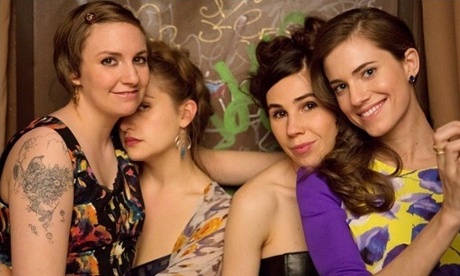
I think Lena Dunham wrote the premiere of season four of her HBO dramedy Girls, just for me. Not that I’ve ever moved for graduate school, leaving a complicated but frequently uncommunicative boyfriend behind. Or sung at a jazz brunch at a macrobiotic restaurant. Or had my parents snap pictures of me giving my mailing address to the registrar after making up a class I failed and finally getting my diploma. Or lost my job aiding a renowned artist at the hands of her debatably masochistic daughter. All these things happen in the premiere (to Dunham’s Hannah, Allison Williams’s Marnie Michaels, Zosia Mamet’s Shoshanna Shapiro, and Jemima Kirke’s Jessa Johansson, respectively) – but really they seemed aimed at the many, many people publicly weighing in on the show’s continued relevance.
“Even in the moments when you were criticising me and doubting my talent, you were supporting me in your own way,” Hannah tells her parents in the episode’s first scene. In a parallel to the show’s first-ever episode that might have been a signal of the series’ end, had it not already been announced that HBO has renewed the show for a fifth season, season four opens with Hannah at dinner with her parents. Seated in seemingly the same fancy restaurant where the earnest Midwesterners told their daughter they were cutting her off financially after supporting her for her first year out of college, astounding Hannah with the unfairness of it all – and prompting her to utter the words that have driven so much of her character and thus the show’s plot and motivations thus far: “I am the voice of a generation … or at least a voice of a generation” – the family Horvath has now gathered to celebrate Hannah’s having gotten into the Iowa Writers’ Workshop for graduate school and her incipient move to the middle of the country in the name of higher education.
While the scene begins with Hannah’s parents raising a glass of champagne in her honour, in true Hannah style she is unable to thank them and accept their praise, instead reminding them of the many ways they have failed to understand and adequately celebrate her many gifts. In other words, the Dunham stand-in is telling us critics, professional and otherwise, that we can take our hate elsewhere. Hannah’s going to “the Harvard of MFA programs” and Dunham’s series isn’t going anywhere anytime soon.
This season’s premiere didn’t do much to advance the plot. At the end of last season we already knew that Hannah would move to Iowa, that Marnie would continue to pursue her music, that Shosh would inevitably graduate, that Jessa would, well, continue being Jessa, draped in enough slips and shawls to make even Stevie Nicks blush. Rather, Dunham, showrunner Jenni Konner and executive producer and frequent cowriter Judd Apatow seem set on reminding audiences that they will not suffer fools – or haters – lightly and that the merit of their work is a foregone conclusion. Back them, or back off.
Notably, there is only one graphic sex scene in the episode, of the kind that was once the show’s calling card. Early in the episode, we see Marnie on the receiving end of an act of what can only be dubbed analingus by musical collaborator Desi. (Later in the episode, we learn that not only are Marnie and Desi not even dating, but that Desi is still with his girlfriend, Clementine.) The scene seems purposefully gratuitous, especially in contrast to the silent missionary-style sex that Hannah and Adam have at the episode’s end on the eve of her departure, without so much as a nipple in sight. This is a show that has a lot more bigger ambitions than just shocking its audience with “real” sex, it seems to insist.
It’s also worth noting that this lone titillating scene involved the character who has changed the most since the show’s premiere, inelegantly falling from Type A grace into a mess of anxiety. Marnie, the character most riddled with self-doubt (an impressive feat in the world of Girls), submits to a sex act performed on her by a man on whom she has staked all hope of achieving success, not just as an artist, but as a person. Sex and ambition, and the haunting spectre of failure, are all painfully intertwined.
In the general absence of sex, much of the episode was devoted to the role and presence of parents. Unusually, all four lead characters’ folks – or at least metaphorical parental stand-ins, in Jessa’s case – not only appeared but featured subtly yet prominently in the episode’s plot. Hannah’s mother and father have come to toast her and help her move. Marnie’s Dina Lohan-esque stage mom (always so flawlessly, painfully played by Rita Wilson) has come to see Marnie’s first public gig (at the Jazz Brunch; while Marnie sings, Wilson, like any good pageant mom, effortlessly mouths along to every single lyric that pours forth from her beloved offspring’s lips).
Shosh’s parents (in a genius stroke of casting, her mother is played by Ana Gasteyer, of Saturday Night Live fame), both named Mel and now divorced, fight over whose house her diploma should be mailed to. Jessa begs Beadie – whom she had agreed to help take her own life during the season-three finale – to tell her that she loves her more than her biological daughter, Ricky, before Beadie leaves Jessa and the city to move in with Ricky (played with caustic, searing disgust by Natasha Lyonne) in Connecticut.
Parents, the show suggests – they may suffocate you, but you need their love and recognition. And it seems that as an artistic venture Girls has a similar attitude to viewers and critics, saying “I don’t need you” and “Please don’t ever leave me” all in the same breath. It’s complicated, you see, learning to feel confident enough in yourself to stand independent of your elders, flaws and all. Striking such a balance may be the watershed between prolonged adolescence and adulthood, the primary focus of Girls as a narrative experiment itself.
The title card of the episode is backed by the ominous soundtrack of Adam’s new depression-medication ad (“Someone’s going to come up to me on the subway and say, ‘I couldn’t get my dick hard on Torpica,’ Adam argues to Hannah, who points out that a job’s a job and adult people sometimes have to work). Though it seemed to suggest a melancholy beginning rife with self-doubt, the episode clicked into an assurance that all our Girls are going to be just fine. After Marnie’s meltdown during her Jazz Brunch performance (“Ugh, that’s so Marnie!” moaned Girls hate-watchers everywhere), Elijah gave Marnie a brilliantly harsh and irreverent pep talk on the sidewalk.
“What do Judy Garland and Lady Gaga have in common?” he asks her.
“They’re both white?” Marnie replies (perhaps also replying to critics who have noted the show’s remarkably whitewashed version of New York City).
“No,” explains Elijah. “They’re both bad bitches who don’t give a fuck what people think. They were told they weren’t thin enough, that they weren’t feminine enough, that they weren’t beautiful enough. And then Judy went and died because it all became too much. But Lady Gaga’s fine.”
In other words, Dunham, who earlier this week announced that she’s taking a break from her beloved Twitter, as its environment and the voices of her naysayers have gotten too toxic, is going to be fine too. And she could care less if you think she’s not thin enough, not feminine enough or not beautiful enough to continue to be an incredibly significant voice of a generation.