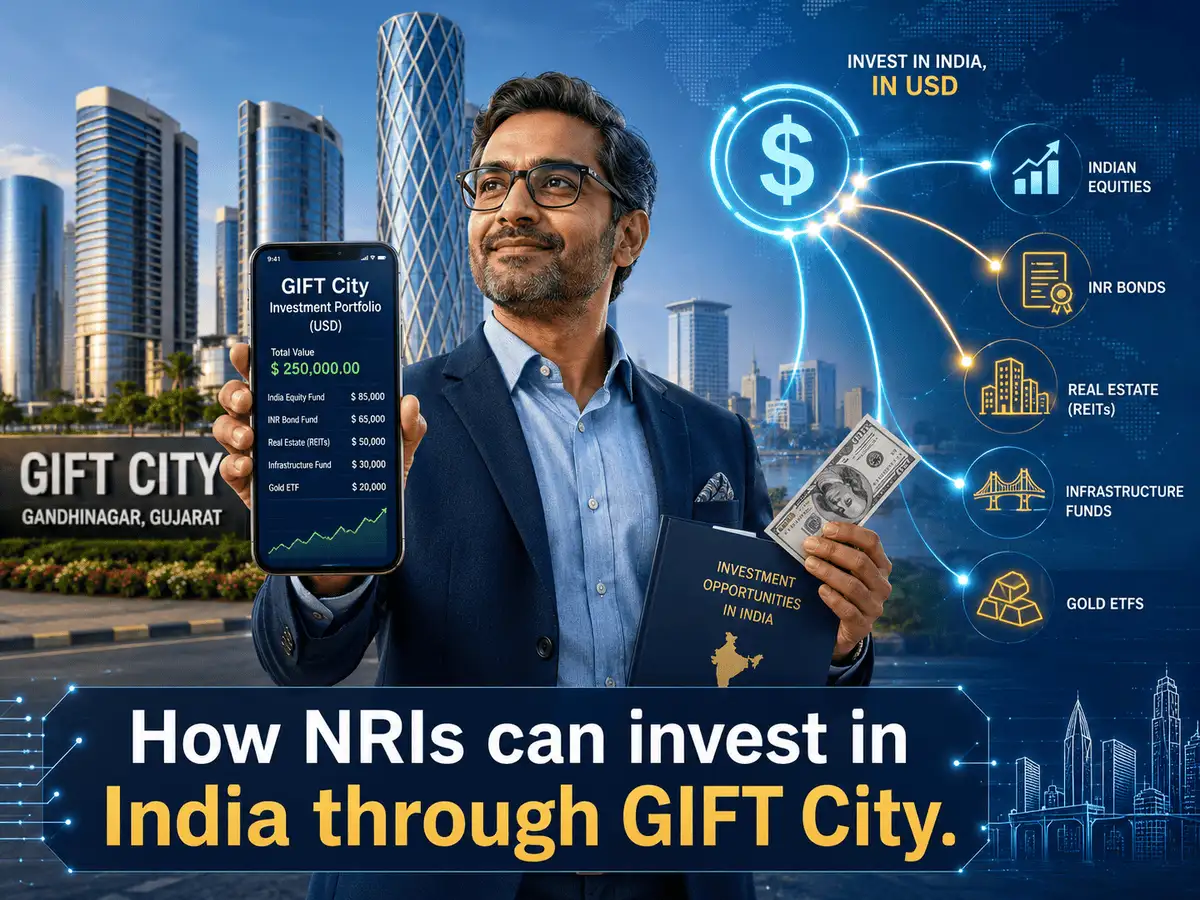
Hey NRIs, are you looking to invest in India without the hassle of converting your dollars into rupees, dealing with conversion fees, or navigating tricky repatriation rules?
Gujarat International Finance Tec-City (GIFT City) is emerging as an alternative investment destination for Non-Resident Indians (NRIs) and Overseas Citizens of India (OCIs). It offers access to both global and Indian investment products within a dollar-denominated, tax-efficient ecosystem.
Here's a look at the investment options, tax benefits, and the process to get started.
Why should NRIs and OCIs consider GIFT City over traditional India investment avenues?
GIFT City allows NRIs and OCIs to invest in India through an international financial centre without routing investments through the traditional domestic framework.
Since investments are made in US Dollars (USD), there is no need to convert money into Indian Rupees before investing.
The main constraint is the LRS limit of $250,000 per individual per financial year. Since this cap is cumulative across all LRS purposes, including investments, travel, education and gifts, investors should factor in their total foreign remittances when planning overseas investments.
“It provides access to a wide range of investment products such as mutual funds, AIFs, global stocks, ETFs, and GIFT Nifty. The platform is regulated by the International Financial Services Centres Authority (IFSCA), ensuring a safe and transparent investment environment,” says Niteen Dongare, Director & CEO, Anand Rathi International Ventures IFSC Pvt Ltd.
Investors also benefit from lower transaction costs, as there is no Securities Transaction Tax (STT), Commodities Transaction Tax (CTT), or GST on transactions. There is no stamp duty, or exchange turnover charges on eligible products either, he adds.
Investors can also repatriate both capital and returns without limits.
“Investors can fund from and withdraw to a foreign bank account or an NRE/NRO account, without the friction that applies to some domestic instruments,” says Ankur Choudhary, CEO and Co-Founder at Belong.
What investment options are available, and what are their features, minimums, risk profiles, and suitability?
GIFT City offers investment products catering to different risk profiles and investment objectives:
|
Investment option
|
Minimum investment
|
Risk profile
|
Best suited for
|
| USD Mutual Funds | From USD 500 | Moderate to High; depends on fund category | Long-term wealth creation with Indian or global market exposure |
| Alternative Investment Funds (AIFs) | Around USD 150,000 | High | High-net-worth individuals (HNIs) seeking sophisticated trading and investment strategies in public or private markets and venture capital |
| US Stocks & ETFs | Varies | Medium to High | Investors seeking direct exposure to global companies |
| GIFT Nifty Futures | Starting with ~3000 USD | High | NRIs/OCIs looking to trade Nifty 50 derivatives in USD |
| USD Fixed Deposits | From USD 1,000 | Low | Capital preservation and earning dollar-denominated returns |
The USD FDs offered by GIFT City branches of Indian banks offer tenures from 7 days to 10-years, unlike other conventional domestic Indian options like FCNR deposits which have a minimum investment tenure of 1 year. These start with a minimum of USD 1,000, held directly in the investor's name at the partner bank. Rates go up to 4.7%, explains Choudhary.
However, India-focused Portfolio Management Services (PMS) are currently not available through GIFT City.
“There's no inbound Portfolio Management Services (PMS) in GIFT City today, so anyone reading about the PMS minimum coming down to USD 75,000 should know that doesn't apply to India-focused strategies,” says Viram Shah, Founder & CEO, Vested Finance.
How can NRIs and OCIs invest in GIFT City? Step-by-step process
According to Harsha Vardhana VM, Founder & Group CEO, Atom Financial Services, investing through GIFT City typically involves five steps:
- Step 1: Open an IFSC account either through a GIFT City banking unit of an Indian bank or through a platform offering IFSC-regulated products.
- Step2: Submit KYC documentation, including passport, PAN, overseas address proof, and NRI or OCI status verification. Onboarding typically takes a few days to two weeks.
- Step 3: Transfer funds in foreign currency directly from an overseas bank account into the IFSC account, bypassing rupee conversion entirely.
- Step 4: Select specific products, retail schemes, AIFs, listed securities, or FC deposits, based on the minimum investment thresholds and risk profile discussed earlier.
- Step 5: Accrued returns can be repatriated in foreign currency with relatively straightforward compliance once local KYC checks are complete.
GIFT City can also simplify the redemption process for certain investment products.
“If you are an NRI redeeming an Indian mutual fund, the fund house (AMC) deducts TDS at source whether or not you actually owe it, and to get treaty relief you need a tax residency certificate and Form 10F on file before you redeem,” explains Shah.
Miss that and you are waiting on a refund through an Indian return. With an inbound fund of funds (FoF) in GIFT City, there's no TDS on withdrawal - the money comes out clean, in dollars. That's a working-capital difference, not just a tax one, he adds.
What are the tax benefits of investing through GIFT City?
GIFT City offers a favourable tax framework for eligible investments, although the final tax liability also depends on the investor's country of residence and the applicable Double Taxation Avoidance Agreement (DTAA).
|
Income Type
|
Tax Treatment in GIFT City / India
|
Tax Implication in Country of Residence
|
| Capital Gains | Income from eligible offshore investments and specified securities through IFSC structures may be exempt from Indian tax for non-resident investors, subject to applicable conditions. (IFSC Authority) | Tax may apply as per the tax laws of the investor's country of residence. DTAA benefits may be available, where applicable. |
| Dividends | Dividend income distributed by certain IFSC funds may be taxable in India at applicable rates (for example, 10% in certain Category III AIF structures). (IFSC Authority) | Dividend taxation depends on the investor's country of residence and local reporting requirements. |
| Interest Income | Interest income from eligible investments may receive favourable tax treatment depending on the structure and type of security. Certain IFSC fund structures provide exemptions for non-resident investors on specified income. | Interest income may be taxable as per the laws of the investor's country of residence. |
| Category III AIF / PMS Income | Category III AIFs are generally subject to fund-level taxation. Certain income from specified securities, offshore securities, and IFSC-traded securities may receive exemptions for non-resident investors. | Investors should check the tax treatment in their country of residence, including the reporting of distributions, gains, and foreign investments.
|
| Repatriation of Investment Proceeds | Investment proceeds can generally be repatriated through permitted banking channels, subject to applicable regulations. | Foreign exchange and tax reporting requirements of the investor's country of residence may apply. |
Investors should remember that while GIFT City may offer tax advantages in India, they may still be liable to pay tax in their country of residence. Experts therefore recommend reviewing the applicable DTAA provisions and seeking professional tax advice before investing.