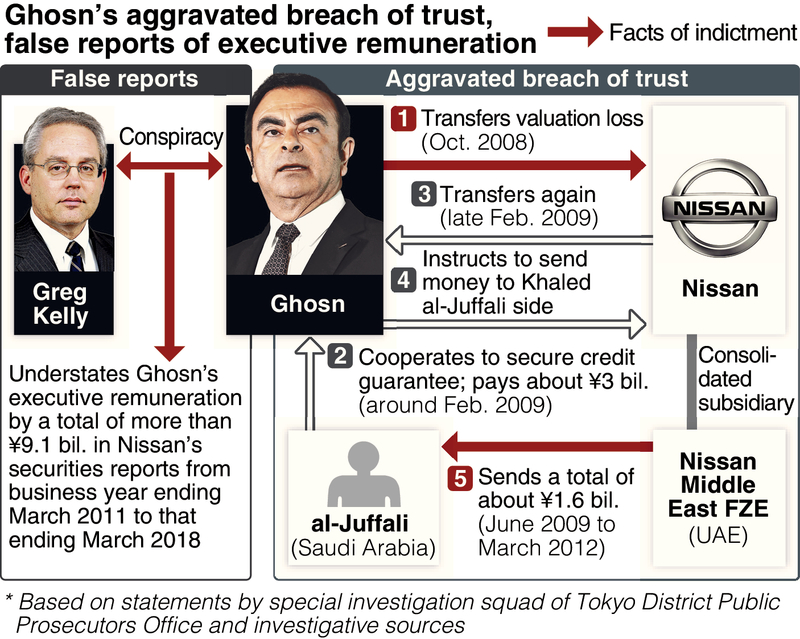
Former Nissan Motor Co. Chairman Carlos Ghosn, who was indicted Friday on charges including aggravated breach of trust in violation of the Companies Law, has made clear his confrontational stance against prosecutors on charges that also include violation of the Financial Instruments and Exchange Law by understating his executive remuneration in the company's securities reports. Whether Ghosn actually inflicted losses on Nissan will be a focal point of the trials.
Regarding the aggravated breach of trust charge, the special investigation squad of the Tokyo District Public Prosecutors Office attaches importance to a series of events including Ghosn transferring to Nissan in October 2008 a valuation loss of about 1.85 billion yen that he incurred through a personal investment, and then sending a total of 14.7 million dollars (about 1.6 billion yen) to his acquaintance Khaled al-Juffali, a businessman in Saudi Arabia.
According to sources, the Securities and Exchange Surveillance Commission became aware that Ghosn transferred the valuation loss to Nissan after it conducted a periodic inspection of a bank with which Ghosn had a deal in around November or December 2008, just after Ghosn transferred the loss. The commission told the 59-year-old former head of Nissan's secretarial office, who was an aide to Ghosn, that Ghosn could be held legally responsible.
Ghosn hurriedly tried to return the valuation loss, but the bank asked Ghosn to put up additional collateral of several billion yen. In the end, al-Juffali paid about 3 billion yen in guarantee fees on Ghosn's behalf around February 2009, which enabled Ghosn to avoid putting up the additional collateral, the sources said. Four months later, Ghosn began sending him the 1.6 billion yen mentioned in the indictment.
A senior prosecutor said: "Ghosn was loathe to incur a loss through the investment, so he transferred the loss [to Nissan]. With that as a starting point, other acts followed one after another. It's clear that he used Nissan for his own private purposes and inflicted loss on the company."
On the other hand, Ghosn's lawyers have insisted that an English expression referring to "no loss to the company" in the minutes of a Nissan board of directors meeting to decide on the transfer of the valuation loss means that there was an agreement that Nissan would suffer no losses, and thus his acts do not consitute a crime.
Meanwhile, the prosecution also has a weakness. In general, in an investigation into a case of aggravated breach of trust, investigative authorities confirm whether the provider of the funds in question needed to offer them to the receiver. However, in this case, as the allegations involve someone overseas, the prosecution cannot directly question al-Juffali, according to sources.
Lawyer Yasuyuki Takai, a former prosecutor in a special investigation squad, said: "If prosecutors cannot prove that Mr. al-Juffali did not actually conduct business, it cannot be said that [Ghosn] inflicted losses on the company." The statment indicates the higher hurdle prosecutors must scale to prove the charge.
In the case involving Ghosn understating his executive remuneration in the company's securities reports, the main focal point is whether the payment of portions of his executive remuneration that were unstated in the company's securities reports was fixed.
The special investigation squad has obtained a large amount of evidence, including memorandums in which "Fixed Remuneration" was specified in English. Prosecutors believe the evidence proves that Ghosn concealed his remuneration systematically and continuously starting just after the business year ending March 2010, when a system was launched that requires companies to disclose the remuneration of individual executives.
Ghosn's lawyers have admitted that Ghosn attempted to receive part of the remuneration after his retirement, but are firm in their stance that the remuneration has yet to be fixed.
This is the first time investigative authorities have built a case concerning falsely reporting executive remuneration. Another focal point is whether executive remuneration is tantamount to "important matters," the false reporting of which is prohibited under the Financial Instruments and Exchange Law.
Keisuke Matsuoka, a professor at Senshu University who is well versed in the Financial Instruments and Exchange Law, said: "Executive remuneration is information for measuring the health of corporate governance. It will be interesting to see how the court will evaluate its importance."
Read more from The Japan News at https://japannews.yomiuri.co.jp/