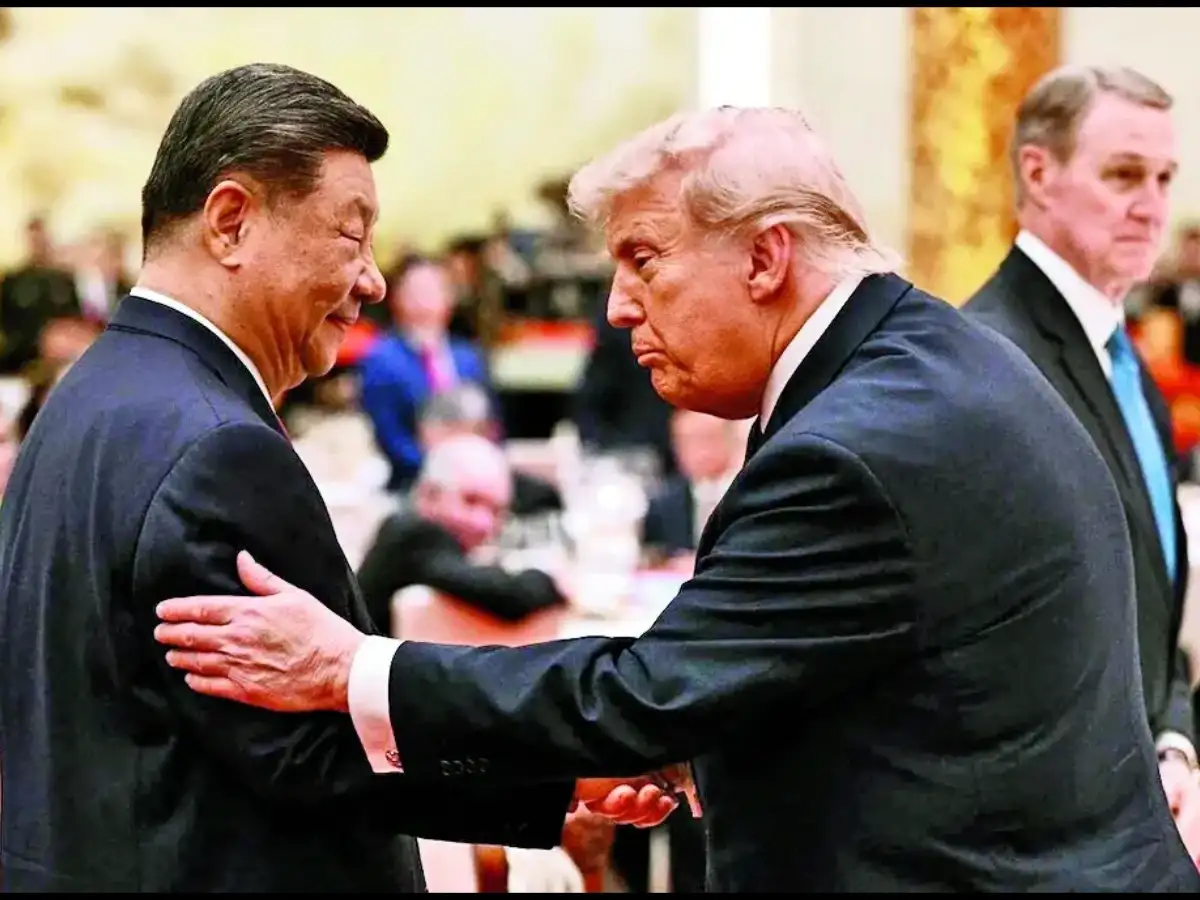
China is placing itself in the driver's seat in great power relations with the US. At the end of a once-postponed Trump-Xi summit in Beijing, Xi set the rules - 'managed competition' and a 'relationship of strategic stability' as governing principles. Lack of concrete outcomes was offset by the US acknowledgement that China is a peer-power.
Xi's reference to a 'Thucydides trap' positioning the US as a declining power didn't go down well with Trump. A decade ago, Xi had denied that such a 'trap' was possible. That's the distance China has travelled. The two sides extended the truce achieved in Busan last year. But there didn't seem to be major concessions by either.
Also read: Trump returns from China visit, calls meeting with Xi 'G-2'
The US retained its Taiwan leverage. China was silent on rare earths and critical minerals exports. Trump may have wanted Xi to use his influence on Iran to end the war, and bail him out of an increasingly uncomfortable spot. Xi sees very little reason to do so. The US in a Gulf quagmire is a sweet spot. Iran also played cleverly, allowing Chinese ships to transit Hormuz just as Trump landed in Beijing.
Trump looked tired, Xi amused. Everybody returned underwhelmed, but largely relieved. Even if this meeting yielded little in real terms, Xi will be in the White House on September 24, and the two men will meet again at the Apec summit in Shenzhen and G20 in Miami. 'Strategic stability' is baked into summit deliverables.
The view from New Delhi is less positive. In one year, Trump has made Pakistan and Asim Munir an indispensable buddy, and looks like coming second in a game of equals with China and Xi. That, in itself, changes the playing field in India. At the functional level, things continue as usual between the US and India. But the political relationship is in the trash bin, which means 'functional' doesn't go far.
Instead, India's 'G-Minus-2' strategy is now a reality. Witness Modi's carefully selected 5-nation tour, as well as India's recent investments in critical sectors in Latin America, Europe and Japan. Trump's ill-judged war on Iran has put the US in second place in the Gulf, and given Iran a shot at greatness. It has given a serious jolt to the Indian economy. Nothing spells Indian vulnerability more than the PM asking Indians to stop buying gold.
Four years ago, India saw itself as a casualty of the Russia-Ukraine war. The current Gulf war threatens to send India into a tailspin. There's a whiff of the 1970s, a potential reprise of 1991, even the hopelessness of 2011-14 in the air.
Also read: Trump says made 'fantastic trade deals' with Xi
The danger from China is at a very different level. India has been playing on the theme of 'China+1', which is now under threat. The Biden administration actively encouraged US companies to look at India, and diversify from China. The US has reversed course under Trump, even describing India as a potential strategic adversary.
Meanwhile China has changed the rules of the game. In two orders, 834 and 835, issued in April, China is arming itself with penal powers against supply chain disruptions. There is an implicit warning here for India. China is now approaching commercial investments and supply chains disruptions through the lens of national security. Individuals and entities can face a range of state action, including arrest and prohibition, if they're found to be part of 'derisking' and 'decoupling' actions by foreign entities.
Global dependence on China's supply chains is Beijing's greatest leverage, and it has tightened the screws. This should be headline concern for New Delhi. If Beijing thinks relocating business from China to India 'weakens' Chinese capabilities, it has armed itself with a host of coercive and penal measures against its own citizens.
China's threat will peak once other routes are found. Chinese involution is a growing threat, where its industrial policies and weak domestic consumption cannibalise each other. Also, political threats often find alternate supply chains. That should be the core of Quad meeting in New Delhi next week. If India and the US need a serious conversation, it should be about China.
Beijing saw Apple's diversification as a betrayal, and is determined to not repeat it. India, for its part, has not been able to repeat the Apple experiment. It was a spectacularly successful bet, since Apple is now India's largest exporter, displacing Maruti Suzuki. But in the years since then, India has not got a single other investment of comparable size or scope. This means India will have to play a different game.
The pull factor from Beijing is increasingly coercive. The pull factor from India is looking weak, disjointed and non-strategic in application. That should change.
China, an active player with Pakistan against India, is now an active player in the disruption of India's economy. Op Sindoor gave India confidence that it can deal militarily against their joint offensive. 'G-Minus-2' should be its new mantra.
The writer is CEO, Ananta Centre