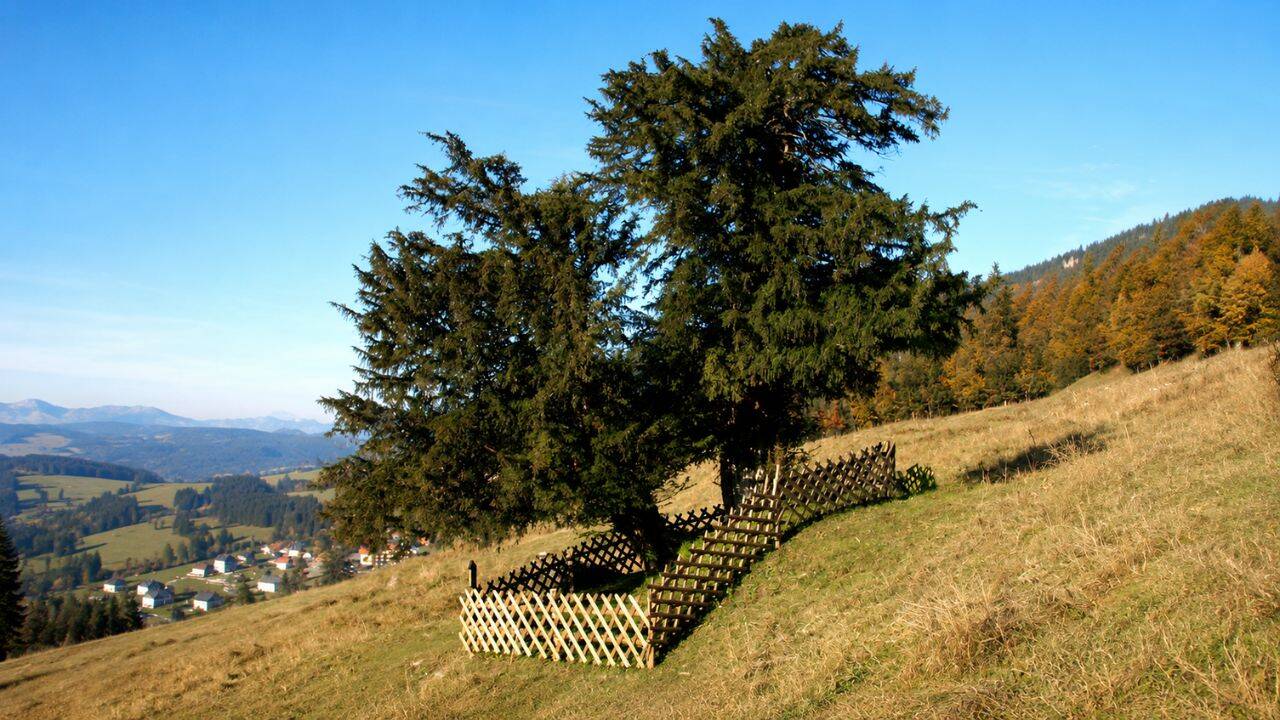
A solitary yew tree growing high in the Bavarian Alps has been recognised as Germany's oldest known tree, giving scientists a rare glimpse into a living organism that has survived for more than a millennium. Hidden on a mountain meadow near the village of Steibis, close to the Austrian border, the ancient tree has quietly endured changing climates, shifting landscapes and centuries of human history. Its remarkable age was established through scientific examination of its growth rings, placing it at around 1,100 years old. According to ORF Vorarlberg, an Austrian public broadcaster's site, the German Dendrological Society has confirmed the tree as the thickest known yew in Germany, adding another distinction to an already extraordinary natural landmark.
Get breaking news anytime, anywhere. Download the TOI app now!
Where Germany's oldest yew tree grows in the Bavarian Alps
The yew stands between Steibis and Balderschwang in the Upper Allgäu region of Bavaria, roughly one kilometre from the Vorarlberg border in Austria. It grows on a grazed alpine meadow about 1,100 metres above sea level, on the northern side of the Hochgrat mountain range.
The tree occupies an unusually demanding location for a European yew. The society explained that the northwest-facing slope receives very little winter sunshine and experiences colder conditions than south-facing slopes at the same elevation. Despite this, the tree has remained healthy enough to continue producing foliage and fruit after more than a thousand years.
The ancient specimen is a female European yew (Taxus baccata), a species known for its longevity but rarely found reaching such an exceptional age in natural conditions.
How scientists determined the age of Germany's oldest yew tree. Determining the age of an old yew is far from straightforward because the centre of its trunk often becomes hollow with time. Instead of counting rings across the full trunk, specialists extracted an eleven-centimetre core sample and analysed the visible annual growth rings before estimating the missing sections.
The calculations indicate an age of about 1,100 years, although the available evidence suggests the tree could realistically be anywhere between 900 and 1,300 years old.
The organisation also described the trunk as a complex structure shaped by centuries of natural growth. It said the massive stem contains fissures, ridges, cracks, cavities and several interconnected sections, characteristics commonly seen in extremely old yew trees that have continued growing despite gradual structural changes over hundreds of years.
Germany's oldest yew is also the country's thickest documented yew tree
The newly recognised record-holder is impressive not only because of its age but also its size. The trunk measures approximately 5.10 metres in circumference, making it the thickest documented yew tree in Germany. The discovery also changes the country's list of oldest trees. Until now, the title was generally associated with the village lime tree in Upstedt, Lower Saxony, which is estimated to be around 1,000 years old. The Steibis yew now appears to exceed that age based on the latest scientific assessment. Although the estimated lifespan carries a margin of uncertainty, specialists say the evidence strongly supports its position among the oldest living trees in Germany.
Germany's oldest yew to receive National Heritage Tree status
The German Dendrological Society intends to officially recognise the tree as a "National Heritage Tree" during a ceremony planned for June. The designation is designed to encourage long-term protection of exceptional trees and ensure they are preserved and managed in ways that allow them to continue ageing naturally.
Recognition also draws attention to the ecological importance of ancient trees, which provide valuable habitats for insects, birds, fungi and other organisms. While the Steibis yew has already stood through more than a thousand years of environmental change, conservationists hope its new status will help safeguard it for generations still to come.