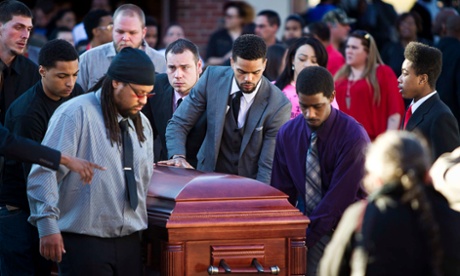
“I’m going to be great. I don’t know how I know, but I do. Just watch. I’m going to change the world.” Tony Terrell Robinson Jr shared those words with friends and family members one afternoon, as they sat on the couch. On Saturday, in Madison, Wisconsin, they became the refrain for his funeral.
Robinson died on 6 March, when he was shot by a police officer. Within minutes, protesters had filled the street in front of the home where Robinson died. Every day since they have held vigils, debates and marches of the kind seen recently across the US, in response to deaths at the hands of police, in an attempt to bring home the message that “Black Lives Matter” in Madison too.
Saturday’s services brought together a diverse group of people. Speaking beforehand, one attendee, Jeff Boatman, said he could empathize with Matt Kenny, the white Madison officer who had killed Robinson.
“I understand, as a law enforcement officer, to be in their job in a situation,” he said. “But then on the other hand, I wish there was a non-lethal way to have dealt with this situation.”
Police say Kenny was responding to two calls about Robinson, who they say was acting violently before the shooting and had knocked Kenny to the ground. Preliminary autopsy reports released on Friday said Robinson was shot in his head, right arm and torso, although they did not say how many times.
While there was empathy for those doing the challenging work of policing, the service brought forth a clear call for change. The visitation and funeral services were held inside the gymnasium at Madison’s East High School. More than a thousand people filled that space and an overflow room. Flowers not only adorned the casket but filled a table near it, most bearing cards of sympathy and solidarity.
From the invocation onward, the speakers made clear that this tragedy should be a watershed moment for the community.
Opening proceedings, Reverend Everett Mitchell quoted Maya Angelou when he reminded those gathered that history “cannot be unlived, but if faced with courage, need not be lived again”.
Robinson’s aunt, Lorien Carter, offered a poem likening Robinson to a martyr, “a champion of change”.
Reverend David Hart said: “Too many of our children are dying before their time.”
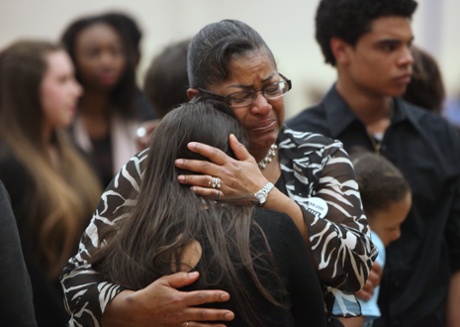
Some of those who took the podium were too overcome by emotion to speak. On more than one occasion, Robinson’s mother and grandmother took to the stage to hold and comfort those who had loved their boy. Friends and family such as Craig and Jack Spaulding, Jordan Robinson and Alize Bell spoke with passion and humor.
“Real change is happening,” said Craig Spaulding. “I’ve been witnessing it all week.”
In her address, Robinson’s grandmother, Sharon Irwin, invoked Martin Luther King Jr. “I believe in unarmed truth and unconditional love will have the final word,” she said.
Telling those assembled that her grandson had walked a spiritual path, Irwin said she had felt her grandson communicating to her through a Phil Collins song, In the Air Tonight. As the song played, she raised her fist in the Black Power salute. She was met with a wave of arms, rising in the air.
Turin Carter, who had acted as Robinson’s mentor, told the Guardian: “Anybody who stands in the way of true justice, I will make it my personal duty to expose it.”
After the funeral, former Madison police chief David C Couper, told the Guardian: “The nation’s police [have] to stand up and say, ‘We’ve changed whatever’s going on because it’s not working.’ We can’t be taking the lives of people who don’t have weapons.”
Couper also said the change needed would go beyond police reform, mentioning poverty, housing and employment issues.
“Almost 50 years after the civil rights movement, there’s not just a few things we need to do,” he said. “We’ve got to do everything. And that’s going to be really hard. It’s going to be hard for America.”