Set in New York and Boston, Arthur Miller’s Death of a Salesman explores the final hours of 63-year-old Willy Loman as he grapples with an unfulfilled life pursuing “the wrong dreams”.
The return of Biff, his estranged son, forces Loman to confront the infidelity that destroyed their once-loving relationship.
But at the end of the second act, after he’s abruptly fired from his job of 34 years, Loman discovers the most “remarkable” thing: his son still loves him. Stirred by this epiphany, the salesman leaves home and crashes his car in the belief the life insurance payout will provide for his family.
The play ends with one of the most moving speeches in modern drama: after finally paying off their mortgage, Linda Loman stands by her husband’s grave and tells him “we’re free”.
There have been more than 30 professional productions of Salesman since it first appeared in Australia in 1953, and a revival of a 2023 production directed by Neil Armfield and starring Anthony LaPaglia has opened in Melbourne, ahead of a tour to Brisbane and Adelaide.
Why does Miller’s play captivate Australian audiences?
The making of a classic
“You don’t choose to be a playwright,” Miller told the Australian Broadcasting Commission in 1980. “It’s a deformation of the mind that you’re born with.”
Yet Miller’s career was almost over before it began. His first play landed on Broadway in 1944. The Man Who Had All the Luck closed after just four performances, and he nearly gave up writing for the stage.
But Miller decided to write one more play, All My Sons (1947). Its success led to a remarkable period of creative output virtually unmatched in American theatre history, writing Death of a Salesman (1949), The Crucible (1953) and A View from the Bridge (1956) in a decade.
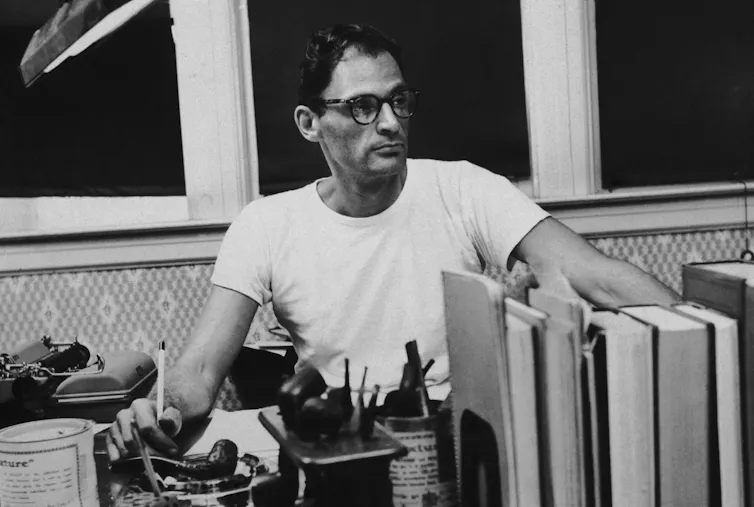
Miller penned Death of a Salesman when he was 32. As he describes in his autobiography, he was inspired by “an indescribable feeling of a new form”. He wrote all night. By the time dawn broke, the first act was done.
Miller believed “the common man is as apt a subject for tragedy in its highest sense as kings were”. Salesman exemplifies this idea.
A Broadway hit, and an Australian mainstay
Directed by Elia Kazan, Salesman was an instant hit on Broadway in 1949. The New York Times critic Brooks Atkinson declared it “one of the finest dramas in the whole range of the American theatre”.
Miller received the Tony, Pulitzer and New York Drama Critics’ Circle Award for playwriting. Salesman also became the first play chosen by the Book of the Month Club, with the published script circulated to hundreds of thousands of eager readers. By 1999, the play had sold 11 million copies.
Within a year of the play’s debut, Miller received more than 1,000 letters from fans detailing how the Loman family tragedy had given them, in the words of one now held in the playwright’s archive, “an exciting new respect for life and humanity”.
Although László Benedek’s film adaptation was released in Australian cinemas in 1952, theatre audiences had to wait until 1953 to finally see Miller’s tragedy on stage.
Salesman first appeared in June at Sydney’s Independent Theatre where the audience “cheered, stamped, and whistled for several minutes” at curtain call, followed by another production in July at Melbourne’s National Theatre that one critic felt struggled to bring Miller’s “grim play” to life.
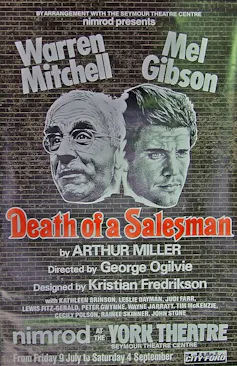
The play’s relevance to Australian audiences only grew in the latter half of the century. In 1982, it was staged at Sydney’s radical Nimrod theatre, directed by George Ogilvie and starring Warren Mitchell as Willy and Mel Gibson as Biff.
Theatre critic H. G. Kippax said Miller’s “drama of shattering power” resonated closely with modern Australian life. Kippax contrasted this staging with the Old Tote Theatre Company’s production in 1970, when the play’s sharp social critique made it a distinctly “American phenomenon” on the shores of The Lucky Country. But Ogilvie’s Salesman, he wrote, was like a “prophecy fulfilled” for Australian audiences now experiencing the effects of an economic downturn.
Other Australian theatre critics, however, were less sure of the play’s brilliance. Writing in The Bulletin, Brian Hoad felt Salesman was among a number of “curriculum plays” struggling companies programmed to boost audience numbers by attracting students studying the text in school.
At times throughout Salesman’s performance history in Australia, the drama has even taken place offstage.
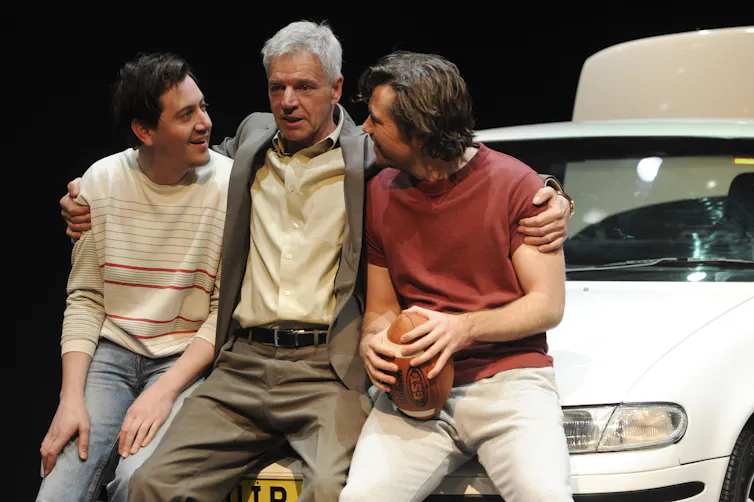
In 2012, the agency representing Miller’s estate threatened to shut down the Belvoir production after learning director Simon Stone had cut the play’s epilogue in which the Loman family grieves before Willy’s grave.
After Belvoir reinstated the final scene, the agency allowed the production to proceed.
Miller’s legacy
For more than seven decades, Miller’s play has stood as a powerful indictment of the American Dream in a postwar capitalist society where, to borrow Willy’s words, “you end up worth more dead than alive”.
Yet there’s a simpler reason why we keep returning to this universal story: Death of a Salesman is, at heart, the all-too-familiar tragedy of a family that sold each other a fantasy rather than buying into reality.
This article was originally published on The Conversation. Read the original article.