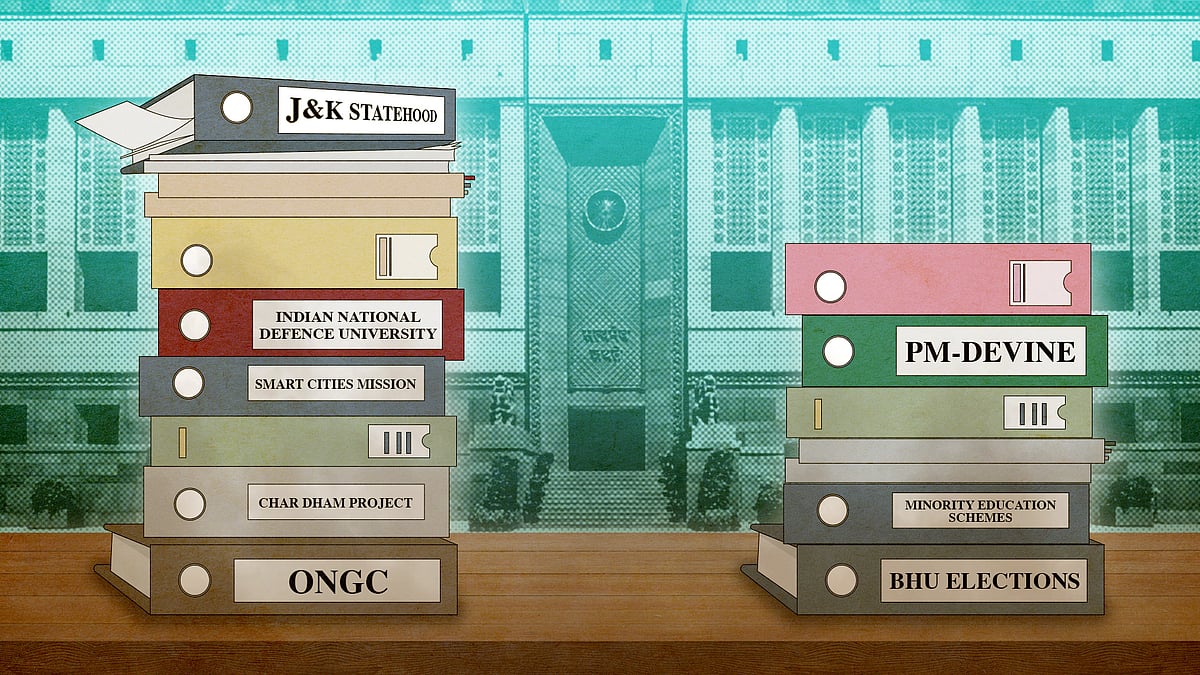
In 2016, the petroleum ministry was asked in the Rajya Sabha if it would act against officials from the government-owned Oil and Natural Gas Corporation and its regulator Directorate General of Hydrocarbons for “inaction”. This was a case of alleged gas flow from an ONGC block to a Reliance Industries block in the Krishna-Godavari basin.
Union petroleum minister Dharmendra Pradhan admitted in Parliament that the ONGC was aware about the matter and would look into the “commissions and omissions”. But nine years later, the ministry has claimed action has been delayed because of a legal case between ONGC and Reliance.
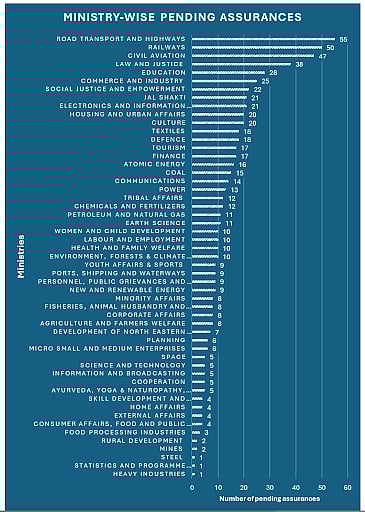
This is among 699 “assurances” that lie unfulfilled before the Parliamentary Committee on Government Assurances in the Rajya Sabha – a watchdog that tracks promises and undertakings made by ministers on the floor of the house and publishes them here. These 699 unfulfilled assurances are by 53 ministries, with road transport topping the list (55), followed by railways (50) and civil aviation (47), as per the panel’s latest report earlier this month.
These figures are only for the Rajya Sabha; data for Lok Sabha assurances was not reviewed for this report.
While Rajya Sabha’s committee has 10 members nominated by the Chairman, Lok Sabha’s committee has up to 15 members nominated by the Speaker annually. No ministers serve on these panels, so that independence is protected. Ministries submit progress via the Ministry of Parliamentary Affairs, with committees summoning officials if needed. Debates are scanned for assurances; and the unimplemented ones go to the committee for review. Any government statement in Parliament that implies further action can be described as assurance. Expressions such as “under review”, “under consideration”, “is being looked into” etc. typically qualify as assurance.
While an assurance given on the floor of the house has to be fulfilled within three months, a ministry can seek extension from the committee towards implementation. The committee is empowered to drop an assurance if ministries are facing genuine difficulties beyond their control.
To expedite the implementation of assurances, the committee also undertakes study visits to interact with various state governments and public sector undertakings to obtain first-hand information about the issues involved.
Promises forgotten
Of the total 699 pending assurances in Rajya Sabha, the oldest are 40 promises pending for 10-15 years.
One of them is related to suspended student elections at Banaras Hindu University. In December 2014, then minister of human resources development Smriti Irani was asked if students’ election could be revived at BHU. She said a committee formed by BHU was looking into the “viability” of the elections.
To fulfill its assurance, the ministry of education tabled an implementation report (IR) in August 2024, giving the chronology of the events.
The assurance committee was miffed with the report which still did not answer the original question: Can elections be held at BHU?
“The committee observes that while the ministry has provided a detailed chronology of committee deliberations and approvals regarding the revival of students’ representation at Banaras Hindu University, it has not clarified the final outcome concerning the viability of a Students’ Union under the direct mode of election, as originally sought,” it wrote in the report. Despite this, the committee treated the report as the assurance being partly fulfilled.
Another assurance pending for more than 10 years is related to setting up the Indian National Defence University. Replying to a starred question in August 2015, then defence minister Manohar Parrikar said the foundation stone for the university was laid in 2013 and “revision cost was under consideration”.
The central government wanted the committee to drop the assurance. “The committee took a serious view of the delay in setting up the proposed Indian National Defence University, while noting that in-principle approval for the same was accorded way back in 2010. The committee directed the ministry to expedite the finalisation of report by the two-members’ committee constituted in the matter and furnish a ‘status note’ in the matter. The committee did not accede to the request of the ministry to drop the assurances,” the committee underlined. Unlike implementation reports, status notes help the committee monitor progress of the assurance.
Statehood to J&K, projects in north-east, minority funds
While scrapping the special status of Jammu and Kashmir in 2019, home minister Amit Shah promised that the statehood could be restored once the situation improved. Three years later, the ministry was reminded of the promise in the Rajya Sabha by then CPM MP Elamaram Kareem: “whether it is a fact that the Minister of Home Affairs had stated in Parliament that the Statehood to the Union Territory of Jammu and Kashmir would be restored, if so, by when, and if not, the reasons therefor.” In his reply, MoS Nityanand Rai said the statehood would be “granted at an appropriate time”.
The committee scrutinised the assurance and asked the Union government to expedite the procedure towards fulfilling the promise. Representatives of the home affairs ministry and an implementation report said the statehood depends on multiple factors and it would be granted at an appropriate time. The committee considered the assurance as partly-fulfilled.
In August 2023, Shiv Sena MP Priyanka Chaturvedi asked the ministry of development of north east region the impact of an infrastructure scheme called Prime Minister’s Development Initiative for North East Region (PM-DevINE), which was announced in the 2022-23 budget. Minister G Kishan Reddy informed the house that the impact study was being taken up at an appropriate time.
In its implementation report filed with the committee, the ministry argued that the impact study of a scheme is taken only after completion of the scheme. It informed that an impact study of two completed projects has been initiated. The committee considered assurance as partly fulfilled since the impact study has not been completed. “However, since the impact study of even these completed projects remains pending, the assurance was treated as part-fulfilled,” according to the report.
In March 2023, a question was asked from the ministry of minority affairs about budget cuts in the allocation of minority schemes. “The tenure for implementation of the ‘Scheme for providing education to Madrasas and Minorities’ was only up to 31.03.2022. The Scheme is under review for continuation or otherwise,” answered then minority affairs minister Smriti Irani in the Rajya Sabha. In an implementation report laid on the table of the house, the ministry repeated its stance that the scheme ran only until 2021-22 but kept silent on the conclusion of the review. The committee refused to drop the assurance and considered the IR as partly fulfilled.
“The committee, therefore, recommends the ministry to explicitly state the outcome of the review, including reasons for discontinuation, if applicable, and liquidate the assurance at the earliest,” read the report.
Ten years ago, the central government announced 6,000 temporary houses to migrant workers in Kashmir under the Prime Minister’s Development Package.
In 2022, the government was asked the total number of houses built and timeline for the remaining under the package. In its reply, the minority affairs ministry revealed: “Construction of 1,025 units has been completed/substantially completed, 1,872 units are at different stages of completion and work on remaining units has been taken up.”
The committee has kept an eye on this assurance since then. In 2024 and 2025, the ministry has filed three IRs to fulfill it. Curiously, the committee has dropped the assurance after the final IR, tabled in March this year, revealed that 3,120 flats have been completed while the rest were at various stages of completion.
Other most prominent pending assurances are related to delays in completing Char Dham road project, bank scams under CBI investigation, construction of storage silos by Food Corporation of India, emergency weather alert system, smart cities project, displacement due to mining, revival of state-run helicopter carrier Pawan Hans etc.
Data discrepancy
For fulfilment of assurances, the ministries forward ‘implementation reports’ (IRs) to the ministry of parliamentary affairs, which lays them on the table of the house and forwards them to the Rajya Sabha secretariat for their examination.
These IRs are duly examined to ascertain whether all aspects of the assurances have been covered. In case, the committee observes any shortcoming in IRs, the observations are communicated to the ministries along with direction to furnish a revised implementation report.
A total of 247 IRs tabled in the Rajya Sabha have been considered by the 79th report covering a period from July 2024 to June 2025. Almost two-thirds, or 164, of these IRs were able to honour assurances while the rest were either partly-fulfilled or not at all. Of the 164 IRs, 37 took more than five years for fulfilment, 48 within a year and the rest 79 from one to five years.
The committee expressed its concern over discrepancies in assurance data maintained by the Rajya Sabha secretariat and parliamentary affairs ministry.
In a letter to all ministries, the Rajya Sabha secretariat said merely filing an implementation report by the ministry should not be construed as fulfillment of the assurance. The letter said the decision to define an assurance fulfilled, partly fulfilled and pending rests only with the committee.
Twenty-five years have transformed how we consume news, but not the core truth that democracy needs a press free from advertisers and power. Mark the moment with a joint NL–TNM subscription and help protect that independence.
Newslaundry is a reader-supported, ad-free, independent news outlet based out of New Delhi. Support their journalism, here.