Economic hardship is a lingering consequence of Brooke’s breast cancer treatment, more than 30 years ago – which she paid for by selling her wedding ring. The treatment left her debilitated, fatigued and unable to work for some time. Friends brought groceries and the Cancer Council provided some financial support, but Brooke needed to scrounge for food for her beloved dogs.
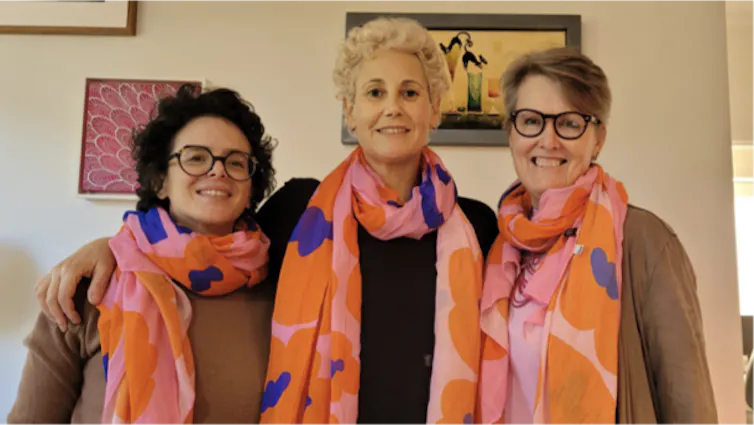
I interviewed Brooke and 24 others, working with Louise Chappell and Siobhan O’Sullivan, who – like me – were both researchers and cancer patients.
I was diagnosed with an aggressive breast cancer that had metastasised to my lymph nodes in 2021, when I was 29 weeks pregnant. Louise was first diagnosed with breast cancer in 2009, with recurrences in 2016 and 2020. She is currently living with metastatic breast cancer, and is in regular treatment. Siobhan was diagnosed with ovarian cancer in 2020, during COVID. Devastatingly, she died in June 2023.
We wanted to find out about the challenges people face when navigating oncology care in Australia, as patients and carers. We also spoke with health-care workers, who revealed what it’s like to be on the “other side” of the desk.
Wendi, a teacher who was treated for breast cancer in 2019, told us she had surgery that Christmas and recovered over the holidays. “Then I started the radiotherapy and was able to take that whole block of ten weeks off, which was great.”
Because she had “heaps” of sick leave the following term, she was able to gradually return to work. But she acknowledged not everyone could – and some in her position would have to return to work immediately. “There’s no way I could have done that.”
In the increasingly casualised Australian workforce, many women diagnosed with cancer lack the resources to pay for treatment, or to support them as they take time off work for treatment and recovery. The financial implications are dire: casual workers have little job security, they receive no pay when they cannot work, and they lack accumulated sick leave for treatment and superannuation for an uncertain future.
In the online spaces I inhabit, cancer patients crowdfund to cover basics such as rent, petrol, childcare and even food. I didn’t have to do that, but I did end up crowdfunding a crucial element of my cancer treatment that was not covered by Australia’s Pharmaceutical Benefits Scheme (PBS).
Growing out-of-pocket expenses
Cancer patients often have to consider: can they afford to support core and supplementary treatments? Does their job offer adequate leave provisions? Can they take time off to rest? Do they belong to a community that can provide practical support such as transport, food, cleaning and care?
Treatment can also be affected by location: the further from an urban centre, the longer the patient will need to wait and the more they will need to pay to cover travel and accommodation expenses.
In Australia, “financial toxicity” in cancer care is growing, with people needing to spend increasingly more out-of-pocket. The ongoing out-of-pocket expenses that patients (and their families and friends) incur during treatment can have a lasting impact on patients’ emotional and psychological wellbeing, as well as their quality of life. It can lead to suboptimal cancer outcomes.
It means doctors might decide not to recommend particular treatments to certain patients, knowing they can’t afford them, or patients deciding certain medications are out of financial reach, or that they cannot sacrifice work to attend medical checkups.
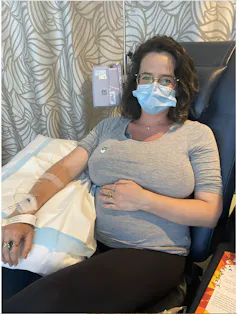
I have experienced this first-hand. At the cancer institute where I receive treatment – I am regularly reminded that it is among the best in the country – there are fees I did not expect.
Every chemotherapy session entails a gap fee of A$50, along with parking and cab charges. Then come the costs of medication, childcare, specialist appointments and additional treatments such as acupuncture, massage and yoga to help manage symptoms.
‘I must cover the substantial gaps’
Like many cancer patients, I now have lymphoedema, a side effect of treatment. Oedema is the swelling and buildup of liquids in the body’s tissue. This condition – which Medicare does not adequately cover – commonly occurs in the arms of breast cancer patients, in the legs of those with gynaecological cancers, and in the head and neck of those with neck, tongue or throat cancers.
The lymphatic system is an intricate network of vessels and nodes that transport fluid (lymph) from the body tissues back to the bloodstream. Lymphoedema happens when the lymphatic system is not working properly, including when lymph nodes need to be removed as part of cancer treatment.
In this case, it is called “secondary lymphoedema”; cancer treatment is its most frequent cause. While lymphoedema is, in some cases, reversible, it cannot be cured and must instead be managed with compression garments, lymphatic drainage massage and sometimes surgery.
Medicare offers modest subsidies for physiotherapy (limited to five visits annually), but I must cover the substantial gaps. In my first two years post-treatment, I’ve spent thousands of dollars on lymphoedema treatment – with no end in sight.
In Australia, lymphoedema affects an estimated 20% of patients with gynaecological, breast, and head and neck cancers, and with melanoma, signalling an urgent need for increased support.
For me, the condition has been psychologically distressing. My affected arm is swollen to double – depending on the weather – the size of my other arm. I cannot wear jewellery or a standard shirt sleeve. Without a compression garment, the arm becomes heavy, painful and weak. With a compression garment, my hand feels constrained, and my arm is hot and sweaty.
Although I have only one breast, it is my lymphoedema-afflicted arm that attracts attention from strangers – a constant reminder of cancer treatment. Lymphoedema is the price I pay to be here, so I try not to begrudge it. But our medical system must respond to the chronic side effects of cancer treatment, which can themselves become medical conditions.
My lymphoedema expenses pale in comparison to the cost of my immunotherapy in 2022 and 2023. Immunotherapy is often used with chemotherapy. Where chemo aims to destroy cancer cells, and a patient’s immune system in the process, immunotherapy helps enhance the body’s immune system, stimulate it, and help it detect and target cancer.
In my case, the drug involved, Pembrolizumab (also known as Keytruda), was originally developed for melanoma patients and was available to them under the PBS for just $42 per treatment. (Now, the maximum cost is $25 per script.) But, because the drug was still in the trial stage for breast cancer patients when I needed it, the PBS did not cover the drug for me.
In September 2023, uses under the PBS were expanded to cover some kinds of breast cancer. A few months ago, it was announced coverage of the drug will be expanded again.
My oncologist explained that, under the pharmaceutical company’s “compassionate access program”, the drug would cost $62,000, leaving my partner and me feeling hopeful about this promising new treatment but despondent that we could not afford it. I sought a second opinion from a triple-negative breast cancer expert, who told me she would take the drug herself, in my situation.
So, it was agreed that the drug could extend or even save my life, but the cost was prohibitive. What could I do?
Crowdfunding cancer treatment
When friends suggested the possibility of crowdfunding, I was dismissive at first. Cancer was my problem. Why should I ask others to help me deal with it?
My partner and I spent anguished days worrying about how to pay for immunotherapy. Our baby was still under special care in the neonatal intensive care unit, making everything difficult to bear. Finally, we agreed to launch a fundraising page. I suggested a modest target of $10,000, which seemed ambitious, but was persuaded to seek the full amount. Within 24 hours, we had the money.

I was shocked, overwhelmed and immensely grateful. The day we secured the funds was the day we brought our baby home. It was unforgettable for both reasons.
Despite my gratitude, I felt ashamed that I could not afford treatment and angry that I had needed to ask for help. I had been paying taxes and the Medicare levy for years. I am ideologically committed to a public health system. I felt betrayed and abandoned by the prevailing powers, including the government and the pharmaceutical industry.
Triple-negative breast cancer disproportionately impacts women under 40, who also tend to be concentrated in casual and part-time jobs and have lower disposable incomes and fewer assets to fund their treatment. The cost of Pembrolizumab/Keytruda exacerbates a deep inequity in Australian society: women’s precarious financial security. It is crucial that emerging treatments for triple-negative breast cancer are covered under the PBS.
When Louise began her most recent treatment, it was not yet listed on the PBS. Patients were expected to pay $10,000 for each of five cycles before the pharmaceutical company would provide for “compassionate use” of the drug.
Louise funded the first round with her savings and intended to use her superannuation for the rest. “How could most people afford even one round of this life-extending treatment?” she said at the time. “What is a single mum, a pensioner, or anyone without savings or resources to do?”
In a twist of luck, the drug she needed became available on the PBS, at a cost of $35 for each infusion. “The scheme does so much for securing equity for Australian cancer patients across the health-care system, but it can never be taken for granted,” she told me. “We need to fight for its protection, and for its improvement and extension.”
For both Louise and me, financial toxicity extended to radiotherapy. While many chemotherapy drugs are supported through the Pharmaceutical Benefits scheme, there are significant gaps for radiotherapy.
I was a public patient, but my radiotherapy cost $20,000. Much of that was rebated, but I had to pay for the treatment in advance before I could be reimbursed. No one warned me of the expense or discussed payment options with me. (The receptionist who scheduled my first radiotherapy sessions told me the cost over the phone.)
To access radiotherapy, Louise traversed the private health system in 2020 – and again the next year. Each course cost nearly $17,000, paid in advance, with out-of-pocket expenses totalling $5,000. When the issue of payment arose, Louise was directed to administrative staff.
“Being told to speak to a financial administrator was such an awkward and individualistic response to essential treatment,” she said. “Why is chemo covered by Medicare but radiotherapy not?” Both are essential to securing good cancer outcomes.
As she said, it’s mystifying and infuriating.
Only last week, pharmaceutical company AstraZeneca announced it intends to pull a breast cancer and endometriosis medication, Zoladex, from the Australian Pharmaceutical Benefits Scheme later this year. The decision, AstraZeneca admits, is commercial.
For many women who take the drug to manage endometriosis and breast cancer, the drug is a lifesaver. The company has said “eligible patients without alternative treatment pathways” will have free access to the drug. They will keep Zoladex on the market at the dose used to treat prostate cancer. These decisions are illustrative of medical misogyny and financial toxicity in cancer care.
Too far away for treatment
The price of treatment climbs for those who must travel to receive it, resulting in what might be termed geographic financial toxicity. Transport and accommodation costs pile on top of treatment expenses.
And, according to the Cancer Council NSW, patients living outside metropolitan areas experience poorer outcomes than those in cities, with one in five skipping appointments because of the travel costs involved. The Cancer Council offers some transport and accommodation assistance, but those services do not reach all regions and are often oversubscribed.
The government provides limited support, leaving patients with the bulk of the financial burden.
That burden loomed large in our conversations – as did the issue of dislocation. When 85-year-old Laurel needed radiotherapy for breast cancer, she spent six weeks in Cancer Council accommodation 100 kilometres from home.
“On about half of the weekends, I was completely on my own in the whole complex,” she recalled. “Most people would go home for the weekend, as they had a husband at home or whatever. But what was I going to do, come home to an empty house?”
For Wayne, an Indigenous man we spoke to, geographic remoteness was a complicating factor when he, his wife and his sister faced cancer treatment. They needed to travel to multiple locations: locally for chemotherapy, 100km for MRI scans and radiation, 300km for PET scans, and up to 600km for surgery.
Remote treatment carries heightened cultural significance for Wayne and his community. When his sister needed treatment away from home, the family stayed with her, as is culturally appropriate.
“She was hesitant about it until she saw the support that her family gave to her, you know, my sisters and two brothers; pretty much the whole family, we went with her.” The family had to pay hefty accommodation expenses over that period.
Some family members have refused treatment because of the travel involved. Wayne told us about a cousin who decided not to go through cancer treatment, because he was told he had to go to a big city to receive it. He said, “No. That’s off Country. I don’t want to do that,” Wayne reported. “I don’t wanna go out of [here]. I don’t wanna get sick on somebody else’s land … If I can’t have it here, I’m not gonna bother with it.”
And, Wayne said, his cousin has been true to his word. “He’s refused to do it. It’s not uncommon.” Wayne and his family’s experiences highlight the need to provide culturally appropriate health services, including cancer care, to patients where they live.
We need to act
“Living in a country with universal health care and a publicly funded social security system, Australians affected by cancer should not be financially ruined, receive suboptimal care, or be unable to obtain health care, due to cost,” the Australian Cancer Council has said.
I strongly agree – although, I would add, nor should patients be disadvantaged financially, or in their ability to access treatment, because of where they live.
To address these problems requires everyone to participate: from the specialists who set their own fees to the health services that provide care – and the government entities that fund treatments.
This edited extract is adapted from Being Patient: Close Encounters in Cancer World by Na'ama Carlin, Louise Chappell and Siobhan O'Sullivan (NewSouth).
Editor’s note: AstraZeneca contacted The Conversation after publication to say Zoladex would be available for eligible patients from November 1.
This article was originally published on The Conversation. Read the original article.