There’s something a bit like an unexploded bomb wedged underneath this election. A device that threatens to radically change Britain, to shake its cultural, political and economic institutions to the core. If the electoral arithmetic falls a certain way we’ll see a level of instability not witnessed since the 1970s.
I’m not talking about the SNP, though you could be forgiven for thinking that if you’d been listening to senior Tories lately. At the weekend Theresa May suggested that a Labour-SNP alliance would bring on a national emergency to match the abdication of Edward VIII in 1936. Boris Johnson also warned of “constitutional crisis”. Put aside for a moment the weird conjuring of Wallis Simpson to terrify us. The rhetoric is designed to entrench the idea that a Labour-led government would steer a dangerous course, taking us into uncharted territory from which Britain might not emerge intact.
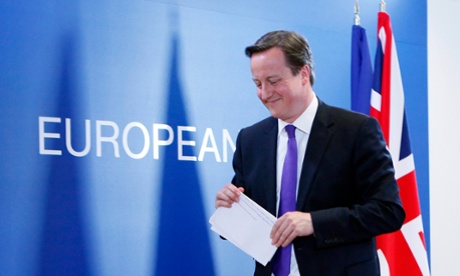
It is amazing that this narrative has been made to stick (the pro-Tory bias of some papers, particularly blatant this time around, has helped). Because the party that actually promises paralysing uncertainty for two years, with the prospect of a national nightmare at the end of it, isn’t Labour. David Cameron’s in-out referendum on the EU would make the current anguish over Scottish votes for English laws look trivial.
There are many Conservative MPs who believe Britain would be better off out of Europe. Their distaste for it is political and visceral: it regulates and interferes, it’s unaccountable and spends vast amounts of money. It’s a small-stater’s nightmare. Some make economic arguments against it too, but in fact Brexit would be a financial catastrophe, costing us as much as 14% of GDP, if studies out this week are to be believed. Douglas Flint, chairman of HSBC, has indicated the bank might move its headquarters from Britain, and a host of business leaders enthusiastically backed Tony Blair when he warned of the consequences of a referendum earlier this month. (The ones corralled by the Conservative campaign into signing a letter to the Telegraph this week warning against Labour government were strangely silent on the issue).
The sad truth is that every British citizen is being made to pay a high price for a Tory family row. As one observer of the party put it to me: it’s as though we’re all being made to foot the bill for someone else’s divorce. The roots of the referendum promise go back at least as far as John Major, when the then prime minister faced down rebels demanding a say on the Maastricht treaty, but paid for it dearly. Cameron, whose modernising movement was partly about burying his party’s reputation for tearing itself apart over Europe, failed spectacularly when he performed a U-turn on his “cast iron guarantee” to hold a vote on the Lisbon treaty. All this was grist to Ukip’s mill, meaning they had to be outflanked, somehow, by Conservative policy on Europe.
And it’s not hard to see how a manifesto pledge on an in-out poll is useful for Tory candidates in marginal constituencies. Without it Nigel Farage and his acolytes would have a stick to beat the Tories with in every interview and on every doorstep. But its usefulness is like that of a dangerous illicit drug. It masks the pain for a short time but comes with an almighty hangover.
Perhaps the greatest irony is that implementation of the pledge would likely bring about the very rift with Scotland Tories have been talking up. In 2016, elections to the Scottish Parliament will be held. Nicola Sturgeon has said that she will not include a second independence vote in her party’s manifesto unless there were a “material change” in circumstances. For this, read a threat to drag her nation, against its will, out of the EU. Sturgeon-watchers say that would be much less likely under Miliband. It’s Cameron, then, who’ll prompt a rerun of the independence referendum that he got through by the seat of his pants. Will the Queen be quite so purring next time around?
However much they might try to throw dirt over it, the unexploded bomb sticking out of the ground of this battlefield belongs to the Tories, and it has EU Ref written on its side. Whoever wins, there will be challenges. But the only realistic prospect of bomb disposal lies with Ed Miliband.