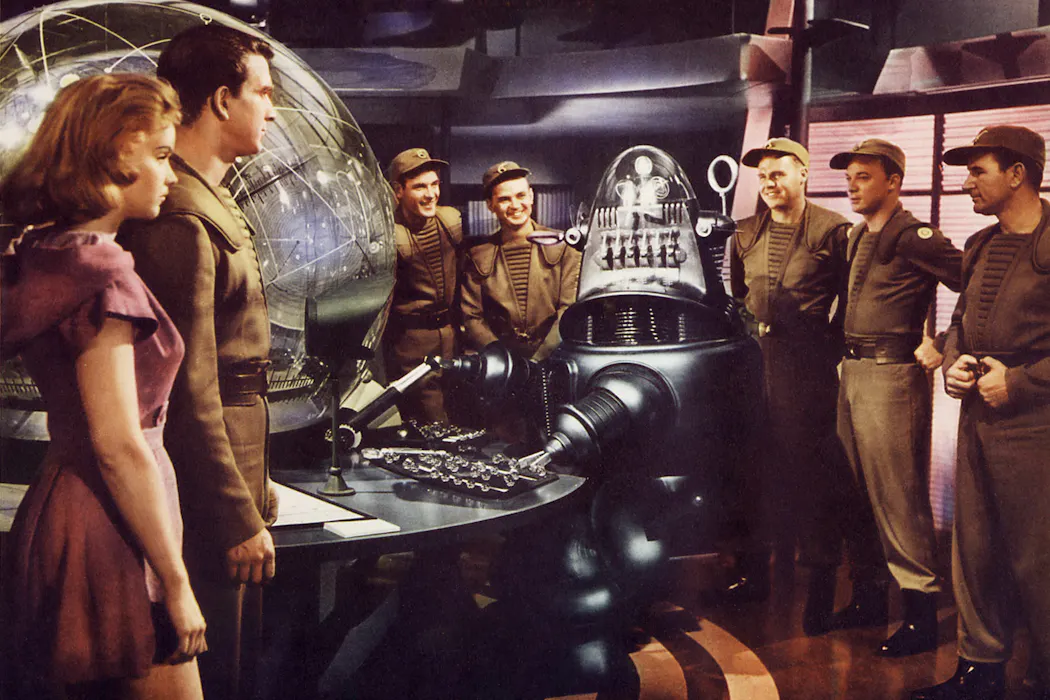
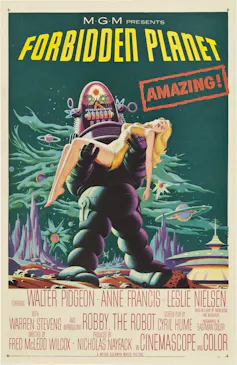
When Forbidden Planet arrived in cinemas in 1956, it was a daring investment in a small genre. At a time when science fiction meant low-budget monster movies and tales of alien invasion, MGM spent big on something far more ambitious: a movie that imagined a world of interplanetary travel, robotics and alien civilisations with real seriousness and scale.
The premise is a familiar sci-fi trope now, but wasn’t then. United Planet Cruiser C-57D crosses the stars using a faster-than-light “hyperdrive” and lands on distant Altair-4. Its mission: find out what happened to the colony there.
The crew, led by Commander Adams (a young Leslie Nielsen), finds Dr Edward Morbius (Walter Pidgeon) living in isolation with his daughter Altaira (Anne Francis) and their mechanical servant, Robby – the screen robot who would go on to be one of sci-fi’s most enduring icons in his own right.
Morbius claims to have unlocked the secrets of the vanished Krell, an ancient civilisation whose technological achievements far outstripped humanity’s. The rest of the colony, he says, were murdered in mysterious circumstances.
The film is interesting to revisit for many reasons, including its interpretation of Shakespeare’s The Tempest, and its legacy in shaping sci-fi cinema. But watching it 70 years after its release, perhaps it is most striking for what it has to say about the rise of artificial intelligence in our own age.
Technology may give us extraordinary new power. But it may also give our deepest, least understood desires a power of their own.
The Tempest, transposed
Loosely based on The Tempest, the script replaced Prospero’s magic with advanced science, the enchanted island with a distant planet, and supernatural forces with the power of an alien civilisation.
Morbius stands in for Prospero, Altaira for Miranda, Robby for Ariel – exiled figures ruling over a world shaped by forces just beyond their understanding.
It’s easy to see this device echoed in later epics like Star Wars (1977), Alien (1979) and Dune (1984). Each takes a familiar human story and inflates it to cosmic scale, trading a single kingdom or family for the fate of entire worlds.
But not everything in Forbidden Planet’s plot is borrowed.
Behind the flying saucers, ray guns and at times unsubtle exposition, is an original idea that now shines through as contemporary and cautionary: the Krell vanished because, at the height of their power, they built a machine that could translate thought directly into physical reality.
In doing so they gave their subconscious minds free rein, and were annihilated by monsters born from their own repressed impulses.
Echoes of the Krell in Silicon Valley
Some of the film’s most striking scenes show Morbius leading Commander Adams through the vast machinery that once powered Krell civilisation – thermonuclear reactors stretching for miles, with enough power to rival an “exploding planetary system”.
The parallel to today’s data-centre build-out, and its voracious appetite for electricity, is hard to miss.
Even more unsettling is the parallel to our own screen addictions.
Early in the film, Morbius demonstrates how he interfaces with the Krell machine via a headset and 3D viewer. Doing so, he boasts, has enhanced his intelligence to superhuman levels.
He has been “plugging in” as often as he can, each time supposedly just chasing a little more of the Krell’s knowledge – but really, we come to realise, for the feeling of intellectual superiority it gives him.
At the film’s climax, Morbius finally understands why the Krell disappeared. What he admired so much as the ultimate evolutionary step – a machine that melded thought and reality – unleashed a “monster from the id”.
Invisible and unstoppable, it tore through the Krell one by one as their own minds turned against them.
The term “id” Morbius reaches for was coined by Freud to describe the primal, irrational part of the subconscious — distinct from the more rational ego and superego.
In 1956, the world had fought two catastrophic world wars in under 40 years, and nuclear weapons had given the id a tool of unprecedented power.
Morbius, reflecting on the Krell’s fate, eulogises:
After a million years of shining sanity they could hardly have understood what power was destroying them.
By the film’s end, Morbius admits the monster on the loose is from his own id, drawing power from the very machine he so admired.
He dies protecting his daughter from the monster, and with his last breath destroys the machine and the Krell planet.
Is AI what we think it is?
Elon Musk recently said AI can lead to “an age of amazing abundance where anybody can have anything they can think of” – the same dream that drove and destroyed both the Krell and Morbius.
Current discussion underwrites that dream, treating AI as our manifest destiny – an inevitable, transformative force we simply need to regulate.
We’re missing a much older, more uncomfortable question: what if AI isn’t new at all? What if it’s just another expression of our most ancient desire for a “brave new world” of better weapons, greater resource exploitation and a more God-like place in the universe?
Forbidden Planet suggests an uncomfortable reading of “AI”: amplified id. Not human intelligence sharpened, but human appetite unleashed.
The Krell did not destroy themselves because their machines failed. They destroyed themselves because their machines succeeded.
This article was originally published on The Conversation. Read the original article.