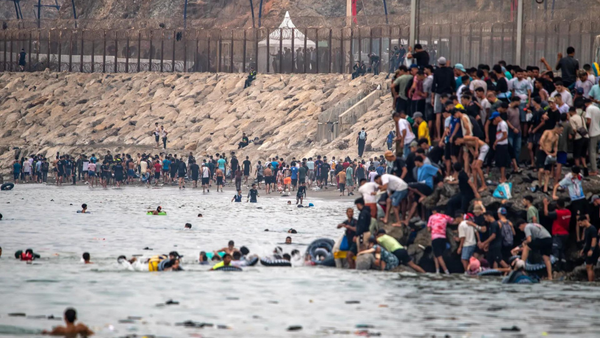
Some 60,000 migrants entered Spain’s north African enclave of Ceuta from Morocco in the space of 24 hours, between Thursday and Friday, leaving at least 34 dead and prompting France to tighten controls along its border with Spain.
Ceuta was struggling on Friday to shelter thousands of migrants, as Spain deployed troops to help manage what quickly became a humanitarian emergency in the small territory.
The influx of some 60,000 people was equivalent to around 70 percent of the enclave’s population of nearly 84,000.
A steady stream of people entered the Spanish territory overnight from Thursday to Friday by land and sea, with many swimming around the breakwater fence separating Ceuta from Morocco. Police said it was impossible to establish a definitive total, with people still crossing on Friday morning.
Many of those who died drowned while attempting to reach the enclave, while others were killed in a stampede near the fence at Tarajal beach, said Rachid Sbihi, who leads a local organisation representing Guardia Civil police officers.
Thousands of migrants, including unaccompanied children, were left without shelter and slept in parks or on pavements, while others wandered through the streets of the enclave.

Humanitarian emergency
Spanish Prime Minister Pedro Sanchez travelled to Ceuta on Friday with his Interior Minister Fernando Grande-Marlaska, as local authorities warned that the enclave was facing a humanitarian emergency.
The breach amounted to “a violation of Spain’s territorial integrity”, Sanchez said during the visit.
The Spanish leader blamed human smugglers for encouraging the crossings, saying they “deceive so many young people, and ultimately lead many of them to their deaths – whether in the ocean or, as in this case, at Spain’s border in the autonomous city of Ceuta”.
More than 25,000 migrants had voluntarily returned to Morocco by Friday, Spain’s Interior Ministry said.

Spain deployed troops to support the Guardia Civil – the Spanish Civil Guard – after the number of arrivals overwhelmed local authorities. The armed forces were tasked with helping maintain security and assisting with the humanitarian response.
Live footage from the frontier showed hundreds of migrants gathered on a hill overlooking Ceuta being dispersed with tear gas by Moroccan forces, while others continued to swim towards the Spanish territory.
Moroccan police deployed additional personnel, using water cannon and firing warning shots in an effort to prevent further crossings, rights groups said.
Morocco’s ambassador to Spain, Karima Benyaich, said the situation had unfolded against her country’s wishes and expressed hope that those who had crossed would return.
Supreme Court ruling
It was not immediately clear what had prompted the mass movement. The number of people trying to reach Ceuta had already increased before the crisis escalated on Thursday, with migrants arriving mainly by swimming from the Moroccan coast.
Authorities in Ceuta and Madrid linked the influx to a Spanish Supreme Court ruling earlier in July that prevented migrants arriving by sea from being immediately returned without due process.
The ruling does not cover those entering Spain by land, including people who climb over the border fence.
Sanchez said the interpretation of the ruling had spread rapidly through human trafficking networks and triggered the mass influx on Thursday.
Attempts were also made to cross into Melilla, Spain’s other north African enclave, where migrants clashed with Moroccan police in the nearby town of Bni Nsar.
A disputed frontier
Ceuta and Melilla – the larger Spanish enclave 400 kilometres to the east – are located on the Mediterranean coast of north Africa. The two autonomous cities form the European Union’s only land borders with Africa.
Ceuta, which covers 18.5 square kilometres, has been under Spanish control since 1580. Its population includes Christians and Muslims, as well as Spanish and Moroccan residents and cross-border workers.
Morocco does not officially recognise Ceuta and Melilla as Spanish territory and frequently describes them as occupied lands.
The enclaves are heavily fortified because they are a destination for migrants seeking to reach Spain from Morocco and other parts of Africa. Some of those who enter are immediately returned, while others are placed in reception centres and can apply for asylum.
Ceuta has repeatedly been a focal point of tensions between Madrid and Rabat.
More than 10,000 migrants entered the enclave over two days in 2021, after Morocco relaxed border controls during a diplomatic dispute with Spain over Western Sahara. The crisis eased in 2022 after Madrid backed Rabat’s autonomy plan for the territory.
Spain remains a major entry point into Europe, although arrivals in Ceuta and Melilla are generally fewer than those recorded through the Canary and Balearic islands.

International response
France said it was prepared to assist Spain and strengthened controls along the Franco-Spanish border in response to the influx.
President Emmanuel Macron ordered tighter checks and said France was ready to provide any assistance requested by the Spanish authorities, including support through the European border agency, Frontex.
French Interior Minister Laurent Nuñez said he had ordered an immediate increase in border checks on Thursday night and activated the Rapid Intervention Border Force to conduct more extensive inspections.
Marine Le Pen, leader of France's far-right National Rally (RN) party, accused the Spanish government of having “encouraged” migrants to enter the country illegally.
“France must immediately strengthen controls at its borders,” Le Pen wrote on social media platform X, while RN president Jordan Bardella called for an emergency meeting of the European Parliament.
Italian Prime Minister Giorgia Meloni threatened to suspend Italy’s open-border Schengen arrangements with Spain “to defend our borders and ensure the safety of our citizens”, although the two countries do not share a land border.
Spain summoned the Italian ambassador in Madrid and rejected claims that its migration policy had caused the crisis.
Danish Prime Minister Mette Frederiksen also said the EU should consider suspending Spain from the Schengen area.
Meanwhile, senior figures in United States President Donald Trump’s administration used footage from Ceuta to attack the Democrats, while Trump warned: “That’s going to be us in three years if the wrong side gets in."
(with newswires)