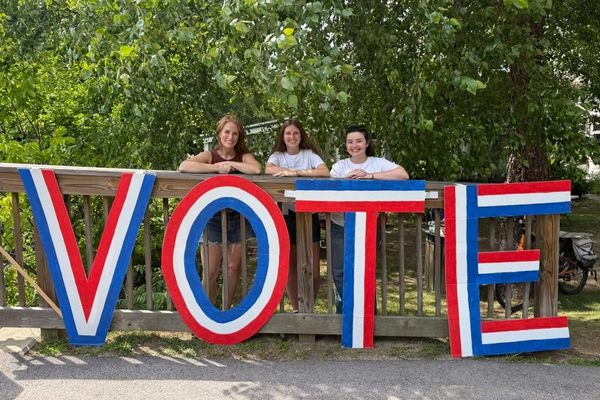
MIAMI — Florida voters choose their party's nominee for governor on Tuesday, August 18, 2026, the state's first contest for an open governor's seat since Ron DeSantis won the office in 2018. Nowhere is the fight for votes more visible than in Miami-Dade County, home to one of the largest — and most internally divided — Latino electorates in the country, spanning Cuban, Venezuelan and South American communities.
DeSantis is barred from seeking a third term under Florida's term-limit rules, leaving a crowded Republican field and a smaller Democratic one to compete for a governor's mansion the GOP has held since the late 1990s.
A Republican Field Chasing the Cuban-American Vote
U.S. Rep. Byron Donalds enters primary day as the clear front-runner, carrying an endorsement from President Trump and a substantial financial edge over his rivals: Lt. Gov. Jay Collins, a former Green Beret appointed to the post by DeSantis; former House Speaker Paul Renner; and investment executive James Fishback, among several lesser-known contenders. A James Madison Institute survey conducted by Targoz Market Research in late July had Donalds at 49% support among Republican primary voters to Collins' 18%, a 31-point gap; a rolling polling average from FiftyPlusOne taken the day before the primary put the margin closer to 24 points, with Fishback edging into second place statewide. Either way, Donalds heads into Tuesday with a commanding lead.
Donalds has built much of his Miami-Dade strategy around Hialeah, the heavily Cuban-American city he visited in May to launch a "Latinos for Byron" coalition. Addressing roughly 300 supporters, Donalds told the crowd that a free Cuba would "always have a friend here in Florida," according to The Floridian. State Rep. Juan Carlos Porras, who has endorsed both Trump and Donalds, used the event to call Hialeah the city with the state's highest concentration of Republican voters.
Doral and the Push for Venezuelan Voters
Donalds' outreach hasn't stopped at Cuban Miami. At a late-July "Defending the Florida Dream" stop in Doral — home to one of the country's largest Venezuelan communities — Donalds appeared alongside Sen. Rick Scott and urged the crowd, many with family roots in Venezuela and other countries that fled socialist governments, to become what he called "the tip of the spear" heading into the primary and November's general election, according to Florida Voice News.
The framing reflects a broader pattern: Republican messaging to Miami-Dade's Latino voters leans heavily on anti-socialist appeals that resonate with exile and diaspora communities from Cuba, Venezuela and, increasingly, Nicaragua and Colombia. Collins and Renner have made fewer targeted stops in Doral and Hialeah than Donalds has, instead emphasizing statewide messaging on insurance costs and affordability that also registers with South Florida's Latino homeowners, many of whom have been squeezed by condo-safety assessments and rising premiums since 2023.

Democrats Consolidate Behind Jolly
On the Democratic side, former Republican congressman David Jolly is the presumptive nominee after his last serious rival, Orange County Mayor Jerry Demings, suspended his campaign in June following a prostate cancer diagnosis — a development that cleared Jolly's path months before voting began. Jolly is running with former U.S. Rep. Gwen Graham as his lieutenant governor pick, and on Aug. 4 the Democratic Hispanic Caucus of Florida endorsed the ticket, calling Jolly and Graham the experienced leadership the state needs. Five lesser-known Democrats — Evelyn Castillo-Bach, Thomas Eloy Fernandez, Dayna Marie Foster, Dotie Joseph and Stephann Norman — also appear on the primary ballot.
Jolly, who left the Republican Party in 2018 and only registered as a Democrat in April 2025, has centered his campaign on property insurance costs, public education funding and reproductive rights rather than the identity-based appeals Republicans are running in Hialeah and Doral. Any general-election path for Jolly would likely require winning over moderate and independent Hispanic voters who have drifted toward the GOP over the past decade.
What Miami-Dade's Numbers Show
The scale of what's locally at stake shows up in the county's own data: as of Aug. 3 — the day early voting opened — Miami-Dade's Supervisor of Elections office counted 796,145 registered Hispanic voters countywide, more than any other racial or ethnic group in the county. Of those, 345,025 are registered Republicans versus 177,579 Democrats, with the remaining roughly 273,500 registered with no party affiliation or a third party — a bloc both campaigns are still trying to move.
That registration gap helps explain why Republican outreach in Miami-Dade has grown more targeted by country of origin rather than treating "Hispanic voters" as a single bloc, while Democrats are leaning on institutional endorsements, like the Hispanic Caucus's backing of Jolly, to try to close it.
Down-Ballot Races Latino Voters Are Also Watching
The governor's primary shares the ballot with other races carrying diaspora significance. In Miami's Congressional District 27, Republican Rep. Maria Elvira Salazar faces a primary challenge from attorney Vincent Michael Arias, while former federal prosecutor Robin Peguero and former television anchor Eliott Rodriguez compete for the Democratic nomination in a district election forecasters have shifted from "Solid Republican" to "Likely Republican". In the neighboring 26th District, anchored in Cuban American communities near Doral and Hialeah, longtime Rep. Mario Diaz-Balart faces no primary opposition, though Democrats there are choosing between Yurina Gil and Nicole Locklin.
Polls close statewide at 7 p.m. Tuesday, with primary winners advancing to the Nov. 3 general election, where Democrats hope to end more than three decades without a governor — a drought dating back to Lawton Chiles' 1994 reelection. Because Florida runs closed primaries, only voters registered with a party can cast a ballot in that party's governor's race, meaning the roughly 251,500 Hispanic voters in Miami-Dade registered with no party affiliation will sit out Tuesday's contest entirely and won't have a direct say until November — a dynamic both campaigns are already weighing in their fall planning.