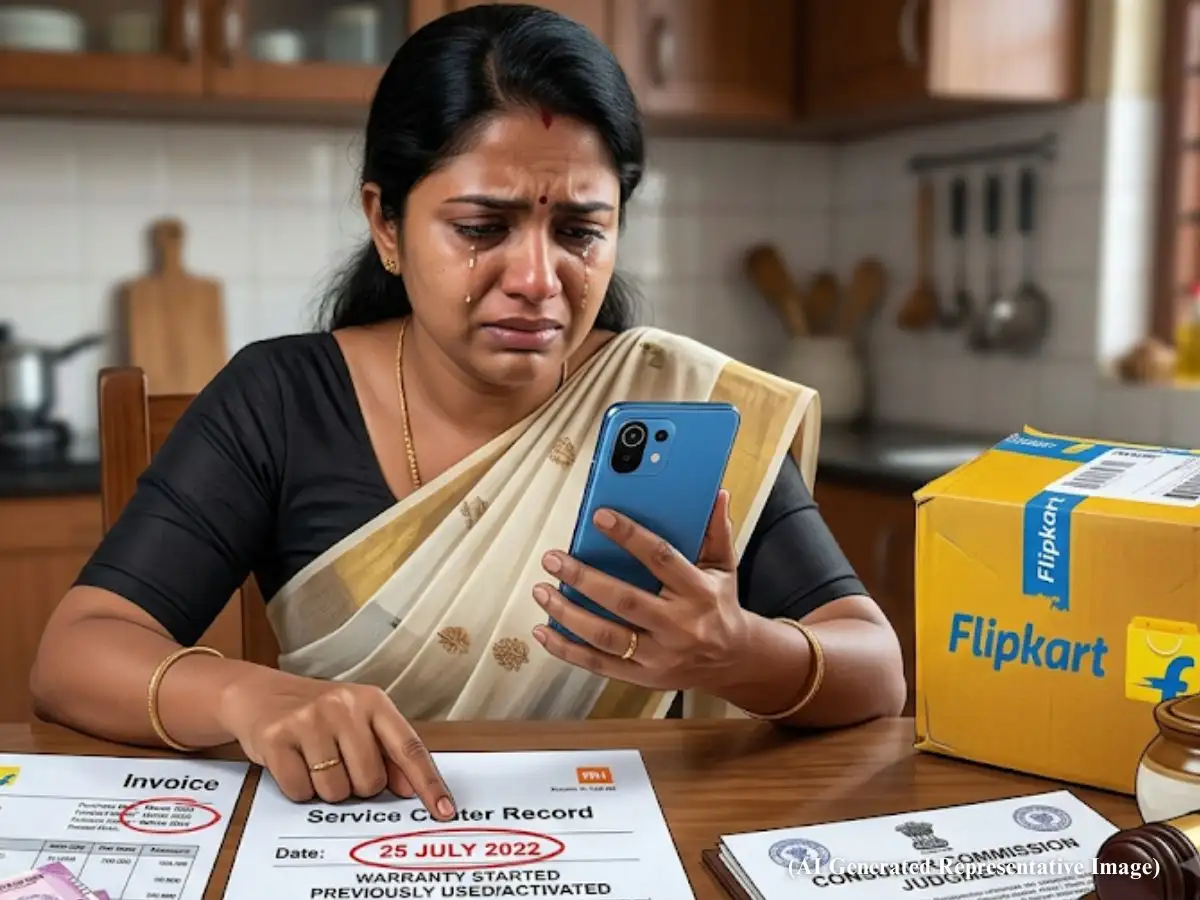
When Shinju K, a resident of Chokli in Kannur district, ordered a Xiaomi 11 Lite NE on Flipkart in March 2023, she expected a brand new phone. What she got, according to a Kerala consumer commission, was a device that had already been used by someone else, with a warranty that had been running for eight months before it ever reached her doorstep.
The District Consumer Disputes Redressal Commission in Kannur has ordered Flipkart to pay her Rs 38,990, covering the full price of the phone, compensation for mental agony, and litigation costs.
A warranty card that told a different story
Shinju placed her order on 10 March 2023. The phone was delivered on 19 March 2023. She paid Rs 23,990 for it.
The phone worked for a while. Then it stopped. When she took it to the Xiaomi service centre in Thalassery on 6 July 2023, the inspection report described the device as "dead" with the remark "does not boot." The recommended repair was a full mainboard replacement.
But the service record revealed something more troubling than a hardware failure. It showed the warranty start date as 25 July 2022, with the warranty set to expire on 25 July 2023. The phone Shinju had purchased as new in March 2023 had, by Xiaomi's own records, been activated and under warranty since the previous year. By the time she received it, more than eight months of her one-year warranty had already elapsed.
The commission found that this was not a clerical error. It was evidence that the phone had been sold to someone else before it reached Shinju, and that Flipkart had delivered a previously used, defective device to her as a new product.
Flipkart's intermediary defence, and why it did not work
Flipkart appeared before the commission and filed a written response. Its argument was a familiar one in e-commerce disputes: that it functions only as an intermediary platform, that sellers are responsible for the products listed on it, and that post-sale issues including delivery, customer satisfaction, and returns are the seller's responsibility, not Flipkart's.
The commission rejected this position.
This is a significant aspect of the ruling. Indian courts and consumer commissions have been increasingly sceptical of the intermediary defence when e-commerce platforms are directly involved in the transaction chain. The Information Technology Act does provide certain protections to intermediaries, but consumer commissions have consistently held that those protections do not extend to cases where the platform is the entity the consumer transacted with, paid money to, and received the product from.
In Shinju's case, Flipkart was the opposite party on the invoice, the order confirmation, and every piece of correspondence. The commission found it could not use its role as a marketplace to escape liability for delivering a used phone as new.
Flipkart produced no oral or documentary evidence in its defence. The commission relied entirely on the nine documents submitted by Shinju, which included the tax invoice, the order confirmation, the warranty card, the service record, call history, and the lawyer notice she had sent to Flipkart in May 2023, which went unanswered.
What the commission ordered
The commission directed Flipkart to pay Rs 23,990 as the full value of the phone, Rs 10,000 as compensation for mental agony, and Rs 5,000 as litigation costs, totalling Rs 38,990.
The order must be complied with within 30 days of receipt. If Flipkart defaults, the principal amount of Rs 23,990 will attract interest at 12 per cent per annum from the date of the order until full realisation. Once payment is made, Flipkart is entitled to take the phone back from the complainant.
Why this matters beyond one case
Warranty date mismatches on products delivered through e-commerce platforms are not uncommon, and consumer advocates have long flagged the practice of returned or refurbished devices being relisted and sold as new without disclosure to buyers.
Under the Consumer Protection (E-Commerce) Rules, 2020, e-commerce platforms are required to ensure that sellers on their platform do not adopt any unfair trade practice. The rules also require platforms to display accurate information about products, including whether they are new, refurbished, or used. Selling a previously used device as new, without disclosure, falls squarely within the definition of an unfair trade practice under the Consumer Protection Act, 2019.
The Kannur commission's ruling reinforces that when something goes this visibly wrong, platforms cannot simply point to the seller and walk away.
Check the case judgement here: