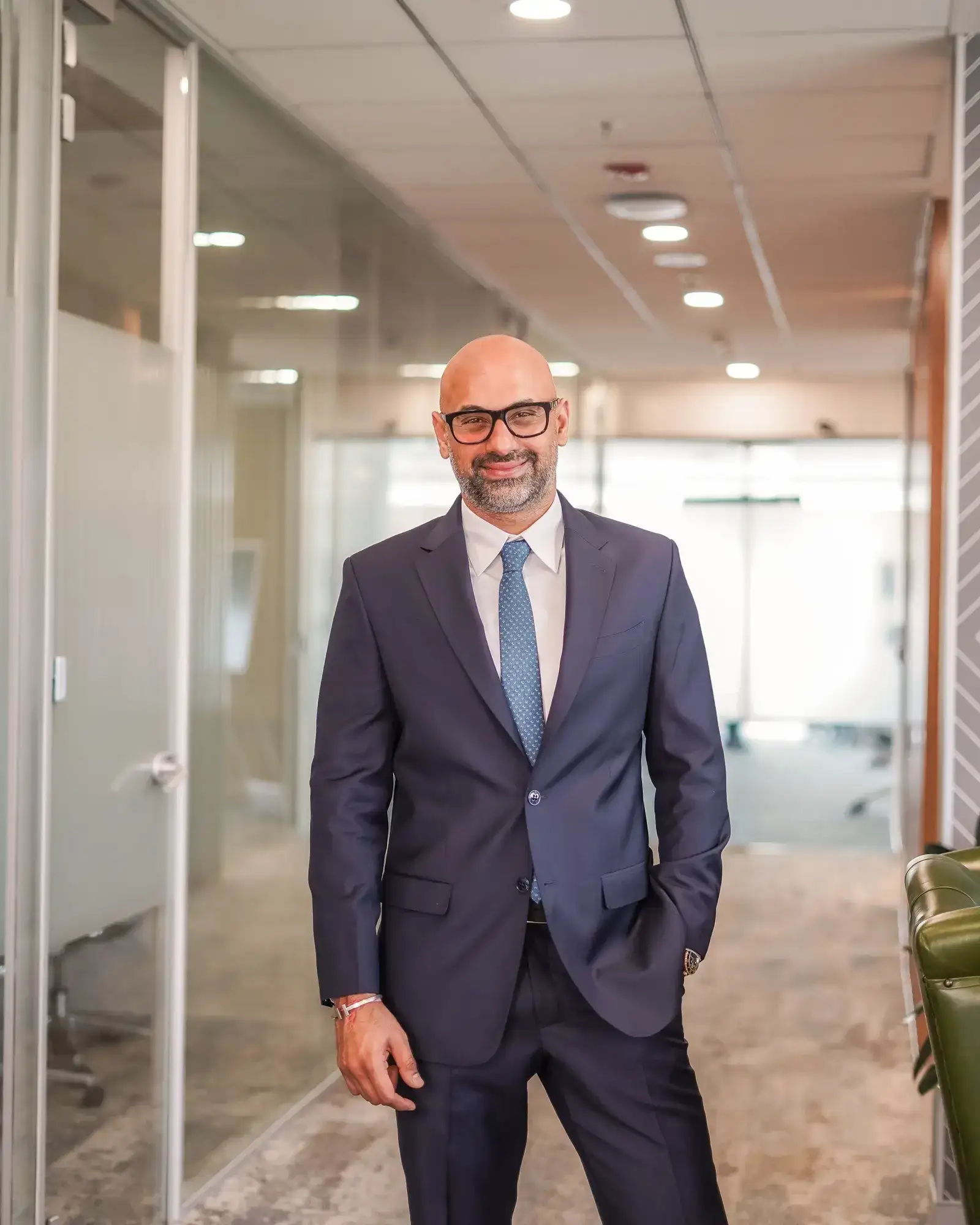
The proliferation of GCCs in India is revolutionizing commercial property, and firms like Table Space are convinced that the upcoming office infrastructure will focus on agility, adaptability, and customised enterprise features instead of enduring traditional lease agreements. In an interview with The Economic Times Digital, Karan Chopra, Co-CEO of Table Space, discusses why managed workspaces are the choice for global firms entering India, how GCC demand is boosting the company’s expansion in major cities, and why he views future workspace providers as more like technology and hospitality businesses than real estate firms. Edited excerpts.
TheEconomic Times (ET): What was the idea behind starting Table Space and what did you want to achieve?
Karan Chopra (KC) : The honest answer is that we saw a market that was being served and not being understood.
Global enterprises were coming into India with serious ambitions. They weren't looking for a hot desk and a coffee machine. They needed real infrastructure, real customisation, real accountability from a partner who would treat their workspace the way they treated their own business. That partner didn't exist in any meaningful form.
The traditional real estate players thought in terms of square footage and lease tenure. The co-working players thought in terms of community and cool aesthetics. Nobody was thinking about the enterprise's actual operating reality. The security protocols. The workforce density. The need to go from zero to a thousand people without losing eighteen months to construction and fit out timelines.
We started Table Space in 2017 with one clear belief: world-class companies deserve world-class workspaces, and that the two things should never be in conflict with each other. Enterprise-grade quality and real flexibility are not opposites. We built a business to prove exactly that.
ET: With GCCs evolving into full-fledged innovation and decision-making hubs, do you believe the traditional office model is becoming obsolete and can co-working or flex managed workspaces realistically meet the complex needs of large GCCs?
KC : I would push back gently on the framing of the question. The traditional office model isn't becoming obsolete. The traditional procurement model for offices is.
The idea that a GCC must spend 12 to 18 months negotiating a lease, another 12 months doing construction, fit-out, and then sit locked into a building for a decade regardless of what the business does in that period, that model is what's broken. The physical office, a dedicated, high-quality, custom environment where serious work gets done, that's not going anywhere. If anything, as GCCs take on more complex mandates, the quality of the workspace becomes more important, not less.
What enterprise managed workspace partners like Table Space offer is a different relationship with the infrastructure. You get the environment that a large, sophisticated enterprise needs without the capital burden, the management overhead, and the inflexibility that conventional real estate demands. Over 90% occupancy across our portfolio tells you that enterprises aren't settling. They are choosing this model deliberately.
ET : You have suggested that flex managed workspace is becoming the default entry model for global firms in India. What is driving this shift, and are there specific types or sizes of GCCs for which this model works best or doesn't?
KC: The decision to locate in India is not just about cost, though the economics are compelling at $150 to $250 per seat per month versus $800 to $1,200 in a US tier-one city. India produces 2.5 million STEM graduates annually, holds more than a quarter of the world's STEM talent, and its GCC workforce is projected to grow from 1.9 million today to 4.5 million by 2030. The workspace is the bridge between that strategic decision and that talent ecosystem.
Three things are driving the choice for flexible and within thin enterprise managed workspaces and they reinforce each other.
First, the speed imperative. India has become a priority market for global firms, and the numbers tell you why. There are over 1,800 active GCCs in India today, up from 600 in 2015, with one new center established every three days. When a board approves India expansion, they want results in quarters, not years. The Table Space capability to be operational in as little as 90 days changes the entire conversation.
Second, the risk calculus has shifted. GCCs typically start with 100 to 500 seats and scale to 500 to 2,000 and beyond sometime in less than 18 months. Signing a long-term lease at the beginning of that journey carries real exposure. Flexible workspaces let you scale your commitment as your confidence and your headcount grow together. That's good capital discipline.
Third, the quality bar has risen significantly. Custom-built environments, enterprise security infrastructure, dedicated floors, branded reception, the whole experience is indistinguishable from a self-managed facility today.
On who this model works best for: first-time India entrants, companies scaling aggressively with low headcount predictability, and organizations managing multi-city footprints. It also extends well beyond traditional IT and BFSI, with 55% of new GCC leasing now coming from engineering and manufacturing. Where it requires more co-creation is for operations with highly specialized or classified infrastructure needs. Solvable, but those conversations need to start earlier.
ET : GCCs today require high levels of data security, compliance, and customization. How feasible is it for co-working-style environments to deliver on these enterprise-grade requirements without compromising flexibility?
KC : This is the question that separates enterprise managed workspace operators like Table Space from the coworking players, and I think the industry hasn't always been honest about the distinction.
Traditional coworking cannot meet these requirements. Period. Shared networks, transient populations, open floor plans, these are fundamentally incompatible with the security posture that a serious GCC needs to maintain.
But that's not what we do. Our model is enterprise managed workspaces - from Day 1 of our inception - we have not deviated from that choice. Custom-built, dedicated, private, enterprise-designed environments where the client controls access, specifies the IT and network architecture, and operates within a physical perimeter that is entirely theirs. We build to their compliance requirements, not to a generic standard.
The same thinking runs through our ready-to-move-in Suites. These are not generic, plug-and-play spaces dressed up for enterprise. They are built from the ground up with enterprise occupancy in mind, which means the infrastructure, the access controls, the network readiness, and the privacy standards are already in place before a client walks in. The speed is a feature. The enterprise-grade quality is non-negotiable.
The flexibility lives in the commercial and operational model, not in the physical boundaries. Your space is yours. The terms under which you hold it, and the ease with which you can scale it, that's where the flex comes in. These are not in conflict, but you have to be purpose-built for enterprise to pull it off.
ET : Speed-to-market seems to be a major advantage for managed office spaces. How critical is this 90-day readiness window in influencing board-level decisions for GCC expansion in India?
KC : It's more critical than most people outside this industry realise, and I will tell you why.
When a global company makes the decision to establish or expand a GCC in India, there's a window. A window of organizational momentum, of budget availability, of competitive urgency. If you tell that leadership team, they need to wait 18 months to have a functioning office, that window can close. The decision gets revisited. Other markets get considered. Timelines slip and sometimes they slip permanently.
90-day readiness solves a big logistics problem. It keeps the decision alive. It converts intention into execution. And for the people championing the India expansion internally, it removes the single biggest risk to their credibility, which is promising something that the organization can't deliver quickly. Table Space delivers a custom-built workspace in as low as 90 days and with our enterprise grade ready-to-move-in Suites - you get operational in less than 24 hours!
We delivered 3.2 million square feet in FY 2025-26 with 20 of those projects above 50,000 square feet each. That level of execution at that scale, running 75 projects simultaneously across 8 cities, requires an operational infrastructure that most organizations simply cannot build in-house. When a board sees that capability, it changes the conversation.
ET : From a business standpoint, how does the revenue model for flex managed workspace providers like Table Space work when catering to GCCs? Is it primarily lease arbitrage, service-led pricing, or a hybrid model?
KC : I would describe it as something more evolved than any of those three labels fully capture.
Pure lease arbitrage, buying cheap and selling expensive, is a commodities game. It's fragile and it doesn't build a real business. Service-led pricing alone doesn't account for the significant capital we deploy to build these environments. What we've built is fundamentally a Workspace-as-a-Service model.
The client pays for a complete operating environment: the space, the infrastructure, the management, the ability to scale up or down. We take on the real estate risk, the capital expenditure, the ongoing facilities management, all of it. In return, we price for the value of that certainty and that capability, not the square footage alone.
What this means in practice is that our revenue is not transactional. We have long-term relationships with over 425 clients, over 90% of our revenue comes from global enterprises, and our occupancy across mature centres sits above 90%. That's a recurring revenue business with strong client retention, which is very different from the traditional real estate model and very different from co-working arbitrage.
ET : Can you share insights into the scale of revenue of this segment? How much has the GCC-focused managed workspaces generated so far, and how significant it is within your overall business?
KC : GCCs are at the core of what we do, not a segment of it. When you look at our client base, 125 of our enterprise clients are GCCs. That is 1 out of every 3 clients in our portfolio. These are not small accounts. These are large, complex, multi-city relationships with organizations that are Fortune 50 and Fortune 500 companies operating their India centers through us.
The growth story is what I find more telling than any single revenue number. In the span of one year, we expanded our portfolio from 9.9 million square feet to 11.5 million square feet, delivering 3.2 million square feet across 125 enterprise projects in FY 2025-26 alone. Pan-India delivery grew 45% year on year. Mumbai grew 250 to 300%. Hyderabad grew approximately 200%. NCR crossed 1 million square feet of total delivery within a 12-month window. GCC demand is the engine behind a significant portion of that growth.
We now operate across over 80 centers in 8 cities, with over 75 projects running simultaneously at any given point. Above 90% occupancy across a leasable area of 10.2 million square feet tells you that this is not speculative supply. It is demand being absorbed in real time, by real enterprises with long-term commitments.
GCC clients define our product direction. Their requirements for customization, security, scale, and speed are what push us to continuously raise our own standards. They are our most demanding clients, and that is exactly why they make us better.
ET : As GCCs move up the value chain into AI, product engineering, and global leadership roles, how are workspace providers rethinking design, amenities, and location strategy to attract and retain top-tier talent?
KC : The workspace is now a talent strategy. When a GCC is doing AI research or product engineering at a global level, the people doing that work have options. They can be in San Francisco, in London, in Singapore. The reason they choose India, and the reason they choose a particular operator within India, is shaped significantly by the environment they will work in every day.
Location is where it starts. Our centers across Bengaluru's ORR and Whitefield, Hyderabad's HITEC City and Kokapet, Pune's Kharadi and Balewadi, NCR's Cyber City and Aerocity, Mumbai's BKC and Worli, none of that is arbitrary. Every location is positioned relative to where senior technology professionals actually want to be.
But location is table stakes. The real differentiation happens inside the building. We have built a dedicated Client Excellence Group whose entire mandate is ensuring that what an enterprise experiences on day one is what they experience on day one thousand. Through DESYN, our design and build offering, we work directly with clients to translate their culture and work patterns into physical environments that support deep work, collaboration, and the kind of spontaneous exchange that produces real innovation.
And then there is ROBi, our in-house autonomous service robot deployed across our managed offices to handle routine operations and elevate the everyday experience. It is a telling signal of where this industry is heading. The best workspace operators will increasingly look less like real estate companies and more like hospitality and technology businesses that happen to run offices.
ET : Looking ahead, do you see co-working and managed office spaces becoming a long-term structural solution for GCCs in India, or will companies eventually revert to owning or leasing traditional office spaces once they scale?
KC : Let me separate two things the question conflates. Co-working and managed workspaces are not the same product, and the long-term answer is very different for each.
Generic co-working was never a serious long-term solution for large GCCs. Shared infrastructure, transient populations, no real customization. It works for small teams in early stages and that's where it should stay.
Managed workspaces are a different proposition entirely. Dedicated, custom-built, enterprise-grade environments where the client owns the experience and we own the complexity. That model does not have a natural ceiling. If anything, it becomes more valuable as a company scales, not less.
The CFO of a large multinational has figured out something important: real estate is not their core competency and it shouldn't consume their leadership's attention. Self-managing means hiring a facilities team, managing vendor relationships, navigating regulatory complexity across multiple cities, and carrying capital on the balance sheet for an asset class that has nothing to do with their business. The companies staying with managed workspaces at scale are not doing so because they haven't grown up. They've simply run the numbers.
What changes as companies scale is the nature of the relationship. It becomes more bespoke, more deeply integrated with the client's systems, culture, and long-term real estate strategy. Not simpler as they get larger, but more sophisticated. That is precisely where we are taking this business. And given that India's GCC story is still in its early chapters, the structural opportunity ahead is significant.