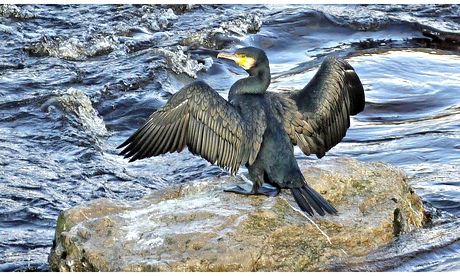
With their ungainly gait cormorants are perhaps unlikely to top the list of Britain’s favourite birds. And yet when I trained my binoculars on three that stood with wings outstretched in the afternoon sun, the fleeting beauty of their feathers became clear.
Each bird reflected a distinctive iridescence. There were indigo chest feathers on one, greenish crown and tail feathers on the second, burnished brass shimmering across the wings of the third.
Even before fossil evidence confirmed the reptilian ancestry of birds the thought must have crossed the minds of many that there was a hint of dinosaur about the cormorant: wing feathers like scales, startling emerald eyes, agitated head movements, and the confident demeanour of a consummate predator.
We watched them slip back into the turbulent river, ride the current then turn to hold station facing upstream, waiting for the river to deliver food. Three dives, three meals. Increasing numbers of cormorants have wintered inland on lakes and rivers since the 1980s and they can come into conflict with the interests of recreational anglers. Human-built lakes that have been expensively stocked with fish are, from this animal’s perspective, as attractive as a bird table is to a blue tit. Under Defra licence more than 13,000 cormorants have been legally shot under since 2003.
They are no strangers to the sound of gunfire. A 19th-century account described shooting wary swimming cormorants with flintlock weapons as “something of a challenge” because “the first flash used to send the cormorant down, so quick was his eye”.
They might have been adept then at evading musketry but one unfortunate bird didn’t see an express train coming. In 1857 the Rev Francis Orpen Morris, in his book A History of British Birds, related the tale of a cormorant “struck down and killed by the funnel of the engine of an express train as it was crossing the Lock of Spynie, in Elginshire, on 20 September 1852”. It may have been the first recorded instance of a bird killed by the new-fangled technology of the steam locomotive.