Fireworks events in various parts of Japan are being canceled one after another because the costs of hiring security staff are rising.
With labor shortages becoming serious, people are tending to avoid security guard jobs for reasons such as low pay and the work being hard and dangerous. It is difficult to recruit young people as security workers and the current guards are getting older. In order to keep these traditional summer events alive, donations have even been sought on the internet.
'Can't secure guards'
The Kishiwada city government in Osaka Prefecture has been organizing the Kishiwada Port Festival fireworks since 1953. An official of the city office was told by a local security company in charge of the event to hike the pay for security guards.
"With the same pay as before, we could not secure a sufficient number of guards. We hope to increase security costs per guard by 2,000 yen."
At last year's event held on July 29, 265 security guards were deployed. If the city government increases labor costs as requested while hiring the same number of guards, their total personnel expenses would amount to about 5.2 million yen, up about 500,000 yen from last year.
Every year, the city government shoulders 70 percent of the costs of the event. The additional burden accompanying the increased labor costs would be a heavy one. Moreover, development in areas surrounding the venue has brought increased traffic that is difficult to regulate. For these reasons, the city government decided to cancel this year's fireworks event.
In Misato, Saitama Prefecture, where a fireworks event is held during the Bon holiday period every year, the cost of hiring security staff last year was up 30 percent from five years before. Bad weather forced the town office to cancel last year's event, and this year it was forced to announce that the event was canceled again, this time because it has been running a deficit for the past few years.
The Katsuragi city government in Nara Prefecture also decided to cancel a fireworks event this year because labor costs have increased by about 20 percent over the past three years.
Aging of security staff
According to the National Police Agency, the number of security workers in the nation has been about 540,000 for the past five years. But they are aging. Last year, about 240,000 security guards were 60 or older, accounting for 43 percent of the total, while the number of guards aged 70 or older increased by about 10,000 from the previous year to over 60,000.
The effective ratio of job openings to job applicants for security-related jobs, including security guards, was 7.11-to-1 as of June this year, far exceeding the average job-to-applicant ratio across all industries of 1.62-to-1. The shortage of workers seems to be causing labor costs to skyrocket.
The Tokyo-based general incorporated association All Japan Security Service Association cites several reasons for security guard jobs being avoided, such as low wages; the job having a reputation as being dangerous and hard; and difficulty in seeing how to improve skills. Although labor costs are rising, a survey by the Health, Labor and Welfare Ministry shows that the average monthly wage for a security guard was 202,000 yen in 2017, significantly lower than that of the average worker at 304,000 yen.
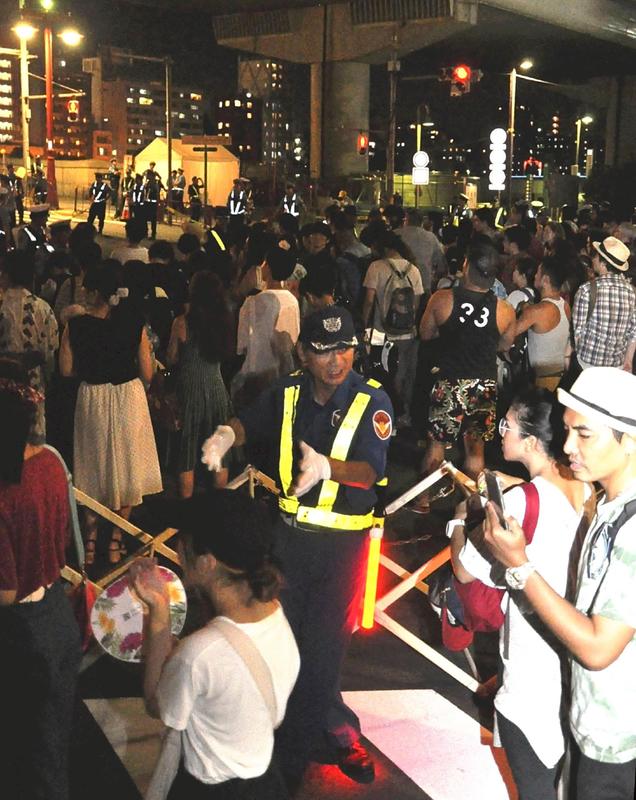
The need for security guards is illustrated by incidents such as one in July 2001 in which 11 people died in a crush at a fireworks festival in Akashi, Hyogo Prefecture. It has become more and more important to ensure safety in crowds, thus requiring more security guards during events.
At the Sumida River Fireworks Festival in Tokyo, which is visited by about 900,000 people every year, the number of security guards has increased by more than 10 percent over the past five years to about 1,600. Personnel expenses increased by 30 percent to about 31 million yen.
Online fundraising
The Sendai Tanabata Festival fireworks, held in Sendai every summer, attract a crowd of about 500,000 visitors. The organizer of the festival has used crowdfunding, a method of raising funds online, since 2016. This year 2.09 million yen was raised through crowdfunding for the festival, which was held on Aug. 5. Labor costs for security guards have reportedly increased by 20 percent over the past three years, and an official of the event organizer, Junior Chamber International Sendai, said: "In order to secure the safety of visitors, we cannot reduce the number of security guards. We will ask for cooperation going forward."
The Tenjin Festival is known for an event called Funatogyo, where boats come and go on the Okawa river through central Osaka and about 5,000 fireworks are launched. Its organizers have also used crowdfunding since 2015, raising about 3 million yen each year.
Toshihiro Kawaguchi, a professor of crowd safety at Kansai University's Faculty of Societal Safety Sciences, said, "Organizers are required to consider various measures such as introducing information technologies to analyze congestion and strengthening cooperation with police. If they cannot have confidence in securing safety even after taking such measures, they should consider cancelling or downsizing an event even if it is traditional."
Read more from The Japan News at https://japannews.yomiuri.co.jp/