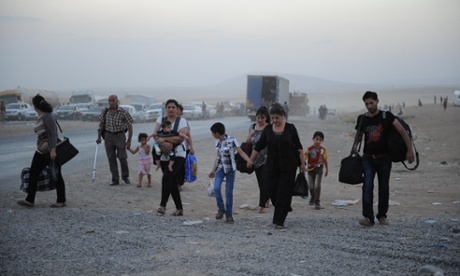
It’s hard when you go into a refugee camp or a host community and there is a real connection with someone. For me that’s the hardest thing. I choose to be here and do this job and if it all gets too much I can go home. But if I meet someone who is the same age as me and she is a mother of four, lives in a tent in a refugee camp, and her husband has no means of income, it’s hard emotionally when you realise that we live in the same world, but we have such completely different lives.
I came to Iraq in January, but I’ve been working with Syrian refugees for a couple of years: in Jordan in the Zaatari refugee camp and before that in Lebanon. In Iraq, some refugees live in camps and some live in the host community. Although there are two nationalities (Iraqi host communities and Syrian refugees) the majority of Syrians have come from the Kurdish region of Syria, and are living here in the KRI (Kurdish region of Iraq). There’s an affinity between the two Kurdish populations. You hear “our Kurdish brothers and sisters” when talking to people in the communities.
Mercy Corps works with Syrian refugees and Iraqis displaced by fighting in western and central Iraq. We provide food, cash assistance and water and sanitation assistance because the displaced people are living in pretty rudimentary shelter. I’m proud that we don’t go for the easy option and that we always try to work in the areas where there aren’t many other humanitarian agencies, or where access and security present more of a challenge.
The Kurdish region is considered much more stable than the rest of the country, so I do have a certain amount of freedom. We are able to move about the city and we are not living within a closed-off compound. That said, Iraq is Iraq, and you’re always conscious that you live in a country that has active fighting, and you’re next to a country that is also at war. That doesn’t ever really leave your mind.
There are certain areas of the city that are “no-go” areas, and certain times of the day when we don’t move around the city. Sometimes we have a curfew in place, or there are certain streets or neighbourhoods we don’t visit.
Security becomes such an integral part of the planning work that you do. Right from the beginning you think: “Yes, we can work here but with these restrictions”, or “No, we can’t work there but we might be able to work there in the future.” When something real and immediate happens, like a recent bomb that exploded in the city, you have steps to take to make sure that everyone is safe. You make sure that if people are on the road you know their exact location and that they are out of harm’s way.
One of the unfortunate things about working in this environment is potentially being in the wrong place at the wrong time – you can end up being collateral damage rather than being specifically targeted. But then again it comes back to planning. There are certain threats we know exist, we just have to find a way to work around the perimeters of our safety protocols to try to avoid being directly affected.
Between missions I try to take a decent break to disconnect with the mission I’ve just finished. For me that’s seeing my family, sleeping in my own bed, and making a cup of tea in my own kitchen. You really appreciate things like 24-hour power and being able to switch a tap on and drink a glass of water. You also have a mixture of feelings. For me it’s relief, exhaustion, and a bit of self-deprecation – you always feel like you could have done more. You have to get used to that and realise that you have to do what you can in the time that you’re here. And then you have to go home and find a way to switch off.
As soon as you land in-country it’s full-on and you have to be able to fully embrace and engage in what’s happening on that particular programme and in that particular country. But I’m an aid worker, this is who I am. I go where there’s a humanitarian emergency and I try and do the best that I can.
We’re so in the thick of it out here that we sometimes don’t take that step back to think: “Why do I do this job?” We’re providing assistance, sure, but we also get a huge amount out of it ourselves: we get to experience places that we would never normally go to; we get to meet people that we’d never normally meet. Some of the people I’ve met are so inspiring. I have found myself wondering “Where do you get your positivity from?” I meet people who have grown up in a refugee camp, who cannot go to school or cannot find a job yet have such incredible hopes and dreams. It’s really inspiring and I don’t think you’d get exposure to that unless you were doing this kind of job. As much as it is tiring and long with hard hours, you feel pretty privileged to be exposed to this kind of work and environment.
Helen Tirebuck was speaking to Katherine Purvis.
Would you like to share your story of working in the field? Email globaldevpros@guardian.co.uk with ‘Field post’ in the headline.
Read more stories like this:
- Aid worker in Yemen: ‘Kidnapping is seen as a very easy way to make money’
- ‘A patient was killed and hospital staff were beaten trying to protect him’
- Quiz: what do you know about humanitarian workers?
- Advertisement feature: NGO workers targets of international kidnappings
Join our community of development professionals and humanitarians. Follow@GuardianGDP on Twitter.