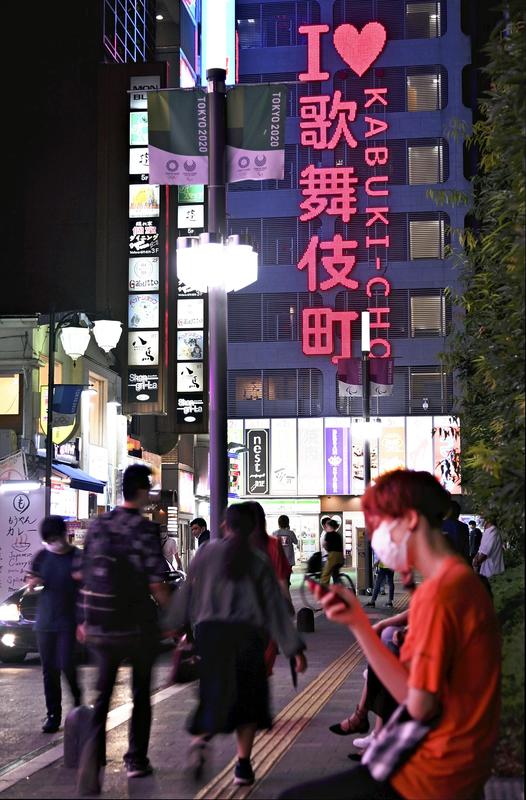
Less than 10% of customers in so-called host clubs in the Kabukicho district in Shinjuku Ward, Tokyo, use masks amid wide spread infections of the novel coronavirus, a team of medical researchers announced in the Monday release of its interim report.
A National Institute of Infectious Diseases research team conducted field studies on numerous clubs in the district where a large number of infections were seen at night-life establishments -- mainly bars and nightspots in which employees entertain patrons.
The team examined activity at the host clubs -- bars at which male employees entertain female customers -- and found that the percentage of customers wearing masks was from less than 10% to as many as several dozen percentage points.
"It is imperative that both customers and employees properly wear masks," Tomimasa Sunagawa, chief of the No. 2 division of the institute's Infectious Diseases Surveillance Center, said at a press conference at the Shinjuku Ward Office.
The team had been examining host clubs in the Kabukicho district since July. It held hearings on those responsible for the management of the host clubs and conducted surveys on their employees.
Said Sunagawa about the low percentages of customers wearing masks: "I think they want to expose their faces and to view the faces of employees, but they must only remove the masks when they eat and drink, and must wear masks when they speak with employees."
He also pointed out problems on the part of the host clubs. For instance, the employees spoke increasingly louder as they became intoxicated.
Sunagawa also pointed to matters such as the difficulty of ventilation for host clubs located on basement floors. He offered measures to deal with such problems.
"Managers should send home employees who are heavily intoxicated. They also need to create paths for air flow by using fans or air circulators," he said.
The team plans to conduct inspections on about 20 more host clubs before winter, when the number of infections might again spike, and compile those results. It also considers holding inspections at dormitories in which groups of host club employees reside.
Read more from The Japan News at https://japannews.yomiuri.co.jp/