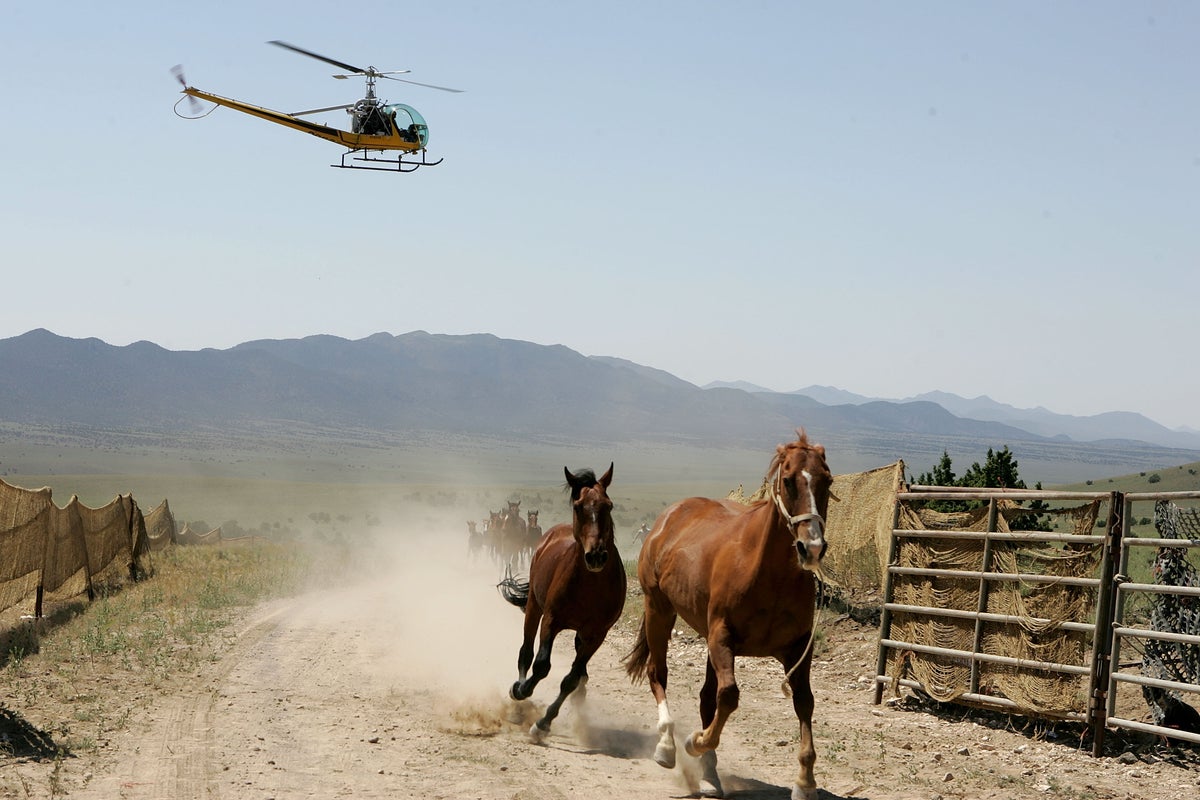
More than 14,000 wild horses are to be removed throughout the West this summer by federal agents using controversial helicopter round-ups.
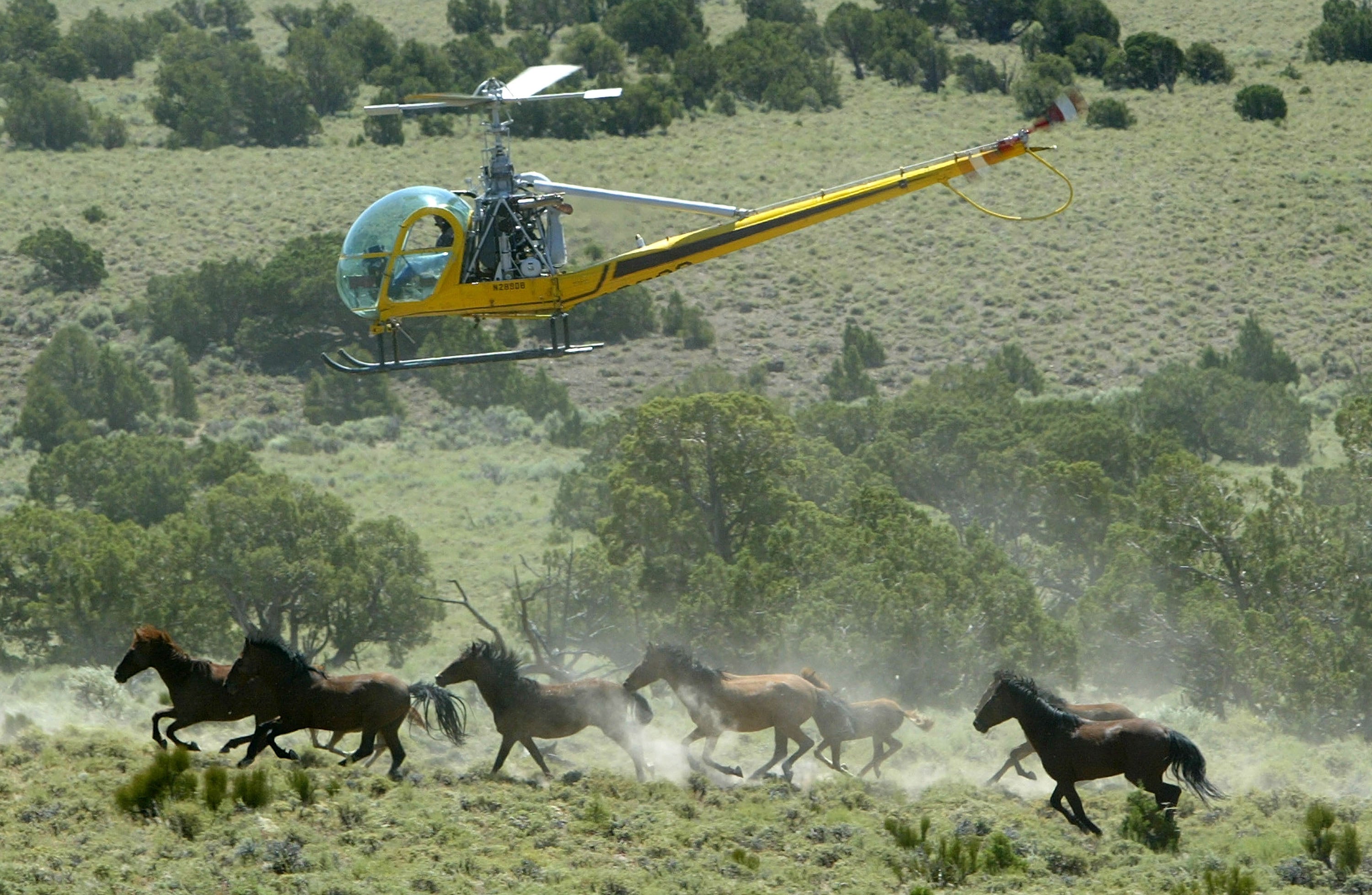
The planned removal, by the Bureau of Land Management, is due to increasing threats of drought and wildfire in western states, leaving little food and water for the wild animals. The agency plans to use helicopters to drive mustangs from above and push wild horses into corrals.
Wild horses will be removed from several Western states, including Colorado, Nevada, California, Arizona and Oregon, according to the BLM’s public schedule.
The plan, set to take place this summer and fall, has angered animal rights advocates who are urging BLM to come up with more humane solutions to control the booming population of wild horses. Helicopter roundups can cause injuries or fatalities to wild horses as the animals flee for miles across rough lands.
Advocates in Las Vegas gathered outside a Bureau of Land Management office on Monday, chanting, “Keep our horses wild and free,” according to Fox 5 Vegas.
“If there’s a problem with overpopulation of horses, there’s other means that can be done, such as using birth control,” protester Maya Sinstress said.
“Rather than capturing all of these wild horses and burrows and putting them in sort of detention centers where they’re not properly cared for and where they could be sold for slaughter, there’s other solutions,” she added.
Sinstress called for “more transparency” surrounding BLM’s plan.
Activists in Colorado had similar complaints. Scott Wilson, a photographer and Director of Strategy and Awareness at the American Wild Horse Conservation, said they were trying to convince federal officials from using helicopters to remove the animals from public land, The Colorado Sun reported.
“Despite earnest efforts to bring stakeholders round the table with the formation of the Colorado Wild Horse Working Group, we are back where we were in 2022, with more than 1,000 horses being targeted for removals by helicopter,” Wilson told the outlet.
He also said the plan to remove 1,111 mustangs in Colorado, and put them in holding pens for the rest of their lives, would cost taxpayers $53 million.
The largest planned operation will see 911 mustangs rounded up by helicopter from the Piceance-East Douglas, a herd management area that sits on 200,000 acres of public land in northwestern Colorado, this August.
“When herds grow faster than the land can support, it puts stress on public lands and on the horses,” BLM spokesperson Steven Hall told the local outlet. “Colorado is experiencing a record drought, and forage and water sources will be impacted, which will impact wild horses particularly hard.”
The agency said it hopes to “reduce the size and frequency” of future roundups by expanding fertility-control treatments.
According to Hall, herds can grow between 15 and 20 percent each year without management, “making fertility control essential to long-term, humane and sustainable population management,” he said.
Some of the areas in Colorado that will see horses removed are “not suitable” for the species, Hall said.
One area in particular is West Douglas, which saw many of the animals removed several years ago after wildfire consumed all remaining forage, Hall said.
While some wild horse advocates have taken issue with rounding up the animals by helicopter, Hall said they “provide one of the safest, most efficient means of gathering wild horses.”
The number of wildfires in Colorado has more than doubled over the past 20 years, from an average 3,400 fires per year from 2000 to 2003 to roughly 7,200 fires a year from 2020 to 2023, according to the Colorado Sun.
In June, there will also be a higher risk of fire expanding across the Colorado West Slope, the Southwest and Southern Utah, according to the National Significant Wildland Fire Potential Outlook.
More than half the continental U.S. is currently facing drought conditions, months ahead of the summer. In Colorado, there are currently 3.6 million residents in areas of drought, according to the National Integrated Drought Information System.
The Independent has contacted BLM for more information.
Vets will have to publish price lists and cap prescription fees by law
Abortion pills are gaining ground as a method for ending pregnancies, and opponents are responding
Record-smashing heat continues: 'Basically the entire U.S. is going to be hot'
America's official mammal, the bison, gets a bronze tribute for the country's 250th birthday
Who is Mohammad Bagher Ghalibaf? Trump’s ‘hot option’ to lead Iran
‘Let’s do it’: Trump pins push for war with Iran on Pete Hegseth in latest shift