Last year, I stifled my appetite to avoid missing an acrobatic opening performance for the Singapore International Festival of Arts (SIFA) against the backdrop of noisy hawker stalls at Bedok Town Square. Only when it ended on a high note did I manage to get some food late at night. But this year, my wish was fulfilled. I could try rojak, kaya sandwich, pandan cake and fried laksa noodles in a bento box during an interactive food-themed show.
"Journalists are always busy working, and sometimes forget to eat," said Chong Tze Chien, who debuts as the new festival director, during lunch the next day at the Arts House. "I think that is what the festival is all about -- to share and have a dialogue."
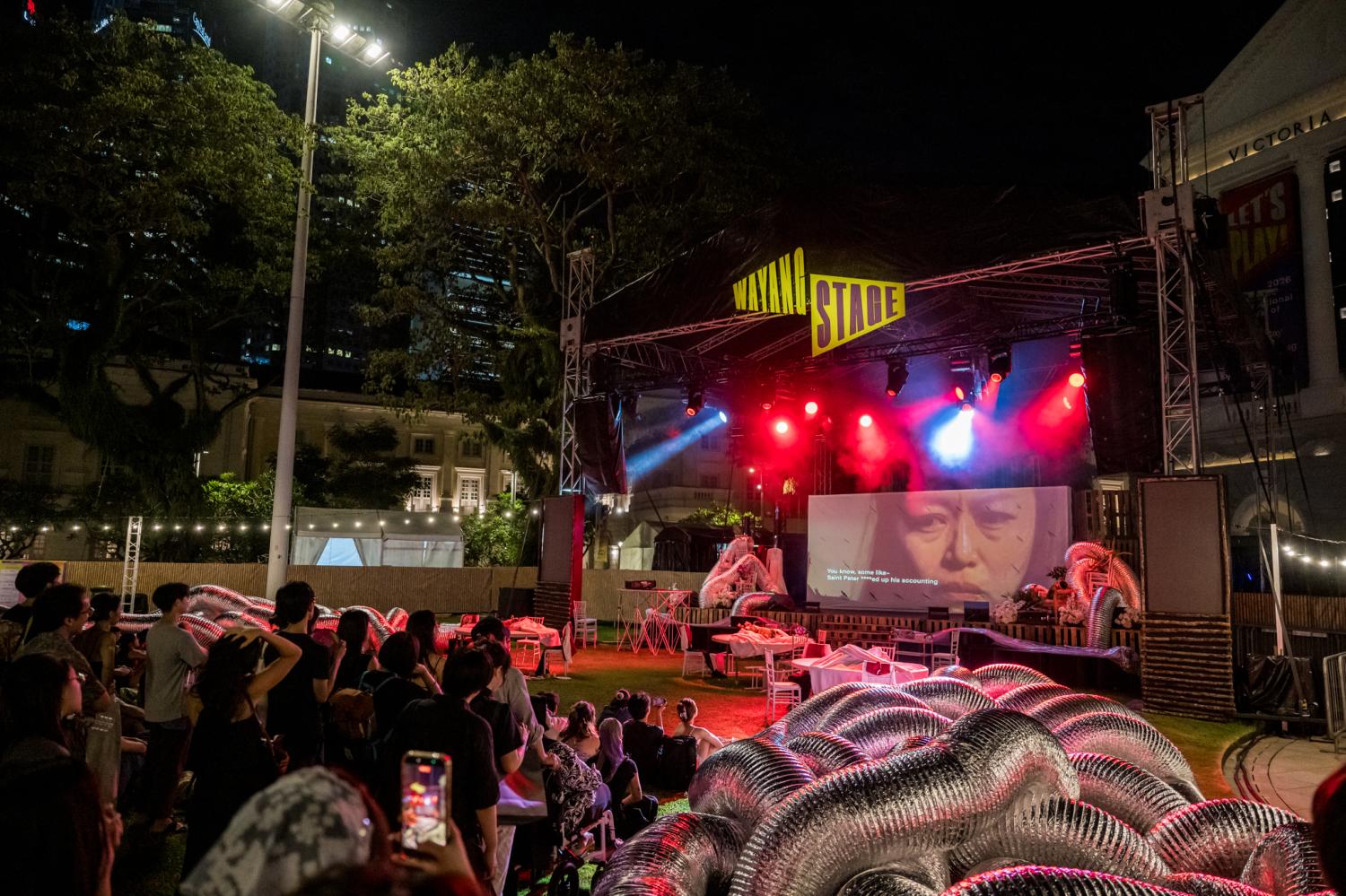
Running for two weeks until the end of this month, SIFA 2026 returns under the theme "Legacy" under his three-year helm. Inspired by the festive spirit of bygone decades, Chong brings back the Festival Village to Empress Lawn to create a community for all. It is packed with shows, installations and parades from dusk to dawn. Night owls and early birds can catch special shows after and before work.
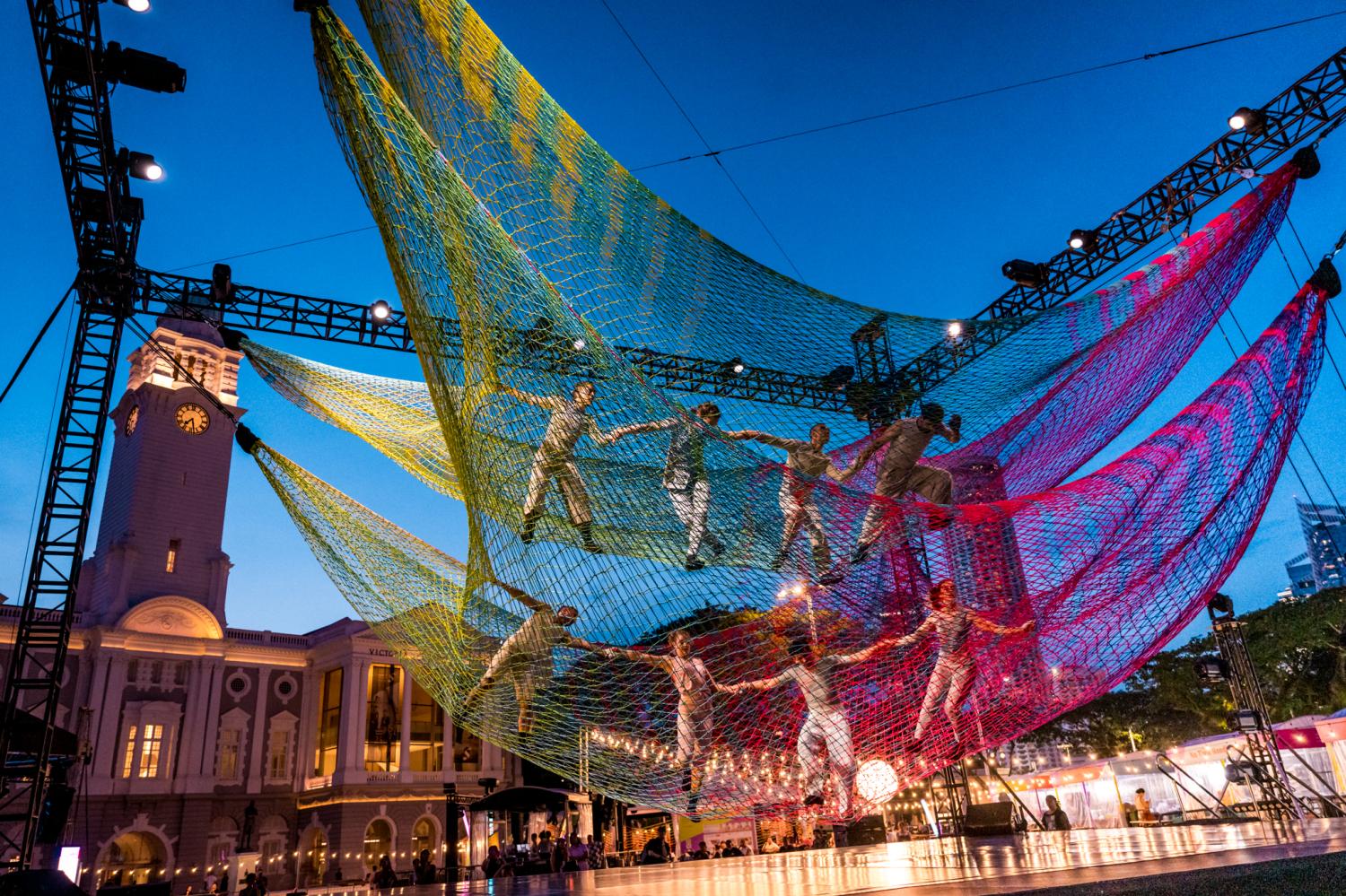
It has lived up to his intention. On the first day, crowds marvelled at the acrobatic feats by performers in Rebecca Lazier and Janet Echelman's Noli Timere. Even after 10pm, they were wide-awake in front of the Wayang Stage cheering when cyborg-like performers in Hothouse's AUTOMATA: Two Weddings & A Rapture climbed out of winding ducts, safe and sound. Free programmes are available to make sure that everybody can experience performing arts.
Bringing together homegrown and international talent, SIFA 2026 invites festivalgoers to confront the weight of the past -- legacy. From food to art and fashion, culture does not emerge from a blank slate. It is inherited, negotiated or subverted. This edition, however, approaches the theme in a playful manner, along with its casual tagline.
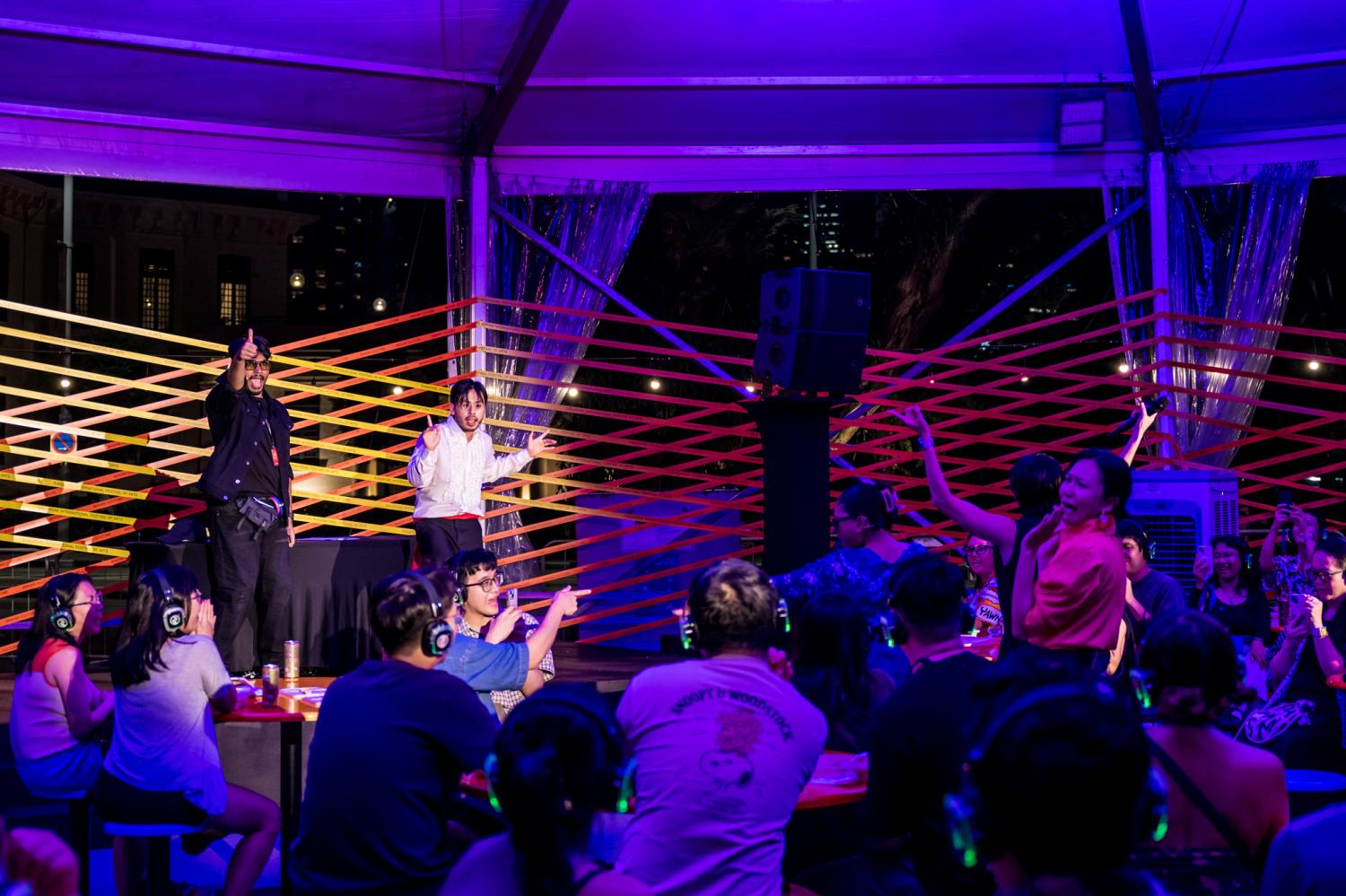
Two shows from SIFA's opening weekend prove its funny bent. Created by Jo Tan and directed by Krish Natarajan, Makan Culture makes fun of asymmetrical power relations between the West and Singapore through the lens of something very local -- food. An outdoor pavilion at the Empress Lawn is converted into something between a hawker centre and a stage. When audiences eat and talk, it does recreate a warm community dining atmosphere. When the show starts, Jo introduces herself as a government official who processes grant applications. It is soon clear that she parodies the role of cultural institutions in shaping public taste. Then Dennis Sofian, who plays an unknown artist, opens his dining show. Ellison Tan, who plays a snobbish critic, rises to her feet, questioning if pandan cake should be presented to international audiences. Masturah Oli, who plays a hawker that sells laksa to celebrate her intermarried parents, asks what is wrong with it. Soon, the show within the show descends into a riotous debate.
At the heart of Makan Culture is a soul-searching question of national identity. Given its colonial past and multicultural background, Singapore is fraught with postcolonial tension between Western culture and local multiculturalism. Ellison flies to study in London to "learn the best by Western standards". She cites Mamma Mia! The Party as an acceptable dining theatre. On the other hand, Dennis and Masturah are vanguards of multiculturalism in Singapore. From pandan cake to rojak, its food culture is a melting pot and symbol of co-existence. Artists use national food to focalise an encounter between "high" and "everyday" cultures. At the end, the highbrow critic admits: "I don't know what my own voice sounds like any more." Singapore should embrace its local, diverse roots rather than blindly inherit cultural legacy.
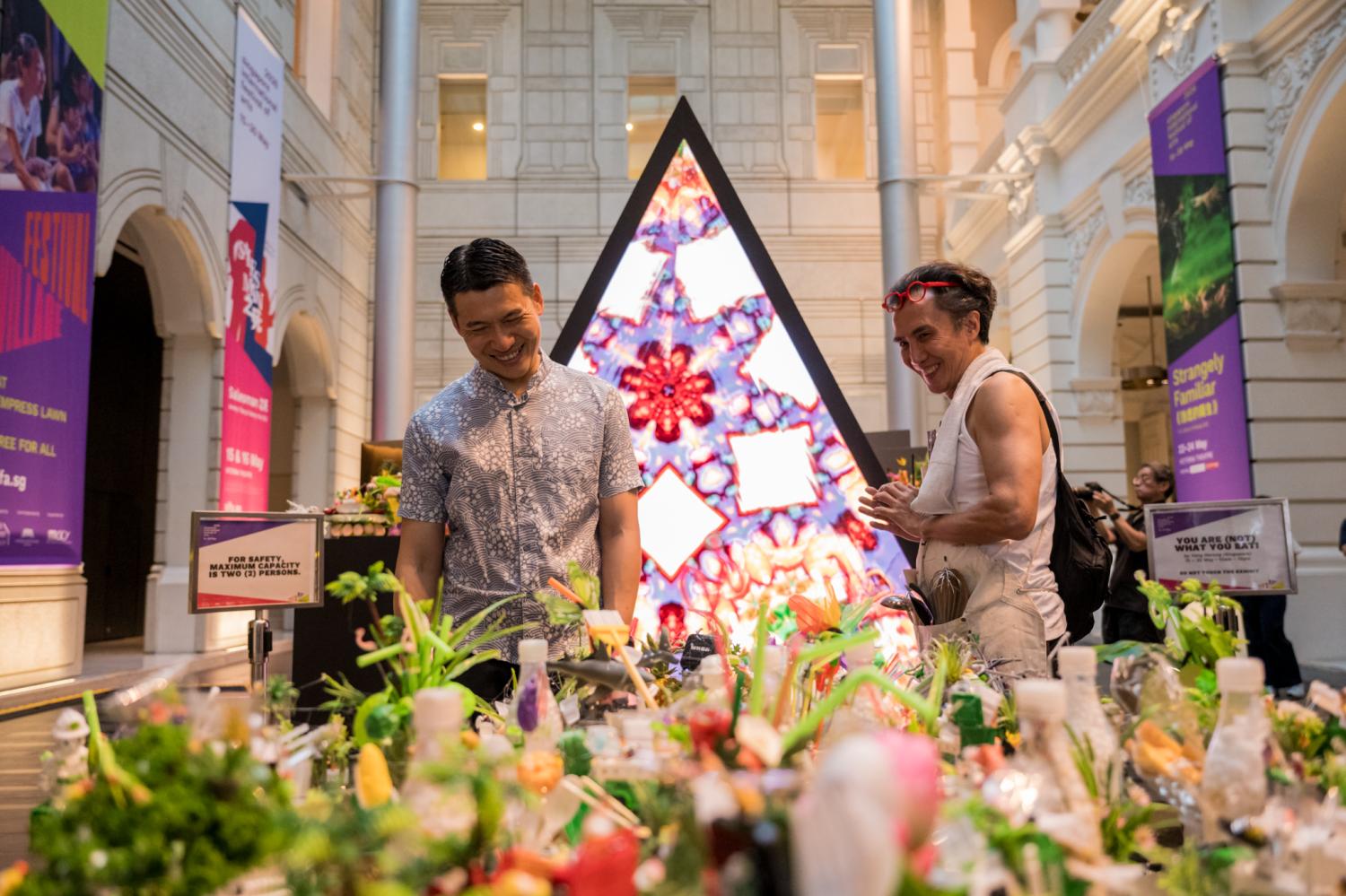
Inside the Victoria Theatre Atrium, Yang Derong's You Are (Not) What You Eat! continues preoccupation with food. His kaleidoscopic installation presents colourful sculptures of packaged hawker meals to raise awareness of plastic pollution. The use of Singlish term shiok, a pun on the word shock, sets the playful tone for contrasting the beautiful and the ugly. "Enjoy the shiok, but feel the shock beneath it," reads a poster. Derong's advice harks back to his pre-plastic, utopian childhood when people brought aluminium containers to food vendors. His take on ubiquitous plastic explores broader tensions between globalisation and local culture.
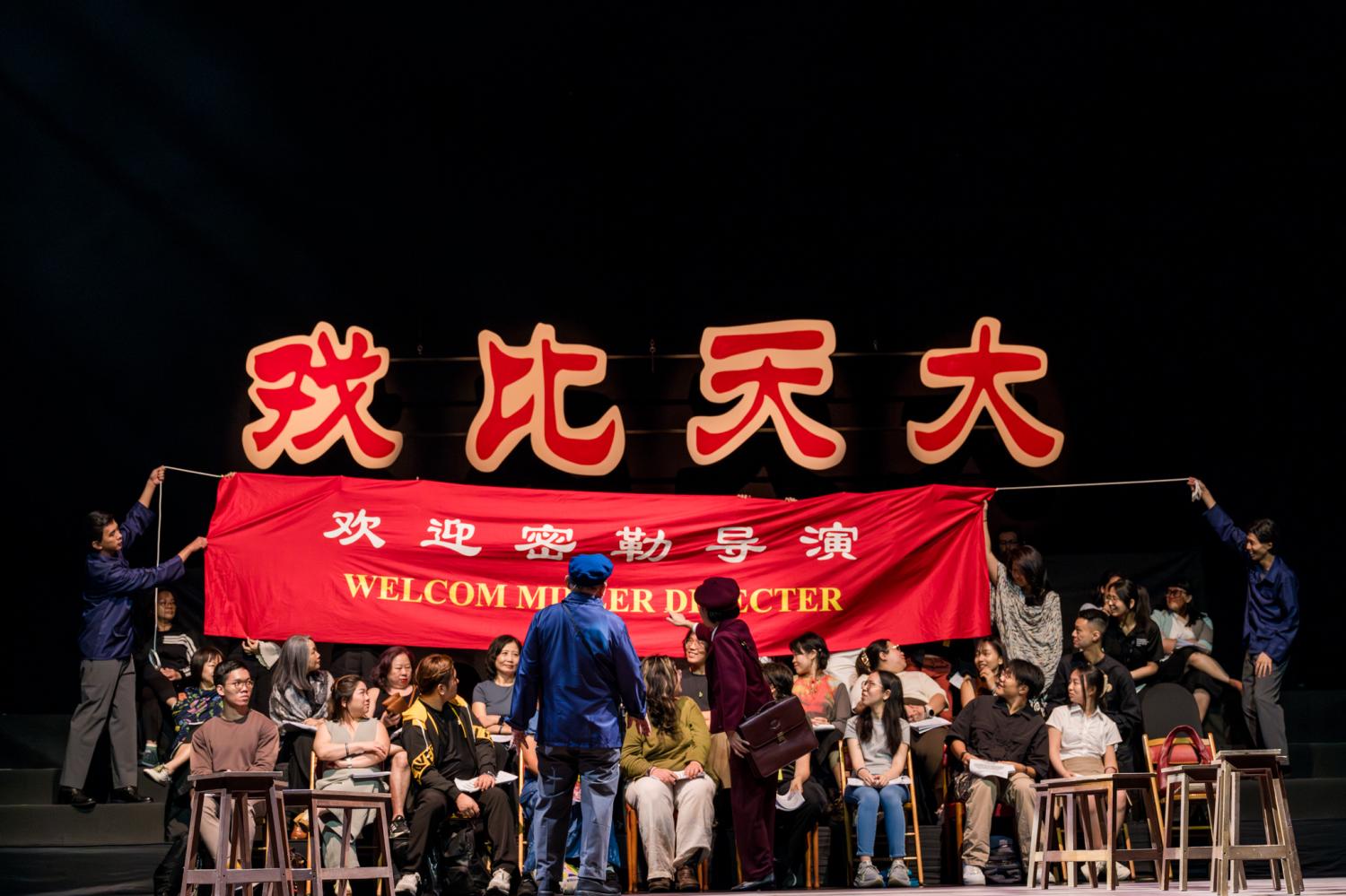
If the question of national identity forms an underlying premise, it entails revisiting, unpacking and challenging historical moments to forge anew. Written by Jeremy Tiang and directed by Danny Yeo, Salesman之死 reveals a gap in cross-cultural communication. Detailed in his memoir, Arthur Miller's command of the first production of his famous play Death Of A Salesman (1949) in Beijing in 1983 provides inspiration for Salesman之死. Yet, this edition foregrounds Shen Huihui, a young literature professor, who is asked to interpret for Miller and Chinese performers, and who -- fresh out of the Cultural Revolution that is anti-bourgeois, anti-intellectual and xenophobic -- neither meets a salesman nor fathoms the concept of it.
At the heart of this chaotic tale are unintended outcomes of translation. It looms at the outset when local actors put up a misspelt banner that reads "Welcom Miller" to impress the heavyweight playwright. As they get down to work, cultural differences grow acute. Miller complains that the play in Mandarin drags on for four hours -- longer than the original, which highlights different theatrical conventions in America and Beijing. More familiar with clarity, local performers are confused when they are told to step through "imaginary walls" onto a forestage. When male and female performers are told to display intimacy, they do so awkwardly because it flouts customs. Despite staging the same play, these scenes reveal irreducibility of cultural difference between America and China.
When it comes to the interpreter herself, the play draws attention to the complexity of interpretation -- there is no direct equivalent. It is further complicated by the fact that Shen writes a thesis on Miller's works. Given her admiration for Miller, is she trying to impress him by filling in the gap on behalf of local performers?
After landmark success in Beijing, Salesman之死 came to the Victoria Theatre for the Singapore Festival of Arts (which has evolved into SIFA) in 1986. Four decades later, it returns to the same ground, but restaging at a different time has profound implications. A power struggle emerges when translation fails to assimilate local performers into the logic of the language of power. As theatre in Singapore is a colonial practice dating back to the early 19th century, Tiang and Danny's appropriation of this medium constitutes an act of resistance to the centre. If legacy cannot be inherited without some kind of loss, the message is clear -- it is time to adapt anything passed down on rather than blindly adopt it.
Caroline Guiela Nguyen's LACRIMA continues the same tenor on a broader scale. Performed at Singtel Waterfront Theatre, this three-hour epic drama examines the deadly burden of legacy through the lens of high art -- Parisian haute couture. It follows Marion Nicholas, an alcoholic head seamstress with Maison Beliana, who receives a commission to create a wedding dress for the Princess of England in a short span of eight months. Craftspeople who embark on this intricate labour sacrifice everything for the golden opportunity. To me, it is a contemporary retelling of Goethe's Faust, where human artists sell their souls to the Devil in exchange for transcendental power.
Because it is so long and the topic sounds lofty, I did not expect it to be this good. Despite a sluggish start, when it catches fire, it burns audiences to ashes with tension. During an online meeting with the Princess, Marion struggles to keep her unruly daughter under control and fails. I remember sitting transfixed by her emotional breakdown when her husband Julien gaslights her out of envy of her professional success.
Central to this epic drama is the cost of inheriting artistic legacy. Marion lies to a doctor out of fear of being dismissed from the project. As her work and life unravel, she commits suicide. Other craftspeople suffer a similar tragic fate. In Mumbai, Abdul Gani, who fastens roses onto duchesse satin, is diagnosed with blindness due to the backbreaking nature of embroidery. A lacemaker's family is forced to confront the "ghost of Hamlet's father" -- an intergenerational apnoea -- that is caused by the work itself. It draws attention to the beautiful and the ugly in craftsmanship. It takes over 4,500 hours to produce the "pride of ancient Europe" for the Princess of England, who wears it only for 27 minutes.
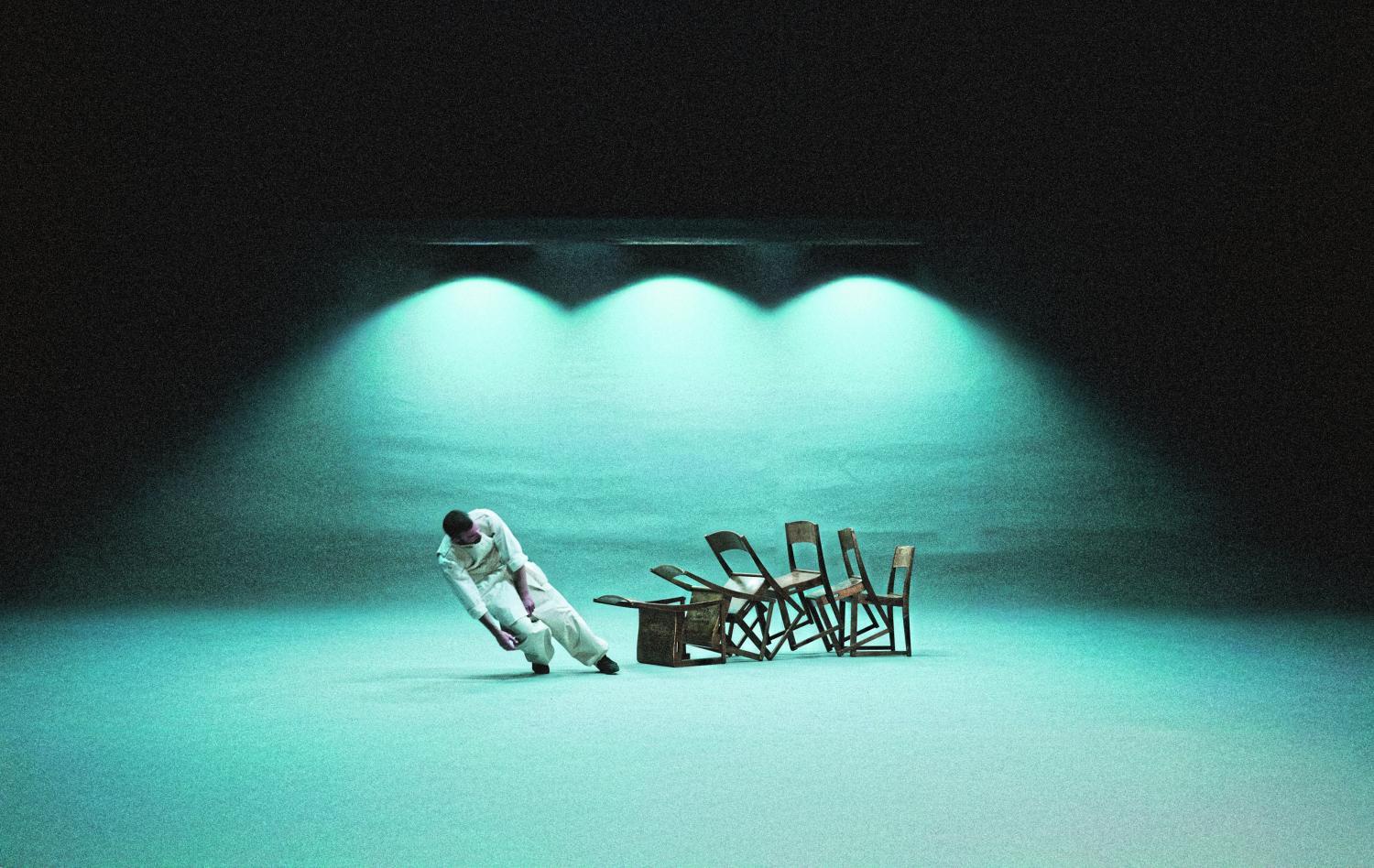
Directed by Kalle Nio, choreographed by Fernando Melo, and with music composed by Samuli Kosminen, Tempo blends text voiceover and performance into a meditation on time. Staged at the Drama Centre Theatre, it follows performers who experience mishap, such as slipping, falling or stumbling, in slow motion. By doing so, these accidents change rhythm and make time visibly felt. I think of it as Samuel Beckett's Waiting For Godot (1952) only without plot. While LACRIMA builds drama over a long duration, Tempo takes it away to immerse audiences in the flow of time, though it runs the risk of boring them at some point. By defamiliarising time, the production raises awareness of meaningful existence and what kind of legacy we will pass on to the next generation.
"As an artist, I have a kind of privilege that people come to the show, sit in the dark and turn off their phones. I am already in charge of their time," said Melo, who sat opposite me during lunch.
"Time is relative. We can sit and have a good talk. Oh my God, an hour went by. Can I influence how people experience life?"
SIFA 2026 unfolds across various venues and timings in Singapore until Saturday. For a full list of programmes, visit sifa.sg.