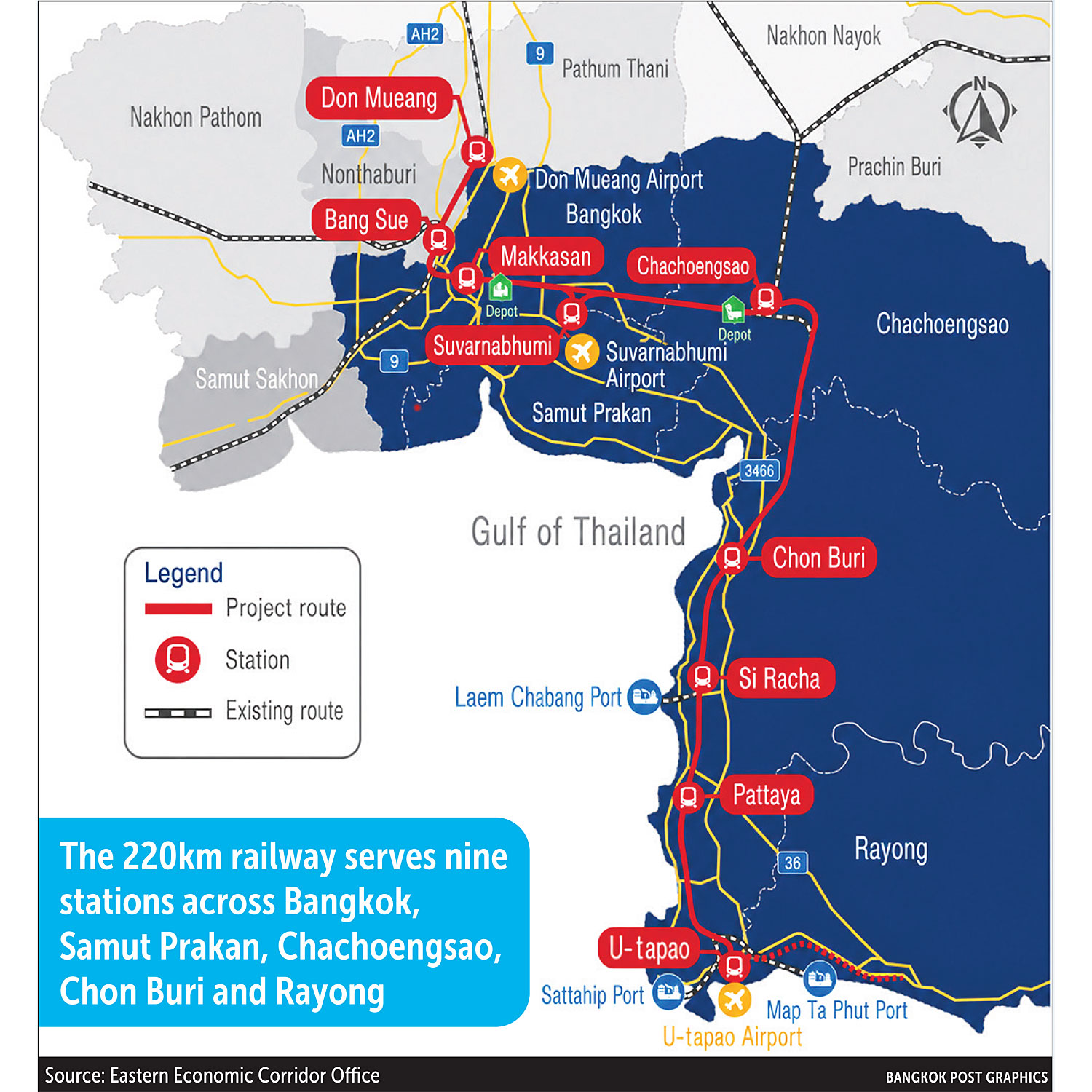
Undeterred by several problems in building a high-speed rail system linking three airports, the government vows to push ahead and continue to draw investments to the Eastern Economic Corridor (EEC).
The 224.5-billion-baht project faces an uncertain future after Chula Sukmanop, secretary-general of the EEC Office, said the government may need to seek a new business partner to replace concessionaire Asia Era One if the problems that led to years of delays cannot be resolved.
Reportedly Asia Era One, the consortium led by Charoen Pokphand (CP) Group that won the concession to develop the railway, wants to terminate the construction agreement made with the State Railway of Thailand (SRT).
This stance was rebuffed by Sarit Jinnasith, president of Asia Era One, who said it never intended to abandon the project.
Prime Minister Anutin Charnvirakul said state contracts cannot be cancelled unilaterally, stressing the government is keen to ensure the project is implemented according to agreed terms, public procurement regulations and the law.
Despite many setbacks, both the state and private sectors remain confident in the EEC's growth, even if high-speed rail system faces adjustments.
NOT A DECISIVE FACTOR
Thailand can still advance its EEC ambitions even if the high-speed rail project linking Don Mueang, Suvarnabhumi and U-tapao airports is abandoned, as industrial investment has already shifted its focus to infrastructure that is operational rather than promised, noted industry leaders.
However, cancelling the rail project could dent confidence in the government's ability to deliver mega-projects and weaken the long-term image of the flagship development zone, said Surachet Kongcheep, head of research at property consultancy Cushman & Wakefield Thailand.
Most private investors have already stopped relying on the rail project as a selling point for developments in the EEC, he noted.
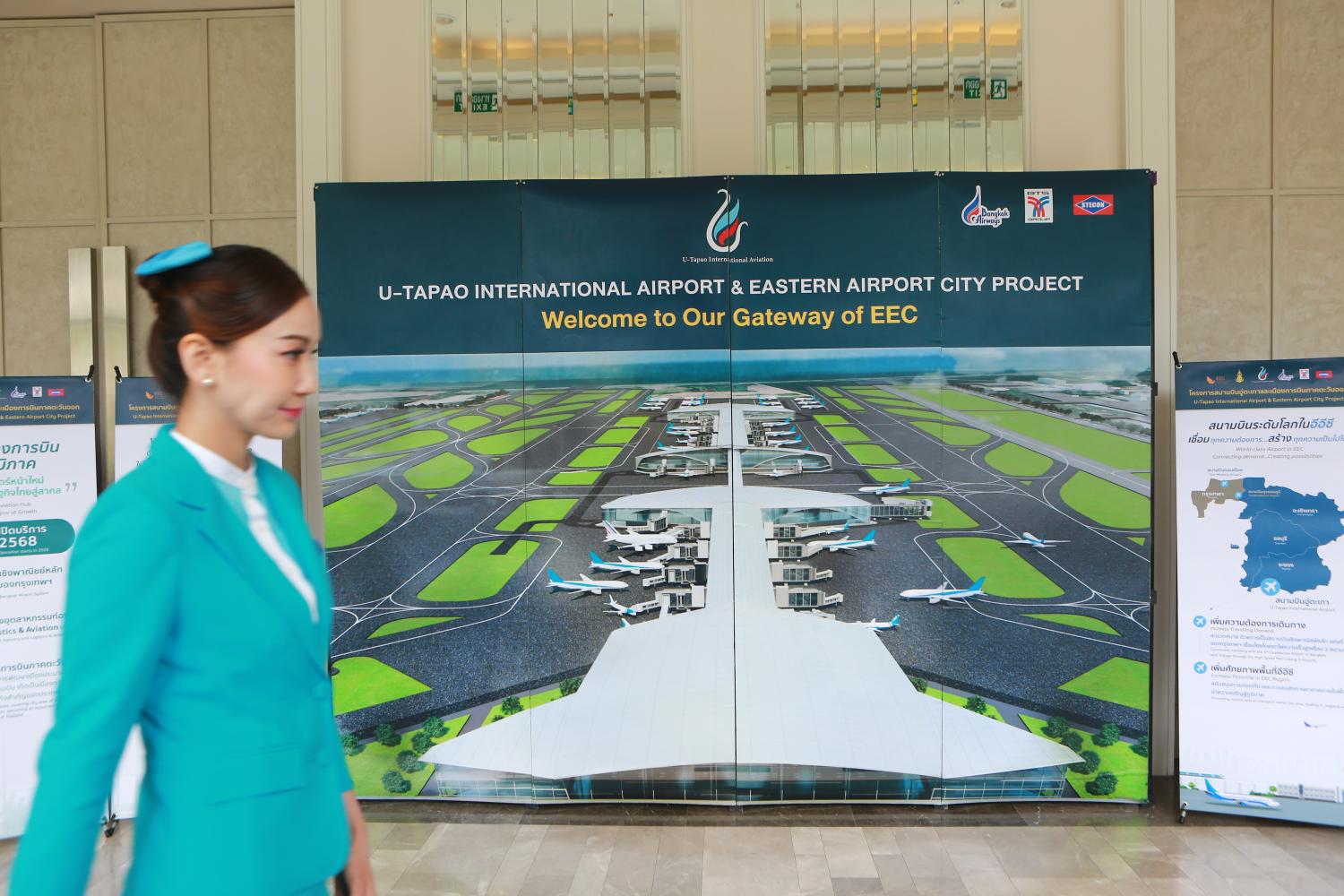
Instead, industrial, residential and hospitality developers are promoting infrastructure already in operation or under construction, including deep-sea ports, motorways, dual-track railways and the expansion of U-tapao airport.
"The market has gradually adjusted because the project faced repeated delays," said Mr Surachet.
"Developers now highlight the EEC's existing strengths rather than waiting for the high-speed rail."
Industrial investors are driving growth in the EEC, and they rely primarily on ports, roads and conventional rail freight rather than high-speed passenger trains, he noted.
Factories in the EEC mainly produce for exports or neighbouring countries, making efficient logistics more important than faster passenger transport.
Residential developers also adapted, as homebuyers no longer choose projects based on proximity to future high-speed rail stations, said Mr Surachet.
"The housing market stopped depending on this project years ago. Developers no longer use station locations as a major selling point," he said.
Hotel operators are unlikely to face significant disruption, as visitors can already access Pattaya, Chon Buri and Rayong through Suvarnabhumi and U-tapao airports, as well as motorway connections.
Even large private investments planned in the EEC are expected to proceed, provided the projects remain attractive enough to draw tourists and businesses, said Mr Surachet.
However, cancelling the project could have wider implications for Thailand's investment reputation, he noted.
The high-speed rail connecting three airports has long been presented alongside the EEC as a flagship infrastructure projects.
"If such a major project cannot be delivered despite involving one of Thailand's largest private partners, foreign investors may question the country's ability to execute large-scale developments," said Mr Surachet.
The government should clearly communicate its next steps and avoid creating uncertainty if the project is cancelled, he said.
LIMITED IMPACT
Delays to the rail project will not derail investment momentum in the EEC, according to the Industrial Estate Authority of Thailand (IEAT) and leaders in the automotive industry.
Sumet Thangprasert, governor of the IEAT, acknowledged the troubled project could slow related developments such as the U-tapao airport upgrade and the Eastern Aviation City, but targeted industrial investments remain unaffected.
Contingency measures have been prepared, he said, including a plan to reduce train speeds from 200 to 160 kilometres per hour to ensure the project can move forward despite construction challenges.
"The IEAT confirms investment in key industries has not stumbled. Investors continue to enter the EEC, and confidence in Thailand remains at 100%. These are separate issues and should not be lumped together," said Mr Sumet.
Foreign investors are interested in semiconductors, artificial intelligence and data centres, he said.
Data centre developers have reserved between 2,000-5,000 rai of industrial land, awaiting clarity from the Energy Ministry on clean electricity supply.
The IEAT expects its industrial land sales in fiscal 2026 (October 2025–September 2026) to surpass last year's 8,000 rai, which fell short of the target of 12,000 rai.
Rising geopolitical tensions and US tariff measures under President Donald Trump are prompting manufacturers to consider relocating production bases to Thailand.
Confidence is also evident in the automotive sector. Vithavat Thongves, secretary of the Automotive Industry Club under the Federation of Thai Industries, said foreign investors remain committed, particularly in electric vehicles (EVs).
Chinese firms dominate current EV investments, but more suppliers are expected to follow.
"Even though the railway project faces obstacles, it has not affected overall investment. Chinese investors remain key players across multiple industries," he said.
An executive from Changan Auto Sales (Thailand), a subsidiary of Chinese EV maker Changan Automobile, echoed this sentiment, noting foreign investors view Thailand as a long-term investment hub, despite infrastructure setbacks.
Their greater concern is Thailand's shrinking car market, weak consumer purchasing power and the economic slowdown.
Some new entrants prefer importing vehicles under the Asean-China free trade agreement rather than building factories locally, said the executive.
EFFECTIVE CONNECTIONS
Replacing the original proposal with a medium-speed railway capable of operating at up to 160km per hour could be a practical alternative, particularly if lower construction costs translate into more affordable fares.
"What matters is not necessarily maximum speed, but whether the system is convenient, affordable and well-connected," said Mr Surachet.
The government should complement any revised rail project with efficient local public transport linking stations to industrial estates, tourist attractions and residential areas, he noted.
This strategy would preserve much of the project's intended economic benefit without requiring a full high-speed rail system, said Mr Surachet.
"Land speculation around future station locations has largely disappeared after years of uncertainty surrounding the project," he said.
Land prices along the proposed route surged two to threefold several years ago, but have remained largely flat as progress stalled.
"If the project is cancelled, landowners near the proposed stations may have to cut asking prices significantly because much of the speculative premium has already disappeared," Mr Surachet said.
The EEC's long-term competitiveness ultimately depends less on a single railway project than on the overall investment structure, policy continuity and the government's ability to deliver infrastructure that supports businesses, he noted.
STILL HOLDS POTENTIAL
Sumet Ongkittikul, vice-president for internal systems and research director for transport and logistics policy at Thailand Development Research Institute, said the high-speed rail remains necessary to support the EEC.
However, the government should reassess the project's economic viability to ensure it reflects the current environment, he said.
"The expectations for this project have been delayed and it remains unclear how the situation will be resolved," said Mr Sumet.
"The government needs to expedite its decision on the project."
The project contract was signed on Oct 24, 2019, between the SRT and Asia Era One Co, though construction has yet to begin.
The project was affected by the economic fallout from the pandemic, while financial institutions have been reluctant to provide loans because they consider the project financially unviable.
The concessionaire was granted a 50-year concession and sought to amend several terms of the contract, but was unsuccessful.
The CP Group submitted a letter to the SRT on July 6 to exercise its contractual right to terminate the agreement.
Mr Sumet said he still believes there is a need for an efficient rail transport option serving the EEC. However, the government must reassess the project's economic value.
High-speed rail entails significantly higher costs than conventional rail. Since the project's inception, there has been debate over whether high-speed rail provides sufficient time savings to justify the higher cost on routes that are not particularly long.
However, a rail system with a relatively low operating speed but greater service efficiency, featuring more frequent departures and additional stations, may help offset the longer travel time, he said.
The project may need to revisit its original concept, particularly regarding its travel model, said Mr Sumet.
Although the railway is designed to connect Don Mueang, Suvarnabhumi and U-tapao airports, he said most passengers are unlikely to travel directly between Suvarnabhumi and U-tapao airports.
For example, with the Airport Rail Link the majority of passengers do not use the service solely to travel to Suvarnabhumi airport. Instead, many passengers travel to intermediate stations such as Lat Krabang, Hua Mak or Thap Chang.
Similarly for the delayed rail project, the primary travel demand is expected to come from destinations such as Pattaya and Si Racha.
If the trains operated at a somewhat lower speed, they could stop more frequently at areas with stronger passenger demand, making it possible to add more stations, said Mr Sumet.
"High-speed rail is a costly undertaking, making it difficult for the private sector to invest. If the government were to fund the project itself, it remains uncertain whether it would have the financial capacity to do so," he said.
"Another option would be to scale down the project to reduce costs."
BEYOND INFRASTRUCTURE
While the government plans to remove all obstacles to the railway construction in order to increase investments, Mr Chula said the EEC plans to focus on more than infrastructure and industry because the region has the potential to build a globally attractive corridor blending business, tourism, sports and lifestyle.
EEC, which covers parts of Chon Buri, Rayong and Chachoengsao, is expected to become the nation's high-tech industrial hub hosting 13 targeted industries, including next-generation cars and smart electronics.
The goal is to become a global hub where people want to invest, work and live, he said.
The government's push for the EEC Capital City or "EECiti" project should help Thailand achieve this goal despite delays to the rail project, said Mr Chula.
EECiti is conceived as a next-generation urban centre intended to anchor Thailand's shift towards high-tech industries, international services and premium tourism.
The project is in its first phase (2023–2027), with authorities preparing to open bidding for 10 major infrastructure and utility systems under public-private partnership schemes, with combined investment projected at 74.5 billion baht. The full master plan extends to 2037.
The government is positioning the EEC as a future hub for global tourism, entertainment and major international events, with proposals including an 80,000-seat stadium, an international sports complex covering 1,500 rai, and a potential Formula One-standard racing circuit near U-tapao.
A revived plan to attract a Disneyland-style theme park has also drawn attention, reflecting efforts to create a large entertainment and lifestyle destination capable of drawing international visitors and investors.
Since 2018, the EEC has attracted 45.7 billion baht in foreign investment, with China, Japan, Australia, Belgium and Singapore among the key contributors.
However, some developers worry the pace of EEC development remains tied to progress on the high-speed rail project, widely seen as the backbone of the EEC strategy.
Mr Sarit from Asia Era One said the project has been hindered by unresolved obstacles, particularly delays in land handovers and legal restrictions affecting construction.
He pointed to prolonged delays in site delivery complicating the project's financing, as well as disruptions such as the impact of the Russian invasion of Ukraine.