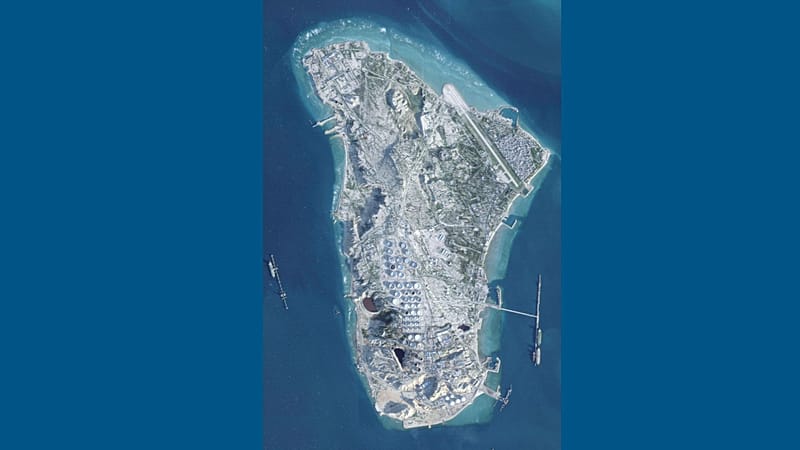
Kharg Island is central to Iran's oil exports and therefore to its economy. Any attack on its energy infrastructure could also have serious consequences for global oil markets that have already been pushed to the brink.
Concerns about a wider energy crisis intensified on Monday as war in the Middle East continued and the Strait of Hormuz, a key shipping route for global energy supplies, remained closed to many tankers. Around 20% of the world's oil trade normally passes through the strait.
Attention has now turned to Kharg Island, Iran's main oil export hub. US President Donald Trump has threatened to target the island's oil infrastructure unless Tehran allows shipping to resume through the strait — a step Washington has historically avoided, so far.
Why Kharg Island is vital to Iran’s oil network
The importance of Kharg Island lies in its role as the centre of Iran’s export system.
About 90% of Iran’s crude oil exports leave the country via the island, much of it destined for China and other Asian markets.
Located in the northern Persian Gulf, Kharg Island is relatively small — about 8 kilometres long and 4–5 kilometers wide — but it hosts extensive infrastructure, including storage tanks, pipelines and offshore loading terminals.
Pipelines from some of Iran’s largest oil fields converge here before crude is loaded onto tankers.
Oil exports remain one of Iran’s main sources of government revenue, making Kharg Island a critical economic asset.
The island’s terminals can load roughly 1.3–1.6 million barrels of crude per day, helped by deep-water access that allows very large crude carriers to dock.
According to an analysis by JPMorgan Chase, Iran increased exports from Kharg Island to near-record levels in the days before the recent escalation in the region.
Between 15 and 20 February, shipments reportedly exceeded three million barrels per day, suggesting Tehran may have been accelerating exports ahead of potential disruptions.
Last week the United States and Israel said they struck military targets on the island.
In a social media post, Trump said the US had “totally obliterated” military assets there.
He warned that if Iran interfered with shipping in the Strait of Hormuz, Washington could reconsider its decision not to strike the island’s oil infrastructure.
Iranian media later reported that Tehran warned it would retaliate against energy infrastructure linked to US companies in the region if its own facilities were attacked.
Global economic implications
Analysts say a strike on Kharg Island’s export terminals could remove 1.5 to 2 million barrels of oil per day from global supply.
That could amount to about 3–4% of global seaborne crude trade, according to Roukaya Ibrahim, commodities strategist at the investment research firm BCA.
Asian economies, including China, are considered particularly exposed because they rely heavily on oil shipments from the Middle East.
“Not only would an attack on Kharg Island’s oil infrastructure damage Iran’s export capacity, it would also increase the risk of wider attacks on regional energy infrastructure,” Ibrahim said.
She added that such escalation could push oil prices towards $120 a barrel.
Since the start of the war, prices for Brent crude oil have surged sharply by 42%, and WTI jumped by 47%, according to Jim Reid, global head of macro research at Deutsche Bank.
The risk of wider retaliation
Analysts warn that the most significant risk would be a broader escalation targeting energy infrastructure across the region.
Potential targets could include pipelines designed to bypass the Strait of Hormuz.
"In particular, attacks on [Saudi Arabia's] East-West pipeline and the UAE’s Abu Dhabi crude oil pipeline, which are both being used to re-route oil flows disrupted by the Strait of Hormuz’s closure, would be a meaningful hit," Ibrahim said.
JPMorgan’s commodities research team also found it likely that an attack on Kharg Island could trigger retaliation in the Strait of Hormuz or against major regional energy facilities.
The bank highlighted several strategically important oil hubs that could be vulnerable, including Saudi Arabia’s Ras Tanura, the Abqaiq processing facility and the UAE’s Fujairah.
Disruption to any of these facilities could further tighten global oil supply.
Meanwhile, analysts say the release of spare production capacity by oil-producing countries may offer limited relief.
Much of the world’s spare capacity is held by members of OPEC, whose exports also depend on the Strait of Hormuz.
“Unless the strait is reopened, that spare capacity cannot easily reach global markets,” Ibrahim said.
What happens next?
Whether the United States ultimately decides to target Kharg Island’s oil infrastructure remains uncertain.
But the possibility alone has added to growing anxiety in global markets, with investors closely watching developments around the Strait of Hormuz.
“The impact on global growth will depend largely on how long the conflict lasts and whether the Strait of Hormuz remains closed,” Ibrahim said.
“A prolonged disruption to oil supply could raise inflation expectations, weigh on global markets and strengthen the US dollar.”