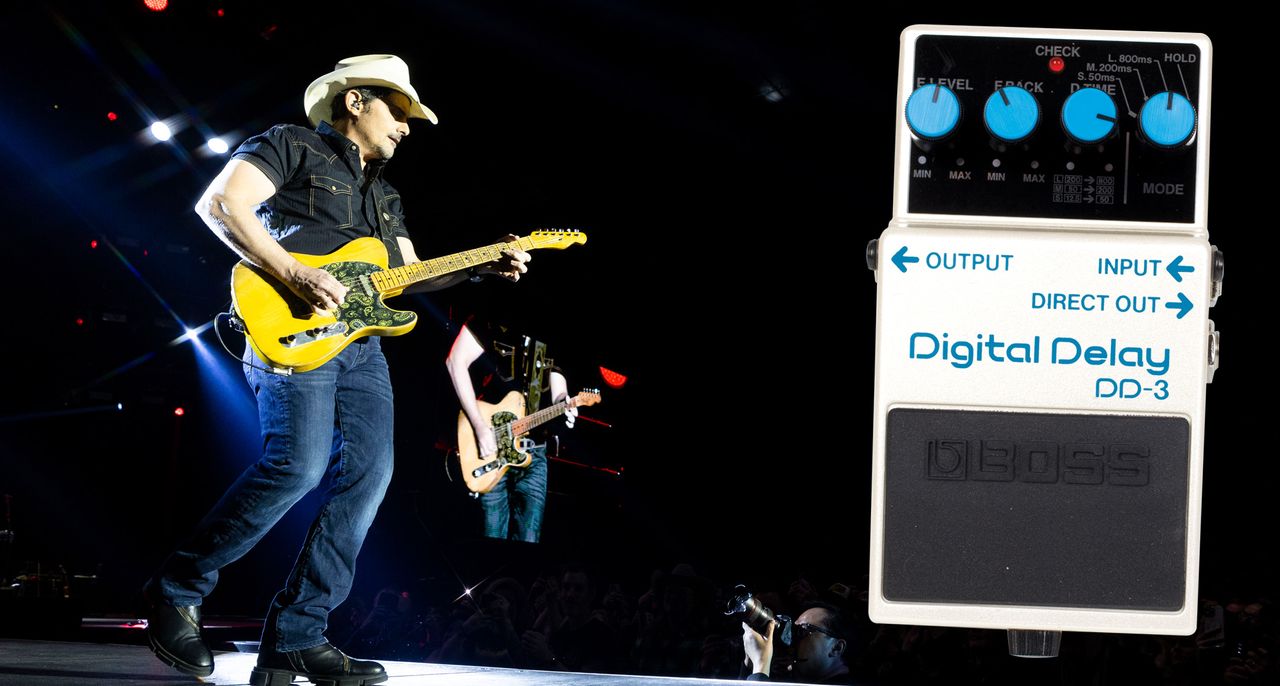
Integrated circuit technology advanced at such a rapid pace during the late ’70s and early ’80s that only seven years passed between the introduction of the first analog delay pedals in 1976 and the debut of the world’s first compact digital delay pedal – the Boss DD-2 Digital Delay – in 1983.
The Boss DD-2 was sort of a spin-off product of the larger and more expensive SDE-3000 rack-unit professional digital delay introduced that same year.
But although the DD-2 contained the same 63H101 CMOS gate array IC “long chip” as the SDE-3000, the pedal version was not an SDE-3000 in a stompbox like some have claimed, as the DD-2 lacked the 3000’s modulation section and had a shorter maximum delay time and lower frequency response of 10Hz to 8kHz (compared to the 3000’s 17kHz upper range), amongst several other feature differences.
Regardless of its spec deficits compared to its big brother rack unit, the DD-2 still sounded superb, with its exceptionally impressive low noise performance and longer delay times (12.5 to 800 milliseconds) than those offered by analog delay pedals.
Many guitarists also preferred the warmer sound of the DD-2’s delayed signal over that of the SDE-3000 thanks to the stompbox’s rolled off high frequencies above 8kHz. With only four knobs on its front panel (effect level, feedback, delay time, delay mode), the DD-2 made it easy for guitarists to dial in delay settings.
When the Hold mode was selected, the pedal would infinitely repeat a short section as long as the footswitch was held down, providing a primitive looper function. The DD-2 also included a pair of output jacks for a stereo setup where the stereo (right) jack output the original dry signal while the mono (left) jack automatically switched from a mixed output to the delayed signal only.
When the cost of the 63H101 chip dropped significantly, Boss changed the pedal’s name to DD-3 and reduced the list price, even though the DD-2 and DD-3 were otherwise completely identical. The decision was mainly a PR move to avoid upsetting DD-2 buyers who paid a lot more for the same thing.
Sometime during the very late ’80s the DD-3’s 63H101 chip was replaced by a smaller square IC that also offered improved bandwidth and audio specs. Further chip upgrades appeared in later iterations of the DD-3 up through 2014.
However, many guitarists feel that the darker, warmer qualities of the more “lo-fi” 63H101 chip sound more musical, so long chip versions of the DD-3 (identifiable by a cutout section on the bottom housing for mounting the old-style large power supply jack) now sell for premium prices.
Despite the fact that digital delay technology continues to expand and improve, many discriminating players like Joe Bonamassa, Nels Cline, Billy Duffy, David Gilmour, Eric Johnson, Tom Morello and Brad Paisley still keep their original DD-2 or long chip DD-3 delays on their pedalboards.
While most guitarists have moved on to more modern digital delay boxes (including the Boss DD-8 and upgraded DD-3T), it seems almost everyone who is anyone has used a DD-2 or DD-3 at some point in their careers. It’s a perennial pedal that simply sounds good and works for anything from rambunctious rockabilly slapback and crisp Edge-style dotted eighth note rhythms to trippy long repeating echoes.
- This article first appeared in Guitar World . Subscribe and save .