
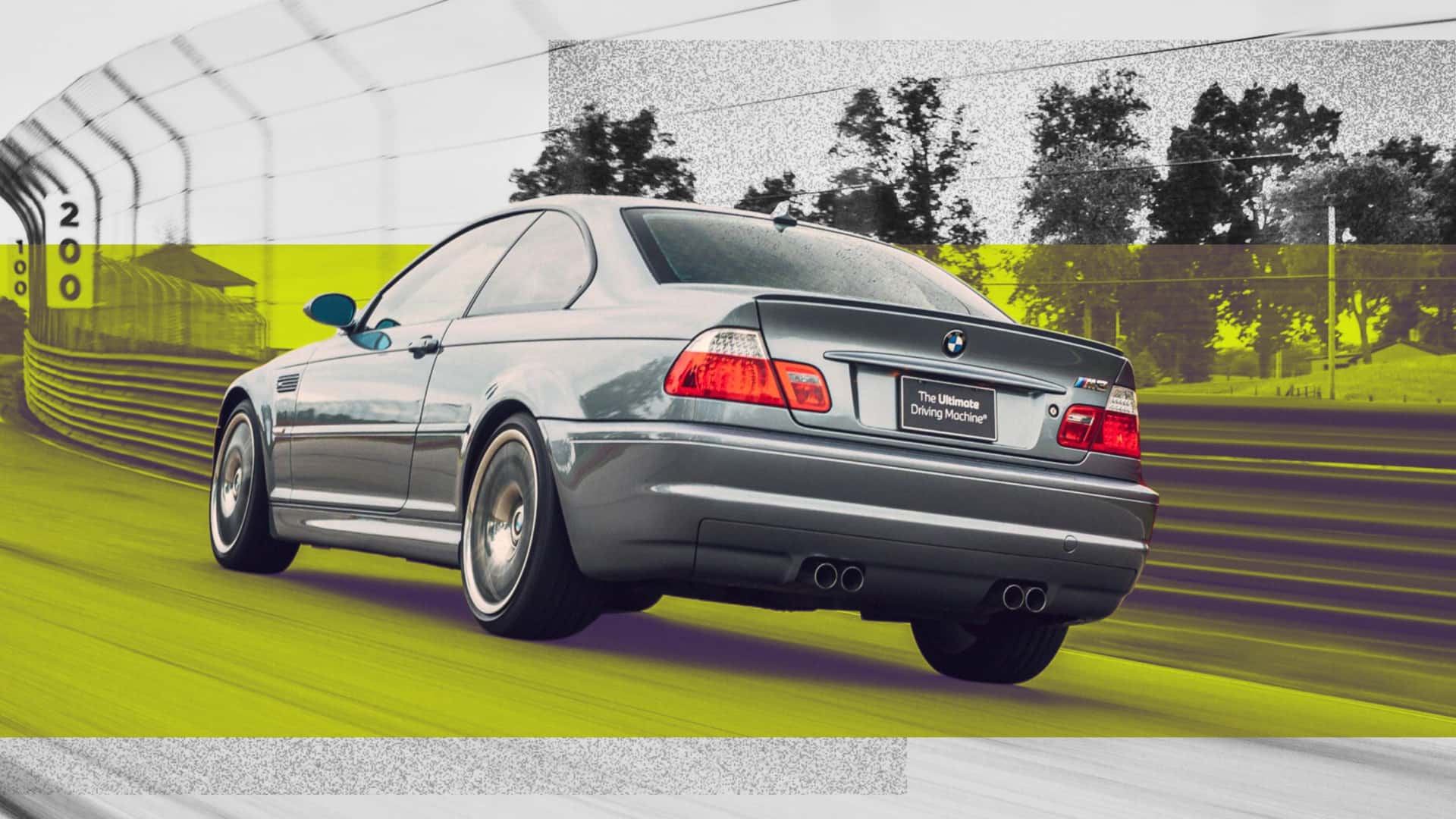
Taking your compact sedan and making it go really fast is essentially the standard operating procedure for most luxury automakers these days, but that wasn’t always the case. While the BMW M3 may not strictly have been the first car of its kind, it’s definitely the one that popularized the formula—and it’s arguably been the benchmark since it dropped in 1986. All others followed.
Yes, the favorite ride of every early-career finance phenom and roundel-obsessed track rat has been around for 40 years, and it’s changed a whole lot over that time. Bigger engines, more doors, more competition, more grille; the story of the M3 hasn’t been an uneventful one, but we thought it’d be fun to take a look back at how a homologation touring car from the ‘80s grew to become the car culture icon it is today.
Here’s everything you need to know about each generation of BMW M3: what made each one tick, how they were received when new, and how they’re remembered now.
Jump To: E30 | E36 | E46 | E90 | F80 | G80
E30 M3 (1986–1991): The Original

- Engine: 2.3-Liter Four-Cylinder (S14)
- Output: 192-197 Horsepower
- Weight: ~2,640 Pounds
The story starts at the 1985 Frankfurt Motor Show, where BMW first publicly showed off the original M3. The company wanted to take the second-gen 3 Series Group A touring car racing, so it needed to sell at least 5,000 road-legal homologation cars within a year. Sporting more power than a regular 3 Series, bulgy box fenders, more aggro suspension, braking components from a 5 Series, and frankly very little from the regular 3er other than the doors and the roof, the E30 M3 was born.
This might come as a surprise to car fans under a certain age, but the mighty M3 started its run with a four-cylinder. Under the E30’s hood sat a 2.3-liter naturally aspirated four-pot called the S14 (no Nissan relation), but the real controversy was that output varied by geography. While European examples made 197 horsepower, E30s sold in the US made 192 hp due to mandatory catalytic converters, a lower compression ratio, and tuning that accommodated lower-octane fuel.
Rarer and spicier Evolution models were introduced in 1987, 1988, and 1990 to keep the M3 competitive on track, culminating with the Sport Evolution seeing 235 hp from a bigger 2.5-liter engine. None of the Evo models, by the way, were officially sold in America.
This might come as a surprise to car fans under a certain age, but the mighty M3 started its run with a four-cylinder.
The racing versions, meanwhile, went on to become what BMW touts as "the most successful touring car ever," winning one World Touring Car championship, two BTCC titles, and 2 DTM championships, among others.
Back in the day, the roadgoing M3 was met with critical acclaim, with Car and Driver using words like "smitten" and praising its "excellent controls," "superbly accurate steering," and "feisty engine." Modern drives, meanwhile, affirm its legendary status, but the E30’s appeal has very much become its raw, rev-happy nature in contrast to modern performance cars. Jalopnik loved it and so did Top Gear, but the latter came away "wanting a bit more."
Nowadays, it’s fair to say that reverence for the E30 M3 is as much about how it drove as it is about what it normalized: not just an iconic bloodline but a whole new segment of fast car that persists today.
E36 M3 (1992–1999): The Six-Cylinder Era Begins
- Engine: 3.0-Liter Straight-Six (S50)
- Output: 240-282 Horsepower
- Weight: ~3,280 Pounds
In 1992, the sophomore M3 landed with a cleaner, more chiseled ‘90s shape and two additional cylinders. The E36 was powered by a 3.0-liter S50 straight-six—an engine configuration that would eventually become synonymous with not just the M3 but arguably BMW as a whole. Debuting with 282 horsepower, this generation of M3 was also the first to be available as a sedan and the first to be available with an automatic transmission. Compared to its racecar-adjacent predecessor, the M3 grew up.
The geography-based performance controversy persisted, though, as US-spec E36 M3s famously used an engine making just 240 hp. I’ve personally always been a sucker for the E36’s exterior design. It’s easily the least fussy-looking M3 of them all; no funky grilles, no weird bulges, no flame surfacing, just a brick with purpose.
Compared to its racecar-adjacent predecessor, the M3 grew up.
Despite the M3 no longer being a homologation race machine, period E36 reviews raved over its potent powertrain (yes, even the U.S. version), exceptional handling, and reasonable livability, with C/D saying it "bristles with excellence," landing "near the top of [their] wish list."
These days, the E36 has a bit of a rep for being the "forgotten" M3—not as coveted as its vintage and mechanical merit might suggest. Not nearly as collectible as its OG forefather, nor an all-time car nerd hero like what would come next, it’s a bit of a middle child in the M3’s history. For that reason, it’s a solid choice for anyone looking to get in on classic BMW M driving dynamics without it costing an arm or a leg.
E46 M3 (2000–2006): The Fan Favorite
- Engine: 3.2-Liter Straight-Six (S54)
- Output: 333 Horsepower
- Weight: ~3,415 Pounds
For a lot of enthusiasts, this is it. This is the one. BMW came out with the E46 M3 at the turn of the century. The E46 went on to be widely recognized, not just as one of the greatest M3s of all time, but perhaps one of the greatest driver’s cars ever made, regardless of badge.
It was powered by a new 3.2-liter S54 straight-six making 333 horsepower at launch, revving to 8,000 rpm. You could choose between a six-speed manual or a famously lurchy six-speed second-gen SMG automated manual. BMW notably skipped a sedan version this time around, as the E46 M3 was only available as a coupe or convertible. A nutty station wagon prototype was made but never reached production.
The E46 went on to be widely recognized, not just as one of the greatest M3s of all time, but perhaps one of the greatest driver’s cars ever made, regardless of badge.
After the first drive, C/D immediately christened it as a “future icon.” It was “heroic” on the road, with “knife-edged turn-in” and a “ferocious, screaming, absolute gem” of an engine. When Motor1 editor-in-chief Jeff Perez took one out recently, he called it “an absolute joy to drive, even slowly.” But BMW wasn’t done because in 2003, it came out with a car that would solidify the E46 into holy grail status: the M3 CSL.
It was 243 pounds lighter than the standard E46 M3, while a reworked engine now meant it made 355 hp and a noise that screamed motorsport. Aggressive chassis, aero, and suspension enhancements, along with semi-slick tires, meant it was able to go around the Nürburgring in under eight minutes, an accomplishment mainly reserved for bona fide supercars at the time.
BMW only ever made 1,383 CSLs, so most of the ones you see around aren’t those. Even in standard form, though, the E46 M3 exists today pretty much universally recognized as an all-timer BMW that transcends its badge and genre. It’s the most modern, most advanced M3 before BMW started, uh, adding things.
E90 / E92 / E93 M3 (2007–2013): The V8 Powerhouse
- Engine: 4.0-Liter V8 (S65)
- Output: 414 Horsepower
- Weight: ~3,700 Pounds
"Things," in this case, are cylinders because the E92 / E90-gen M3 debuted in 2007 with a 4.0-liter S65 V8 engine making 414 horsepower revving to a glorious 8,300 rpm. To this day, it’s still the largest displacement powerplant in M3 history. Thankfully, it didn’t go full Mustang—the handling, luxury, and refinement remained a triumph.
A carbon fiber roof like the one from the old CSL became standard equipment on the coupe. The V-8’s block was made in the same plant where BMW was building its Formula 1 engines, and the whole motor was somehow 33 pounds lighter than the straight-six it replaced. This was the generation of M3 where adjustable dampers came into the picture, as did a seven-speed dual-clutch automatic transmission. It also became available as a sedan again; E92 referred to coupes, E93s were convertibles, and the E90 chassis code stood for the sedans.
To this day, it’s still the largest displacement powerplant in M3 history...
As the M3’s engine grew, so did the whole car itself. The E9x cars weren’t bulky per se, but they also weren’t really lithe or “compact” anymore outside of government classification docs. This was also the 3 Series that came with Chris Bangle-era flame surfacing, and it’s actually aged really well, if you ask me. If the E36 is the simplest-looking M3, the E92 is arguably the most beautiful. It’s styled but not crude or busy.
By this time, rival products from Mercedes and Audi had become seriously desirable performance cars in their own rights—the C63 AMG was louder and rowdier, the RS4 had all-wheel drive and versatility—but to most, the M3 remained the dynamic benchmark. When Top Gear (the show, not the mag) put all three together for a shootout, all three of the show’s famously disagreeable hosts agreed that the E92 M3 was objectively the best car.
In the 2020s, the V-8 rendition of the M3 may not have reached quite the cult status of the E46, but it’s still an immensely popular used enthusiast choice, and it’s not hard to see why. Not for nothing, a bright orange Lime Rock E92 M3 with the titanium exhaust remains the best BMW I’ve ever driven—EIC Perez went as far as calling it “BMW’s most complete sports car” and “the brand’s best M3 ever."
F80 / F82 / F83 M3 (2014–2018): The Turbo Era
- Engine: Twin-Turbo 3.0-Liter Straight-Six (S55)
- Output: 425-493 Horsepower
- Weight: ~3,560 Pounds
In a lot of ways, the F80 M3 was cursed from the get-go. How do you even follow up on the cars that came before it? Alas, that along with ever more stringent efficiency mandates meant a fifth-gen M3 debuting in 2014 that would mark the beginning of the nameplate’s addiction to perpetual low-key controversy.
For starters, the engine got smaller. It was a 425-horsepower 3.0-liter straight-six, which would be fine given this car’s roots, but the part that got purists riled up is the fact that the S55 is twin-turbocharged. Secondly, electric power steering took over in place of the previous version’s hydraulic rack and was widely received as numb, especially in the early, pre-refresh cars. And to cap it all off, this was the generation in which BMW decided to rename the two-door versions as the M4, while M3 would exclusively refer to the sedan. And we all know how much car enthusiasts like it when you switch up names of stuff they love.
On the plus side, the two-door F82 M4 was actually 176 pounds lighter than the E92 it replaced. This era also saw the introduction of the Competition badge. The F8x M3 and M4 Comps got 19 more hp as well as a new suspension setup, a tweaked differential, retuned stability control, and lighter sport seats.
In a lot of ways, the F80 M3 was cursed from the get-go.
There was also a track-ready M4 GTS pushing 493 horses, weighing 60 pounds less, costing almost $100K more, and rocking OLED taillights. It even used a water injection system that had drivers filling up a reservoir in the trunk trackside, like it’s a humidifier. In 2017, 453-hp M3 and M4 CS variants were launched, splitting the difference between the Comp and the more hardcore GTS, and they turned out to be a high point of the F8x’s arc.
On pure performance merit, the F80 generation of M3 and F82 M4 were far from bad cars. That turbo engine pulls hard and early, it can grip and slide like a MF, the later CS cars were by most accounts pretty special, and it’s proven to be a reliable, perfectly streetable track weapon over the years.
But on seat-of-the-pants feel, most variants failed to really spark joy or reverence like the other cars in its lineage have. C/D once pinned it as a car you respect but not love, and as someone who happened to briefly pilot a GTS a couple of years ago, it’s an apt verdict.
G80 / G82 / G83 / G81 M3 (2021–Present): The Modern Machine
- Engine: Twin-Turbo 3.0-Liter Straight-Six (S58)
- Output: 473-543 Horsepower
- Weight: ~3,760 Pounds
Where its direct predecessor stoked division with a handful of little things, the G80 M3 and G82 M4 did it with one big thing: that front-end styling. It was universally clowned on when it first came out, and rightfully so, because what the heck is even that? That was all the way back in 2020, which I know doesn’t sound like a long time ago until you realize it kind of is.
And given the benefit of hindsight, I gotta admit that it still sucks, actually.
I feel most enthusiasts have normalized it in their minds on sheer exposure, but has it swung around to being attractive? Eh. Thankfully, the stuff under the skin of the current-gen M3 and M4 is, by most accounts, pretty superb.
Where its direct predecessor stoked division with a handful of little things, the G80 M3 and G82 M4 did it with one big thing: that front-end styling.
Behind those huge nostrils sits yet another twin-turbo 3.0-liter straight-six, but it’s the more robust S58 this time around. This motor makes 473 horsepower in base, manual form, and 503 hp in the Competition cars with the eight-speed ZF automatic. The Comps can even be had with optional xDrive, making it the first M3/M4 to get all-wheel drive. Another first, albeit not sold in America: a production M3 Touring wagon.
Associate Editor Chris Rosales recently christened the M3 Comp as a “German GT-R” that “approaches M3 perfection,” while I once wrote of the M4, “It’ll comfortably cruise all day, carve up a backroad with extreme prejudice, and, thankfully, let your emotions become part of the action as well… [it’s] extremely well made, and is just one hell of a car in all of the ways that matter.”
A track-star M4 CSL dropped in 2022, making 543 hp, and almost making me puke. Then, CS models came out for 2025, producing the same power while being notably more forgiving to drive on the road. BMW even makes an M3 CS Touring overseas—the UK press unit is green with gold wheels. It rules.
I have a feeling that 10 years from now, we’ll all still be arguing about this car’s face. It’s ugly, sure, but if you think about it, it’s the M3 the TikTok generation deserves: one that demands your attention within the first 0.4 seconds of looking at it and doesn’t let go. Thankfully, the engineering underneath also makes it a formidable performance car that more than earns its place in its own dynasty.
BMW M3 FAQs
Is The BMW M3 A Reliable Car?
The BMW M3 can be reliable if properly maintained, but it is a high-performance car that demands consistent upkeep and higher ownership costs than a standard 3 Series; for example, the BMW M3 E46 is known for rod bearing and subframe concerns, the BMW M3 E90 can have throttle actuator and rod bearing issues, and modern turbocharged models like the BMW M3 F80 are generally strong but still expensive to maintain. With documented service history and preventative maintenance, many M3s can be dependable daily drivers.
What Is The Difference Between M3 And M4?
The main difference between the BMW M3 and M4 is body style: the M3 is traditionally the four-door performance sedan, while the M4 is the two-door coupe (and convertible); for instance, the BMW M3 G80 is the four-door version, whereas the BMW M4 G82 is its two-door counterpart, and mechanically they share the same engines, chassis, and performance options, with only minor weight and styling differences separating them.
How Many Generations Of M3 Are There?
There are six generations of the BMW M3: the BMW M3 E30, BMW M3 E36, BMW M3 E46, BMW M3 E90 (which also includes E92 coupe and E93 convertible), BMW M3 F80, and the current BMW M3 G80, each evolving in performance, technology, and design while keeping the M3’s core identity as a high-performance 3 Series.
Which Generation Of The M3 Had A V8?
Only the fourth generation M3 had a V8 engine: the BMW M3 E90 (including E92 and E93 variants) featured the naturally aspirated 4.0-liter S65 V8, revving to 8,400 rpm and producing one of the most distinctive exhaust notes in M3 history; all other generations have used inline-four, inline-six, or turbocharged inline-six engines.
What Is The Rarest M3 Spec?
One of the rarest and most valuable M3 specifications is the BMW M3 GTS, a lightweight, track-focused V8 model with limited global production, while the original BMW M3 Sport Evolution is also extremely rare and highly sought after; individual paint-to-sample or special Individual builds can be rarer in specific configurations, but factory limited editions typically command the most collector attention.