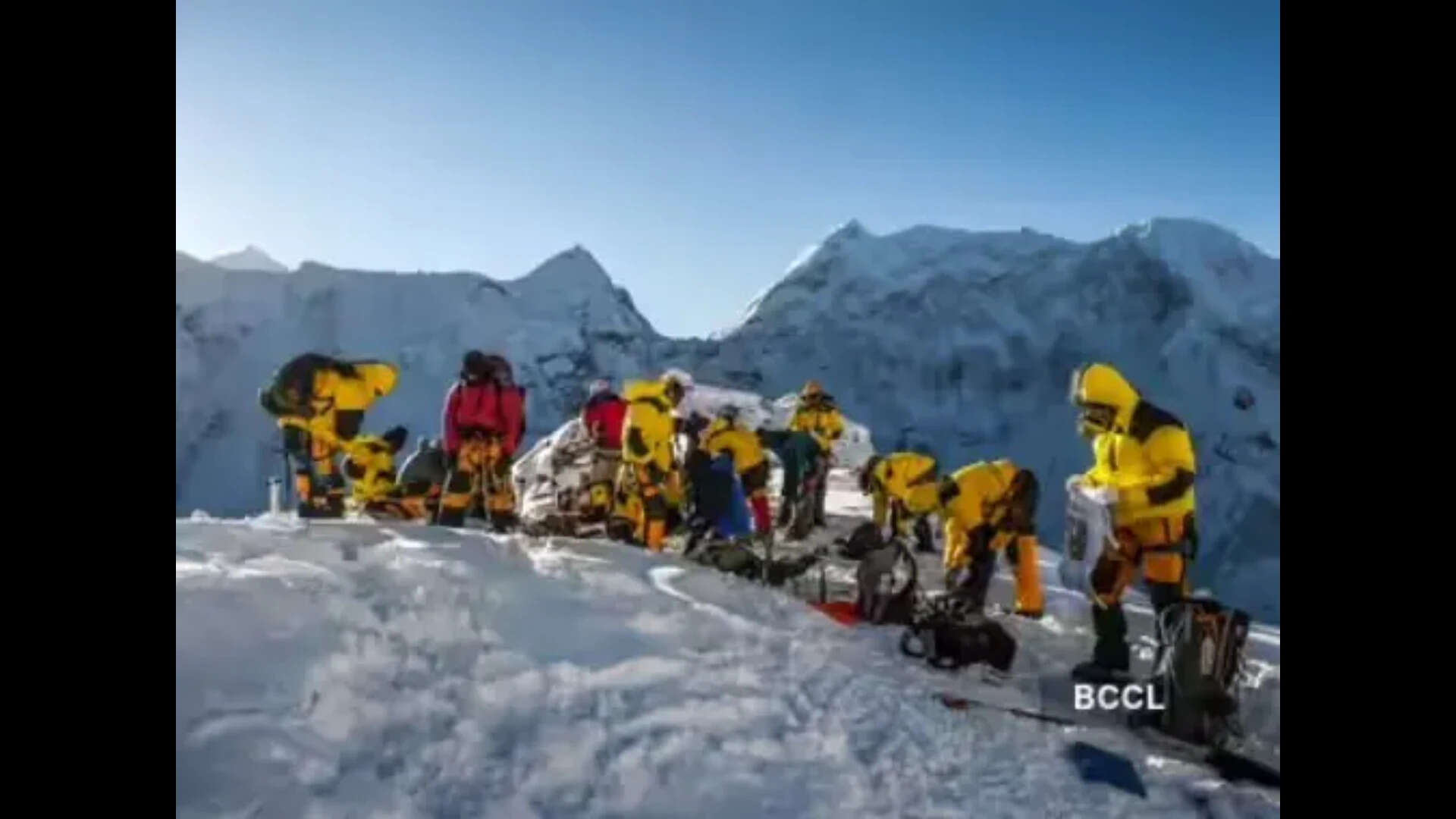
For decades, Western companies sold the Everest dream to the world while Sherpas provided the muscle. Agencies based in New Zealand, Britain and the US marketed summit attempts to wealthy climbers and charged premium fees while Sherpas carried oxygen cylinders through Khumbu Icefall, fixed ropes above 8,000 metres, set up camps in avalanche zones and guided — sometimes even carried — exhausted clients to the summit.
All that is changing now.
Expedition literature — stretching from early British colonial endeavours to the rise of commercial guiding in the 1990s — reduced Sherpas to "porters, cooks, support staff," shifting the heroic spotlight onto foreign climbers. Yet, the survival of these expeditions depended squarely on Sherpa expertise. Jon Krakauer highlighted this reality in ‘Into Thin Air’, his account of the 1996 Everest disaster, in which eight people, including celeb guides Rob Hall and Scott Fischer, died. “None of us would have stood a chance on Everest without the help of the Sherpas,” Krakauer wrote.
Until 2010, outfits like Adventure Consultants and Himex (New Zealand), Alpine Ascents International and International Mountain Guides (US), and Jagged Globe (UK) dominated Everest, while Nepalis worked merely as employees for these firms.
The shift that followed was turbulent. In 2013, Sherpa rope-fixers and three European climbers — Ueli Steck, Simone Moro and Jonathan Griffith — brawled at Camp Two after the climbers entered an active rope-fixing section on Lhotse Face, causing ice to fall on Sherpas working below. A written agreement was made, and the Europeans cancelled their climb. The episode came to symbolise Sherpas’ growing assertion over Everest operations.
In his book 'Everest, Inc.', Will Cockrell wrote, “This fight was not just a dispute over an insult or hanging a rope. By that time, Sherpas were feeling that their ownership and control in the Everest climbing industry were increasing. They felt that they were being looked down upon by foreign climbers, and this incident was like a big rebellion they did for their self-respect and rights.”
A year later, 16 Sherpas died in an avalanche in Khumbu Icefall, triggering strikes and demands for better compensation, insurance and worker protections. They submitted a charter of demands to govt. The incident changed the power balance and upended the hierarchy. Sherpas now own expedition agencies, control logistics and direct climbs, increasingly running the Everest economy.
“Compared to a decade ago, 80 to 90% of the Everest mountaineering economy is under the control of Nepali companies,” Medhavi Gulati, a former member of URField Lab-Kathmandu who studies mountains and Sherpa communities, told TOI. “In a sector where international operators once dominated, Nepali operators have gained significant economic power, and foreign companies are slowly exiting.”
The movement also followed the money. As climbers from India, China and Southeast Asia became a larger force on Everest, many began booking directly with Kathmandu-based firms that offered cheaper packages and controlled more of the supply chain themselves. This season, Nepal issued a record 494 Everest permits to climbers from 55 countries, including 61 Indians and 109 Chinese, while the US fielded 77.
Nepali firms sell entry-level Everest climbs for $30,000 to $45,000, undercutting many Western operators that charge $50,000 to $100,000, while "luxury" packages can go up to $300,000. Everest no longer has to be sold through London or New York when Mumbai, Delhi and Beijing can deal directly with Kathmandu.
Founded in 2009 by Mingma Sherpa and his brothers, Seven Summit Treks has grown into a powerhouse that now operates expeditions in Pakistan and Tibet. This season, the agency is handling 85 Everest climbers entirely on its own. For Mingma, 47, the trailblazing Nepali climber who was the first from his country to summit all 14 peaks above 8,000 metres, the industry's evolution is obvious in how clients book their trips.
“Many people who want to climb mountains used to contact foreign companies first; now they come directly to us,” Mingma told TOI. “It’s not that people don’t come through foreign contacts anymore, but that number is small -- of the 492 Everest permits issued this year, just about 100 have come through Western agencies while the rest came through direct contact with Nepali companies.”
Nepali firms also won the business by taking over the supply chain. Several operators now manage oxygen procurement networks, helicopter partnerships, equipment inventories, base camp infrastructure and large teams of high-altitude Sherpas. “The old narrative said only Western agencies possessed the professionalism and prestige to run premium expeditions,” said Nirmal “Nims” Purja, co-founder of Elite Exped and a former Gurkha and British special forces soldier whose 2019 dash across all 14 peaks above 8,000 metres was chronicled in the Netflix documentary ‘14 Peaks: Nothing Is Impossible’. “We completely shattered that myth.”
Tashi Lakpa Sherpa, founder and CEO of 14 Peaks Expedition, said, “For nearly a century, our people were the invisible backbone of this mountain range. We are no longer just guiding climbers to the top; we are building international corporations.”
Gulati said the expansion reflected a deeper shift in skill, training and confidence among Sherpa operators who had spent decades learning Everest from the inside before turning that knowledge into business power. As global climbing demographics changed, Nepali firms such as Seven Summit Treks, 14 Peaks Expedition, Elite Exped, Asian Trekking, Pioneer Adventure and 8K Expeditions moved from support roles to the centre of the market.
Mingma David Sherpa, co-founder of Elite Exped, said the shift reflected decades of accumulated knowledge among Sherpas who had started at the bottom of the hierarchy. “I started carrying the heavy loads of foreign clients through the Khumbu Icefall,” Mingma David said. “But over the years, we didn’t just learn how to climb — we learned how to operate.”
Formal training helped complete the shift. Mountaineering schools in remote places such as Humde and Phortse produced a generation of Sherpas who were not just strong high-altitude workers but skilled technical climbers, rescue hands and expedition managers. Their expertise gave Nepali companies the ability to run large commercial operations without relying on Western leadership, while the global Sherpa brand — built on records, rescues and repeated Everest summits — gave those companies credibility with international clients.
“The people who best understand how to survive the mountain are now the ones running it,” Mingma David said.