
Thousands of residents who were forced to evacuate from the region of Madrid returned home on Wednesday as the wildfires had been stabilised.
A day prior, Spanish authorities had lifted over a dozen evacuation orders for municipalities west of the capital of Madrid, where the fire had burned most fiercely.
"24,000 evacuated individuals have been able to return to their homes, and another 20,000 have been released from confinement in the Community of Madrid," central government delegate to the region Francisco Martin Aguirre said on X late on Tuesday.
Regional authorities said weather conditions improved overnight, which helped firefighting teams reduce the intensity of the fires.
On Tuesday, President of the Community of Madrid Isabel Díaz Ayuso wrote the situation was "improving little by little,"
Also in Valencia, the regional government lifted similar measures, although on Tuesday, firefighters struggled to contain advancing wildfires in the province of Castellon due to high temperatures, strong winds and terrain with difficult access.
The main areas of concern were between the small towns of Artana and Eslida.
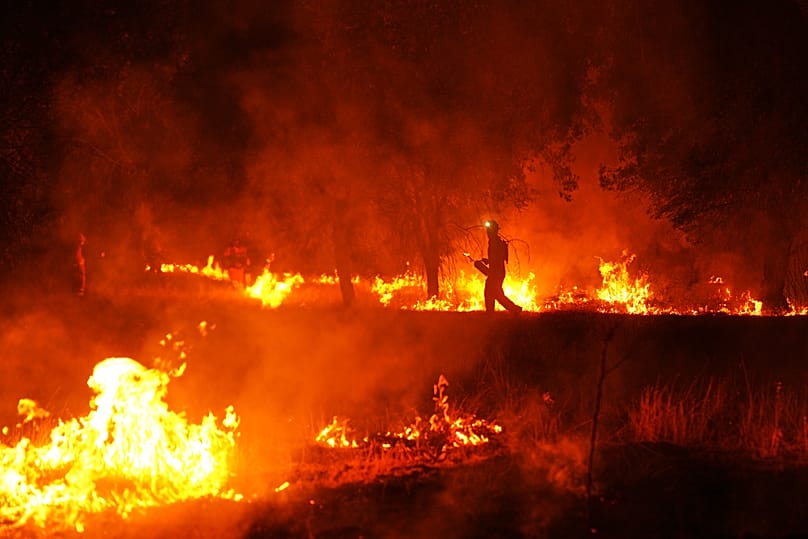
In total, 207,000 hectares of land have burned across Spain so far this year, the highest amount recorded in the country for any January-to-July period, according to the European Forest Fire Information System. Spanish authorities have reported marginally different figures.
In neighbouring France, 92,000 hectares were burned, the largest on record in two decades.
France remains vigilant amid new incoming heatwave
Authorities in the Gironde prefecture, the most heavily impacted by the wildfires, reported a second calm night, adding that the major fire near the city of Bordeaux was stable.
However, French President Emmanuel Macron—who called the fire crises the country's worst crisis since WWII—reminded the coming weeks will be tough, with weather conditions set to worsen on Wednesday.
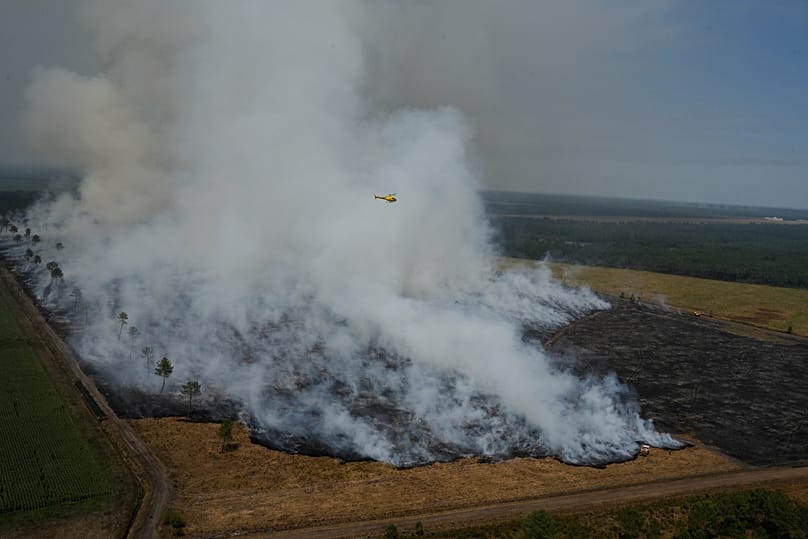
Both the Girande and Landes regions are under an orange-level warning, with temperatures expected to reach 41 degrees Celsius inland and 38 on the coast.
Strong winds with gusts of 30 to 45 km/h are also expected, raising concerns that they could reignite the fires.
Wednesday "will be an important day that we will be watching very closely, given the extreme temperatures we are going to have," Gironde fire chief Lieutenant Colonel Eric Pitault said on Tuesday.
Europe is the world's fastest-warming continent
The wildfires that swept across Spain and France are among the largest the two countries have experienced in recent history.
Scientists have warned that the June heatwave, which helped fuel the wildfires, was not an isolated event.
According to their European State of the Climate 2025 report, Europe is the fastest-warming continent in the world, with temperatures rising at around twice the global average.
Climate experts warn that human-induced climate change is making heatwaves more frequent, more intense, and increasingly likely to occur earlier and later in the year.