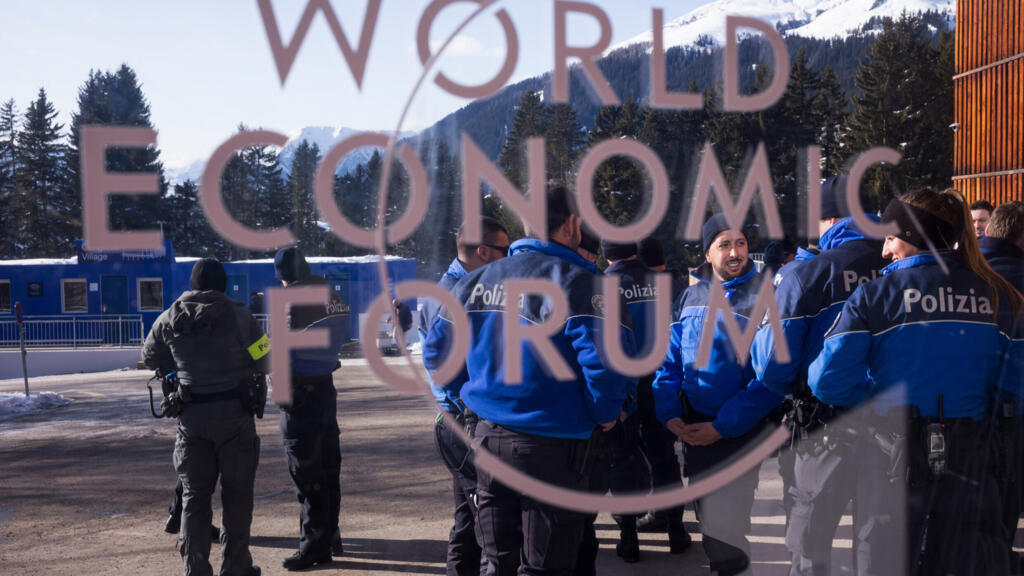
European leaders take centre stage at Davos on Tuesday, hoping to steady fraying transatlantic ties before US President Donald Trump arrives with fresh tariff threats aimed at the EU over Greenland.
European Union chief Ursula von der Leyen and French President Emmanuel Macron will address the World Economic Forum (WEF) on Tuesday, alongside Chinese Vice Premier He Lifeng and Canadian Prime Minister Mark Carney, whose countries have their own disputes with Trump.
Trump will deliver a speech on Wednesday and attend other events on Thursday.
His participation is set to dominate the week at the Swiss ski resort, after he said he would take part in a meeting of "various parties" while there about his bid to take over Greenland.
Europe is weighing countermeasures after Trump threatened to impose tariffs on eight European countries over the standoff.
The US president said he did not think European leaders would "push back too much" on his attempt to buy the vast Arctic island, telling reporters on Monday: "They have to have this done. They can't protect it."
What is the EU’s ‘anti-coercion instrument’ and will it be used against Trump?
Trump has flagged wanting to protect Greenland from perceived Russian and Chinese threats as a key justification for taking over the strategically-located territory, though analysts suggest Beijing is a small player in the region.
US Treasury Secretary Scott Bessent, who is leading the US contingent in Davos, warned that EU retaliation "would be very unwise".
Von der Leyen met with a bipartisan US congressional delegation in Davos on Monday and said on social media that she had "addressed the need to unequivocally respect the sovereignty of Greenland and of the Kingdom of Denmark".
While Macron will leave on Tuesday without seeing Trump in Davos, German Chancellor Friedrich Merz said he would seek to meet the US president at the forum on Wednesday.
European allies hit back at US threat to start trade war over Greenland
Merz said Germany and other European countries agreed "that we want to avoid any escalation in this dispute if at all possible".
European Union leaders will hold an emergency summit in Brussels on Thursday to discuss their response to the Greenland crisis, one of the gravest in years to hit transatlantic ties.
Macron sent a "private message" to Trump offering to organise a G7 summit in Paris on Thursday in which Russia could be invited on the sidelines.
"I can organise a G7 meeting in Paris on Thursday afternoon after Davos," Macron wrote. "I can invite the Ukrainians, the Danes, the Syrians and the Russians on the sidelines" of the meeting, he added.
Macron warns of 'cascading consequences' if US seizes Greenland
At a news conference in Davos, Finland's President Alexander Stubb said "tariff threats at the allied level are unacceptable. They weaken our transatlantic relationship and, in the worst case, can lead to a vicious cycle".
When asked if the United States might use force, Stubb said: "I don't believe that the United States will take control of Greenland militarily."
Denmark has proposed that NATO start surveillance operations in Greenland to confront security concerns.
Other prominent foreign leaders addressing the WEF on Tuesday include Carney, who has sought to reduce his country's reliance on the United States as Trump has raised tariffs on Canadian products.
As US ties fray, Carney turned the page on years of diplomatic tensions with China during a visit to Beijing last week, securing a preliminary trade agreement to reduce tariffs.
Chinese Vice Premier He Lifeng, whose country has had long-running trade spats with Trump, will also address the WEF.
Other flashpoints on the WEF agenda include the crises in Venezuela, Gaza, Ukraine and Iran.
(with AFP)