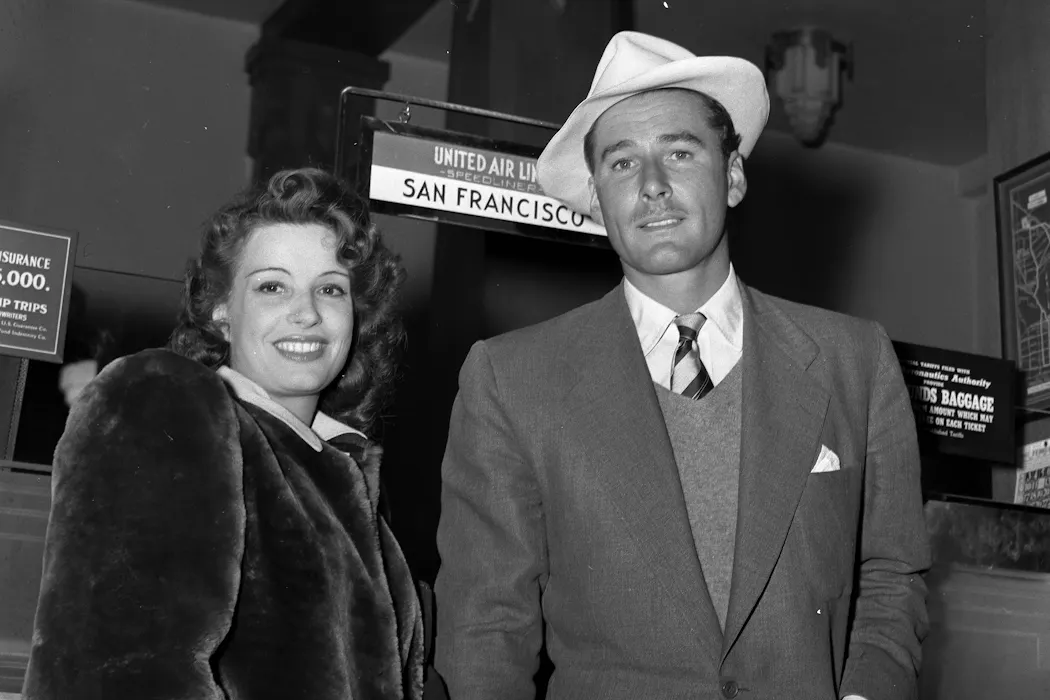
Before Rupert Murdoch, there was Errol Flynn. The Tasmanian born Hollywood actor was arguably our most famous export to the United States until Murdoch moved in to control much of its media.
Between 1934 and his final film in 1959, Flynn was one of the stars of the “golden age” of Hollywood, known for his swashbuckling roles in films such as The Adventures of Robin Hood and Captain Blood.
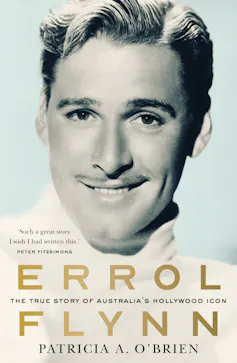
There is already a considerable literature on Errol Flynn, including his own autobiography, My Wicked, Wicked Ways, but Patricia O’Brien has taken his life as a way of exploring the intertwined assumptions around race and sex that make Flynn a remarkable epitome of his time.
Errol Flynn: The true story of Australia’s Hollywood Icon – Patricia O’Brien (Allen & Unwin)
Flynn died in 1959, after appearing in 57 films, listed in an appendix. He was subsequently portrayed on film by Guy Pearce, Jude Law and Kevin Kline. His fame lives on in the expression “in like Flynn”, though the phrase was in use long before it became associated with him. There is even an Australian film of that name, about Flynn’s time in New Guinea, which has, deservedly, been largely forgotten.
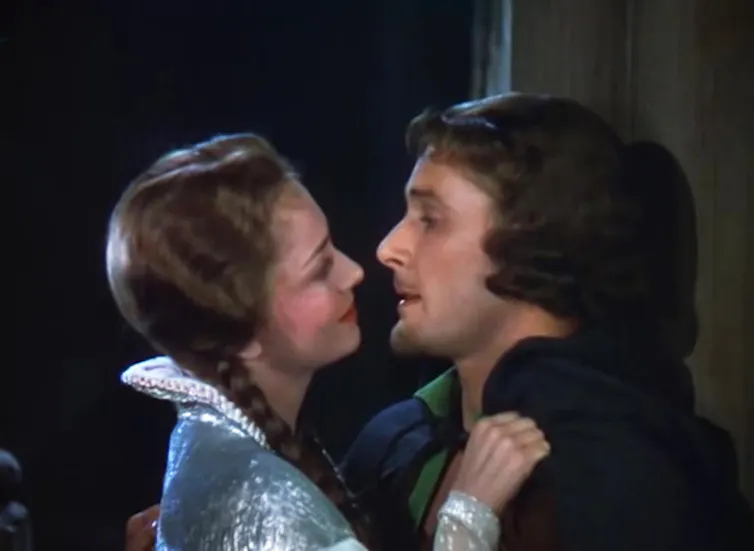
Times have changed, and most of Flynn’s films now seem at best B-grade, replete with assumptions of white male privilege. In the interest of research, I subjected myself to several of his lesser-known films, Gentleman Jim and The Adventures of Don Juan. Sadly, I remained impervious to his charm.
Whether cast as a boxer in 19th-century San Francisco or a Casanova in 16th-century Spain, he seemed to be playing the same role: smooth, charming and the inevitable winner against impossible odds.
Bodies have changed over the past 80 years; once regarded as a perfect male, Flynn would hardly measure up against the gym-toned buffness of today’s Hollywood actors.
During his career, Flynn was often described as Irish, but he grew up in Hobart, where he attended all the best schools, and was expelled by most. His parents had a tumultuous marriage, and his mother soon moved to Sydney. Flynn followed, to attend Shore Grammar, from which he was also expelled.
Do we need yet another biography?
A wealth of unnecessary vulgarity?
Much of what O’Brien writes repeats the basic story Michael Freedland recounted in The Two Lives of Errol Flynn, though without the overwhelming emphasis on Flynn’s reputation as “a man’s man whose principal hobby was women”. While Freedland revelled in sexual gossip, O’Brien approaches Flynn as emblematic of a larger culture than the Hollywood world.
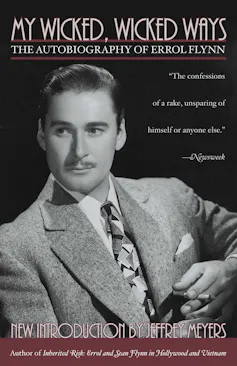
The year before his death Flynn hired a ghost writer, Earl Conrad, to help produce his own autobiography, My Wicked, Wicked Ways, which had mixed reviews. It is, as one might expect, self-serving but entertaining, in the way bad reality shows are when one is tired, stressed and willing to suspend judgement.
In the conclusion to his autobiography, Flynn claimed: “few others alive in the present century have taken into their maw more of the world than I have”. Contemporary readers might agree with Noel Coward’s judgment: “Such a wealth of unnecessary vulgarity”.
O’Brien approaches Flynn’s life in her capacity as a Pacific historian, based both in Australia and the United States. Her contribution is to situate Flynn within the racist culture of British imperialism, most notably in the discussion of his time as a young man in New Guinea.
After World War I, the former German colony of New Guinea was added to Australia’s control of Papua and remained under Australian rule until Whitlam declared independence for the colony in 1975.
The 18-year-old Flynn was lured to New Guinea by the gold rush of 1927, and remained there for six years, seeking his fortune in mining and tobacco. In ways that are rather unusual for the biography of a movie star, O’Brien dissects the appalling racism of Australian rule, which reinforced the sense of racial superiority Flynn had learnt from his father back in Tasmania.
Theodore Flynn, who was the first professor of biology in Tasmania, had strong views about the superiority of the white race and the undesirability of interracial sex, but his son’s sexual appetite meant he was soon taking advantage of his colonial privilege to bed local women.
From his teenage years, Flynn seems to have regarded any woman he found attractive as fair game. He continued to bed a large number of young women, despite his three unsuccessful marriages.
O’Brien calls him “the greatest heartthrob of his time”, which ignores actors such as Humphrey Bogart and Clark Gable, neither of whom are acknowledged in this book.
But his reputation as a great lover was established from his first days in Hollywood, through three marriages, countless affairs and several accusations of rape.
A sexual culture like Epstein
O’Brien devotes a chapter to the major rape trial in Los Angeles in 1943, where the judge appears to have shown extraordinary sympathy to Flynn, who was eventually acquitted. O’Brien is right to point to the ways Flynn represented a sexual culture we associate with Jeffrey Epstein today.
There are echoes of Ernest Hemingway in Flynn’s life; he also spent time as a sporadic war correspondent in Spain during the Civil War, where he sympathised with the Republicans. More interesting was his time in Cuba in 1959, where he spent five days alongside Fidel Castro.
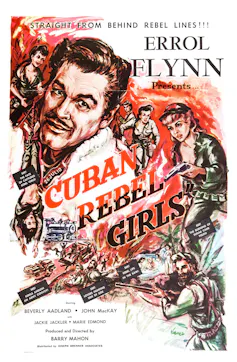
His final film, Cuban Rebel Girls, is a mixture of support for Castro and heterosexual titillation. This provided the basis of a novel by Boyd Anderson (Errol, Fidel and the Cuban Rebel Girls) that even my duties as a reviewer could not persuade me to pursue.
Most of us will share a dislike of the racism and sexism central to Flynn’s life and career – but at times O’Brien’s judgements grate, as when she refers to Nabokov’s Lolita as “a tawdry tale of abuse and ‘perversion’”.
Claims of a liaison with Tyrone Powell – and a rebuff from David Niven – are dismissed by O’Brien as “preposterous”. Without accepting the gossip relayed in Charles Higham’s Errol Flynn: The Untold Story, I would have liked more willingness to explore the persistent rumours of Flynn’s possible bisexual side.
Occasionally, O’Brien lapses into the sort of exaggeration common to movie star biographies, as when she writes: “he was about to conquer the vast land that lay ahead of him in ways no man had done before”. (Maybe she intended irony?)
But Errol Flynn is compulsive reading – even if few of his films deserve re-screening.
This article was originally published on The Conversation. Read the original article.