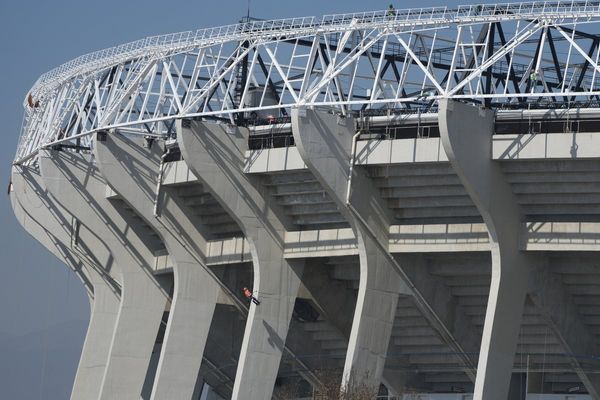
If England could choose the perfect day to be in Ireland pursuing a grand slam this would not be it. St Patrick’s weekend is in full exuberant swing and there are enough American tourists in Dublin to invite comparisons with Chicago, where Ireland ended New Zealand’s 18-Test winning streak in November. With England also now seeking a 19th straight victory, the omens are not wholly favourable.
The Ireland captain, Rory Best, certainly did not sound like a man throwing in the towel as he sat in the bowels of the Aviva Stadium contemplating the final act of a compelling tournament. Instead, the Ulsterman politely suggested the away team should be feeling the more anxious: “We’re well aware what England are going for but it’s St Paddy’s weekend and we’re at home. We’ll beat England because we’re pulling on a green jersey and we expect a better performance than we have delivered so far.”
Goodness knows how sky-high the anticipation levels would be were Ireland still eyeing the title, rather than merely competing for second place. England should also be aware Best’s side are desperate to avoid slipping from the top four in the world rankings, which could condemn them to a horrible 2019 Rugby World Cup pool draw. Should Wales beat France in Paris and Ireland lose, that risk will become a probability.
So, no pressure for Dylan Hartley and his band of (thus far) invincibles. The good news for supporters crossing the Irish Sea is that the visiting team are not shy of conquering foreign fields. Since Eddie Jones took charge they have won in Edinburgh, Rome, Paris, Brisbane, Melbourne, Sydney and Cardiff, an impressive list by anyone’s standards. “We’re ready as a team to take the next step,” insisted Hartley, who did not require a message from Will Carling this week to remind him the last England team to win back-to-back grand slams was 25 years ago.
Hartley’s first instinct is to distance himself from such fate-tempting chat – “Carling has been texting me, telling me how great he was. You can’t call yourself great, can you?” – but he also knows what a huge opportunity awaits. Win and he will celebrate his 31st birthday next week as the skipper of a squad who – with apologies to Cyprus, who won 24 games on the trot at a less exalted level – have strung together more consecutive Test victories than anyone in history. As epitaphs go, it reads slightly better than his disciplinary record.
Given his memories of last year’s grand slam were hazy because of the concussion he suffered in Paris, this would also be a glorious antidote to past failures, not least the “dirty feeling” he and others experienced against the same opponents in 2011. “James Haskell has been playing since 2007 and what’s he got to put to his name?” asked Hartley, rhetorically. “Aside from last year, only a Six Nations title a few years ago when we lost the final game. That’s a dirty feeling to have.
“Looking back – and knowing how hard we train and prepare now – I didn’t do what I needed to be right for that game and people like James would say the same. You think you are doing everything right but we were a long way off. You don’t get these opportunities very often in life; we need to make the most of them.”
The other mildly encouraging news for England is that Hartley’s father, Guy, will not be present – on the last two occasions he has flown over from New Zealand, England were hammered in Cardiff in 2013 and Northampton lost to Leinster in the 2011 European Cup final. The latter game was among Johnny Sexton’s finest hours but the great Irish fly-half, still battered from the Wales game, must tackle the English without his tactical lieutenant Conor Murray on Saturday.
With the beanpole figure of Devin Toner also not starting, England may just fancy their chances in the lineout where Maro Itoje will be hoping to complicate the lives of Best and Murray’s replacement Kieran Marmion, who will be making his first Six Nations start. If the fit-again Billy Vunipola also starts to rumble, Ireland will need to muster all the defensive sinew they possess.
In that respect they have the perfect defence coach: if anyone should know how to make life awkward for Owen Farrell, it is his father, Andy. When Best spoke about the need for “a green wave” of Irish defenders to swamp their opponents, he did so in the certain knowledge Farrell Sr will not stand for a repeat of the 3-0 try-count in Wales’s favour last week. England may have scored seven tries against Scotland but they will not enjoy the same midfield freedom here.
Ever since slipping in the bathroom on the morning of the tournament launch and bashing his head, however, Jones has scarcely put a foot wrong – at least not in terms of motivation. In Hartley, he also has a captain with the knack of establishing the right pre-match tone. “People are asking about Ireland stopping us after stopping the All Blacks but I try to flip it round,” said the hooker. “My message to the team is that our motivation has to be greater: to kick on and to win the grand slam. That motivation, to me, is greater than upsetting another team’s party.
“We didn’t start by sitting down and saying: ‘Let’s win this many games in a row’. We focused on [winning] last year’s Six Nations and then this one. When you set goals, you like to tick them off. This is our next job. When it comes down to the nitty-gritty it’s just a kick-off, a catch, a carry or a ruck – we have to stay in that moment and not worry about the result. If we do that for 80 minutes, things will take care of themselves.”
Right there is Ireland’s challenge: to rediscover the savage tempo of Chicago and lay glorious waste to England’s perfect day. The champions, though, would have drawn some inspiration from the American woman at the breakfast buffet with “I’m not lucky, I’m good” printed in green capitals on her white top: two English grand slams in succession – and it really should come to pass – would be no fluke.
Previous Ireland v England grand slam deciders
Ireland 20 England 14 20 October 2001
Pre-match Supposed to be third time lucky for England. In 1999 it was Wales’s Scott Gibbs who denied Clive Woodward’s side the grand slam, a year later it was Scotland but this time England stick more than 40 points on Wales, France and Scotland and 80 on Italy. Nothing can stop them. Well, nothing except the outbreak of foot and mouth which means the match is delayed until October.
The match England, without the injured Martin Johnson and Lawrence Dallaglio, never settle and Ireland march into a 14-6 lead thanks to three David Humphries penalties and a try from the imperious Keith Wood. Jonny Wilkinson pulls England to within touching distance and Dan Luger seems certain to score after a superb solo run until Peter Stringer intervenes. A late Austin Healey try gives England forlorn hope.
The fallout Woodward has recently admitted to making a number of mistakes in the buildup to the match such as not organising any warm-up matches while Ireland had two other postponed Six Nations fixtures beforehand. While England still win the Championship, Neil Back remarks that: “It is impossible for me to believe that any side in the history of sport has felt so empty at being declared the best.”
Ireland 6 England 42 30 March 2003
Pre-match After France had claimed the title the previous year, England move up the gears before arriving in Ireland, who are also on course for the grand slam – their first since 1948. Martin Johnson sets the tone when famously refusing to budge, even for the then Irish president, Mary McAleese, after lining his team up on the wrong side of the pitch for the anthems.
The match The scoreline suggests a hammering but in truth it is a ferocious contest in which England’s defence is superb. England are only 13-6 to the good at half-time but rattle off 29 unanswered points in the second half with Will Greenwood finishing with two tries and Dallaglio, Luger and Mike Tindall all one apiece. Wilkinson adds 15 points in an emphatic victory.
The fallout As McAleese is forced to walk on the grass, rather than the red carpet, both unions issue apologies but Woodward’s troops go forth to underline their world No1 status by claiming summer victories away to New Zealand and Australia before clinching the World Cup later that year.
Ireland 24 England 8 19 March 2011
Pre-match A youthful England side head to Dublin with optimism in a World Cup year after beginning their campaign with victory in Cardiff and a thumping win over Italy – Chris Ashton scoring four tries in those two matches. Hard-fought wins over France and Scotland follow, putting England, now managed by Johnson, on the cusp of a first grand slam since 2003.
The match An England side that features Dylan Hartley, Dan Cole, Ben Youngs and James Haskell slip to a 17-3 deficit at half-time with Ireland’s scrum on top and Johnny Sexton on song. Brian O’Driscoll then scores a record 25th championship try. Steve Thompson gets a consolation try but England are comfortably beaten.
Fallout England have the ignominy of having to wait to receive the trophy in their team hotel after being crowned champions by virtue of France’s victory over Wales later that night. It proves a defeat that bursts the bubble of growing optimism under Johnson, whose tenure unravels so dramatically at the World Cup later that year.
And the last time Ireland hosted England Two years ago England travelled to Ireland, who were defending champions, confident they could handle their opponents’ kicking game and prevail, as they had done in 2013. They couldn’t – Robbie Henshaw beats Alex Goode to Conor Murray’s box-kick for the game’s only try in a 19-9 win for Ireland. Gerard Meagher