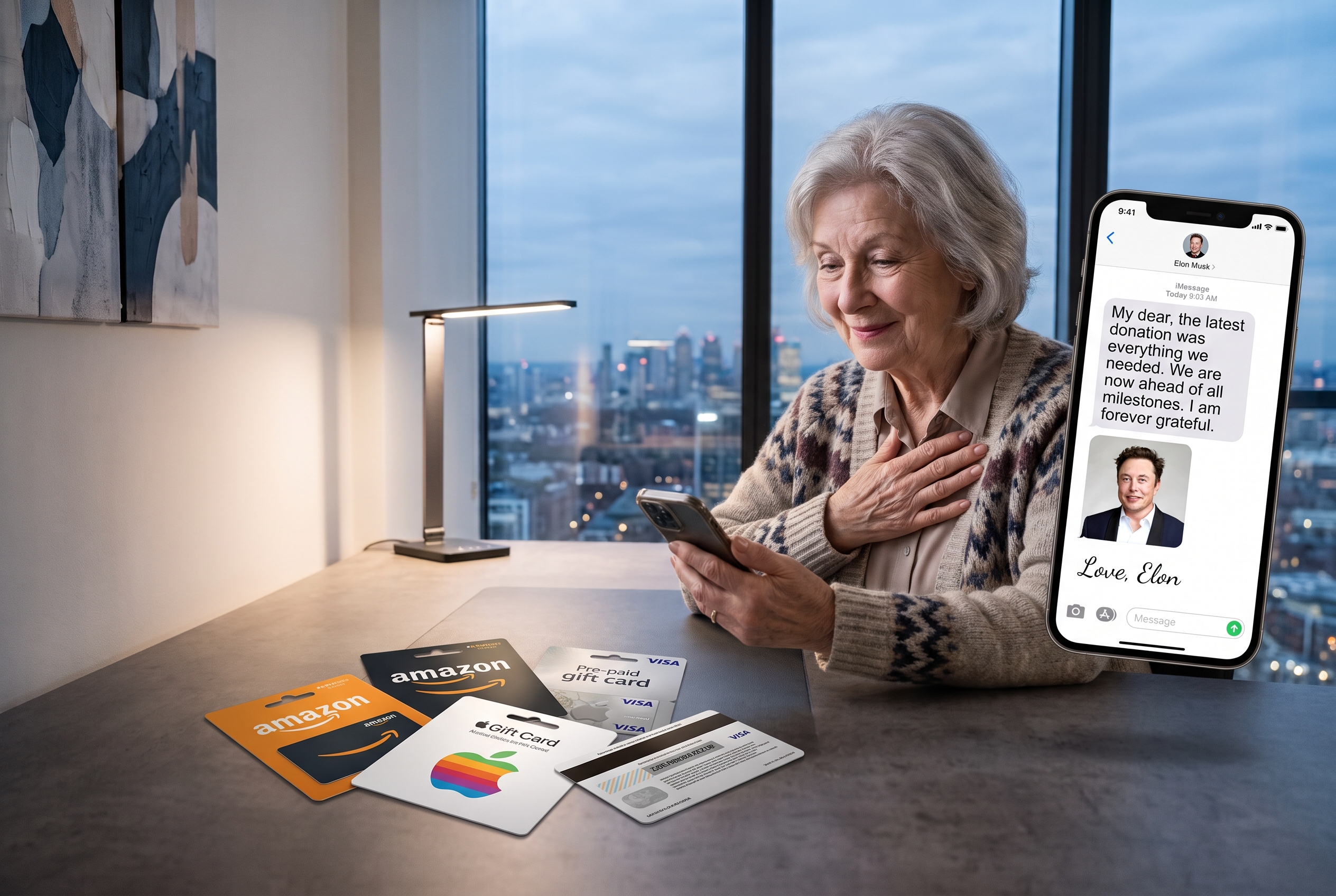
Criminals impersonating Elon Musk and other well known figures are talking victims into buying gift cards. In Surrey and Sussex, women account for 80% of those caught in celebrity impersonation cases, Surrey Police said in a fraud bulletin published in February.
Conventional romance fraud across the two counties is roughly evenly split between men and women.
The same approach is visible in a screenshot posted to Reddit's r/scammers forum this month. A woman's WhatsApp lists a contact called Elon Musk, his photograph set beside a US mobile number carrying a Texas area code. The messages arriving from it ask for gift cards.
Her son posted it with a request for advice. His mother believes she is talking to a real person, he wrote. She receives AI-generated voice notes that appear to come from Musk and others, telling her she is loved, and the account has asked her for gift cards and floated a wire transfer. 'How do I stop these scammers?' he asked.
She also believes she is in contact with Donald Trump and Jesus. The account has no connection to Musk. Criminals take photographs and videos that are already public, then build profiles around them, the force said.
His mother lives on social security payments and a small bank pension, he wrote, and he has no access to her bank accounts. She has refused to see a doctor, insisting she is fine. Taking her phone away would change nothing, he added, because she would replace it.
Where the Fake Elon Musk Scam Sits in Police Data
Reports have climbed sharply over the past year from victims convinced they are in a relationship with a celebrity, the force said. Musk is among the names criminals borrow most often, alongside Keanu Reeves, Emma Watson, and Kevin Costner.
The route the conversations take is consistent. Contact tends to start on Facebook, Instagram, or a dating site before moving to WhatsApp or Telegram, the force said, and excuses follow for why a live video call cannot happen.
The sums run high. One Sussex victim lost £275,000 ($373,000). A woman in Surrey told officers, 'I had to buy him gift cards.' What started as a £20 ($27) request eventually absorbed her whole benefits payment, she said, leaving nothing for her grandchildren's presents or her household bills. It continued for three years and seven months.
Gift Cards and Voice Cloning in the Elon Musk Scam
Retail gift cards sit on the FBI's list of scam warning signs, alongside requests to wire money, unsolicited calls and texts, and offers that look too good to be true. Money that leaves by those routes seldom returns. The bureau describes recovery as difficult and unlikely, particularly where the operation is run from overseas.
Its most recent figures set out the scale. Americans aged 60 and over filed more than 201,000 complaints with the FBI's Internet Crime Complaint Center in 2025 and reported losses above $7.7B (£5.7B). Complaints rose 37% in 2024 and losses 59%. The average reported loss passed $38,000 (£28,000), and at least 12,400 older victims each lost $100,000 (£74,000) or more.
Two things make that age group worth targeting, according to the bureau: savings built up across a working life, and loneliness that makes a stranger's message worth answering. Older victims are also more likely to engage with an unsolicited call, text, or email in the first place.
Stopping the Payments When a Relative Will Not Listen
Surrey Police points to a check anyone can run. Any photograph can be put through a reverse image search, using Google Lens, TinEye, or a similar service, before money changes hands.
A picture that also turns up on fan pages or in press archives belongs to someone whose identity has been taken. Victims in the two counties are asked to call 101.
The victimised woman's son was also urged to approach the bank. Confidentiality rules stop staff discussing a customer's account with a relative, though a family member who can verify their own identity may be able to have it marked as belonging to a vulnerable person.
Ron Miller, a special agent in the FBI's Washington Field Office, reduces the advice to ignoring unsolicited contact altogether. 'Just don't engage', he said.
The post does not say how much the woman has already handed over, whether any of it has been reported to police, or whether her bank has been alerted. No arrests have been announced.