With the polls so tight, traders are unsure how to position themselves. A whole host of scenarios have been considered for the election aftermath. So once some kind of result is in, how best to gauge what investors make of it?
Ian Stewart, chief UK economist at Deloitte, has come up with some key indicators to watch on Friday and the days that follow. We pick out five here.
Deloitte’s latest survey of chief financial officers at big companies highlighted their fears over policy shakeups, following the election. The second biggest source of anxiety was the potential turmoil of a vote on Britain’s membership of the EU, as promised by David Cameron.
Stewart comments:
There are three concerns for markets and businesses after the election. One fear is a breakdown of what was thought to be a consensus about deficit reduction. The second is accretion of regulation and tax, so a re-setting of micro-economic policy to the left, and the third thing is Brexit.”
His top indicators to watch include:
1. Market expectations for interest rates
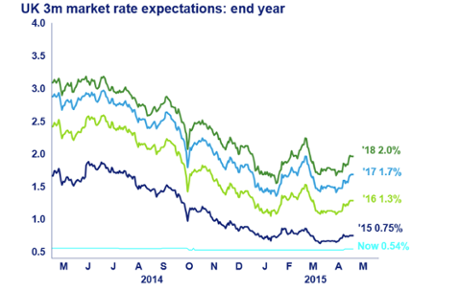
The lines show where traders expect three-month interest rates – which run at similar levels to base rates – to be at the end of this year, next year, 2017 and 2018. As the chart shows, over the past year, financial markets have lowered their expectations for interest rates.
Stewart notes:
If the general election ushers in sustained political uncertainty that seems likely to weigh on growth, market expectations for interest rates are likely to drop further. Conversely, if the new government were decisively to break with austerity and seek to boost the economy through more public spending, interest rate expectations are likely to rise.”
2. Mortgage rates
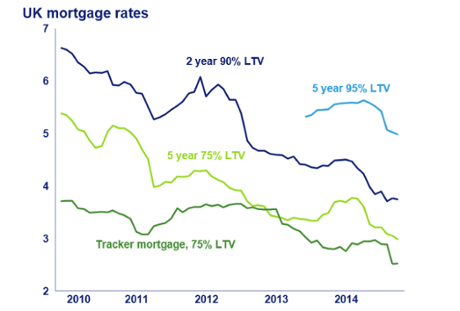
Similar to market expectations for base rates, as set by the Bank of England, mortgage rates are likely to move, depending on the election outcome.
3. FTSE 100
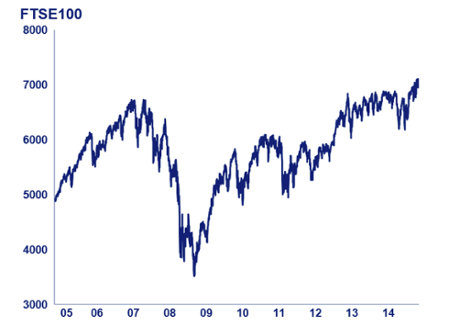
The index of leading London-listed shares, the FTSE 100, is near an all-time high. There are fears that an inconclusive outcome could knock confidence. Some analysts have warned that a Labour government, or Labour-led coalition, could put shares in banks, bookmakers and energy companies under pressure. Meanwhile, the prospect of an EU referendum under the Conservatives could knock the whole index back, analysts warn.
4. Foreign exchange volatility
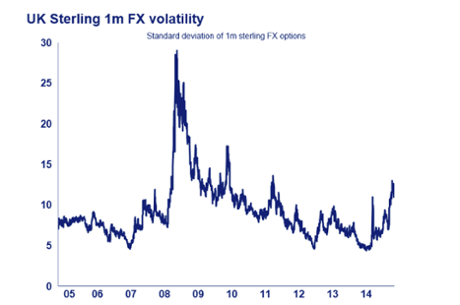
This is a measure of uncertainty in the foreign exchange market for sterling. “If the election – as seems quite likely – delivers no clear winner, and a period of deal-making as parties try to build viable alliances, this measure is likely to rise,” says Stewart.
5. Gilt-Bund spread
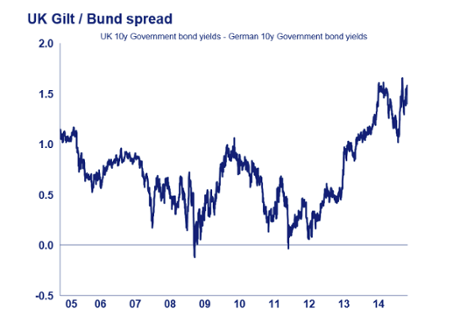
This shows the gap between the yield, or interest rate, on benchmark 10-year UK government bonds (gilts) and on 10-year German government bonds (Bunds). Both Bunds and gilts have been seen as safe-haven investments in these recent times of instability in the eurozone. So their yields are lower than the equivalent interest rates on French, Spanish and other bonds (yields move inversely to the price of a bond. So a lower yield indicates higher demand).
Yields on gilts are higher than yields on Bunds and the gap between the two has widened since 2012, as shown in the chart.
Looking at the gap, or spread, between Bund and gilt yields gives an indication of (among other things) the relative risks investors attach to each economy and ultimately each government’s credit-worthiness. If the spread widens, for example, it shows investors have a preference for owning German government bonds relative to gilts.
In the election aftermath, this is one to watch but will not necessarily be easy to interpret.
If spreads were to increase markedly following the election result, this could be interpreted as a sign of:
a) Improved confidence in the UK’s growth outlook, therefore an expectation of rising interest rates
b) Concerns that a lack of fiscal tightening will usher in higher base rates or cause growing worries about the UK’s credit-worthiness
c) Higher risk premia on the back of growing political uncertainty related to the prospect of minority governments and the risk of another election.