Jamie Grierson's evening summary
A sign of desperation or a shrewd turn to a safe pair of hands? Sir John Major was wheeled out by the Tory party today as the three-way war of words between the Conservatives, SNP and Labour continued to heat up. Major, dubbed a “party legend” by the Sun’s political editor Tom Newton Dunn and “Jurassic John” by the Mirror’s Kevin Maguire, warned voters of the perils of a Labour-SNP tie-up after the election. He said it would be a “recipe for mayhem”.
But the real mayhem appears to be the in-fighting the Tory’s focus on the SNP has sparked. Amid deepening unease among Tory grandees, former Tory chairman Lord Tebbit said it was “logical” to vote Labour in areas where Conservatives stand no chance. His comments follow the remarks of Tory peer Lord Forsyth that leading Conservatives are playing a “short term and dangerous” game that threatens the future of the UK by building up the SNP as a way of damaging the Labour party in Scotland.
Cameron is delivering a speech in Bedfordshire tomorrow - let’s see if he respects his elders and count how many times the SNP gets a namecheck.
The big picture

Major’s appearance did successfully wrestle airtime away from Miliband, who delivered a key speech in Manchester on saving the NHS - Labour’s campaign centrepiece. He claimed there is a fortnight to “rescue” the NHS as he accused Cameron of being a “mortal danger” to the service. The Labour leader pledged to take action to “save” it from day one of taking office with a rescue plan to boost funding and tackle a “crisis” in staffing.
What happened today
- Sir John Major has called on the Conservative party to show more passion in its election campaign, as he warned that economic statistics meant nothing unless people feel their lives are improving. The former prime minister praised the coalition government for bringing Britain “back from the brink to the genuine prospect of prosperity”. But he indicated that the Tories needed to liven up their campaign.
- David Cameron is demeaning himself and his office by endangering the union in an attempt to stay in Downing Street, Ed Miliband has said. Instead of confronting the SNP, the Labour leader said, Cameron was talking them up to highlight the threat of a hung parliament and persuade voters to back a majority Tory government.
- The Conservatives are to draft in a deployment of Republican activists to bolster their efforts in key seats before the UK election. In an unusual move, a team organised by the US Young Republicans International Committee will arrive on 2 May to help out in the marginal seat of Enfield North, and the constituency of Aylesbury, where the Conservatives face a challenge from the UK Independence party (Ukip), as well as the safer seat of Windsor.
- Conservative party supporters should consider voting tactically for Labour in most areas of Scotland as the best way of supporting the UK, the former Tory chairman Lord Tebbit has said. Amid deepening unease among Tory grandees at the party leadership’s attacks on Ed Miliband over possible plans for a post-election pact with the SNP, Tebbit said it was “logical” to vote Labour in areas where Conservatives stand no chance.
- Wikipedia has blocked a user account on suspicions that it is being used by the Conservative party chairman, Grant Shapps, “or someone acting on his behalf” to edit his own page along with the entries of Tory rivals and political opponents. The online encyclopedia, where pages are edited and created by readers, has tracked the changes made by a user called “Contribsx” who has systematically removed embarrassing references on Shapps’ Wikipedia page about the Tory chairman’s business activities as Michael Green, the self-styled millionaire web marketer.
- The Scottish National party’s flagship financial policy of full fiscal autonomy could lead to a shortfall of nearly £9bn in Scotland’s finances by 2020, according to the latest projections from the Institute of Fiscal Studies – a gap that would only be closed if growth were to double that predicted for the UK as a whole. The IFS published its report on Tuesday after the SNP leader, Nicola Sturgeon, dismissed as irrelevant the institute’s previous projection of a £7.6bn shortfall for 2015-16 under the policy, which would require Scotland to fully fund spending through its own tax revenues and borrowing.
-
London mayor is being primed to take bigger role in Conservative campaign after getting starstruck response while canvassing in the capital.
- Nigel Farage has said that critics of the lack of ethnic diversity in the Ukip manifesto have got it wrong, because along with “one fully black person” it also features a “half-black” party spokesman. The spokesman the Ukip leader was referring to is Steven Woolfe, the party’s migration spokesman, whose grandfather was African American.
-
With just 16 days to the election, the latest Guardian projection has the main parties virtually tied: the Conservatives are on 271 seats and Labour on 270. Behind them, the SNP is projected to win 55 seats, the Lib Dems 28, Ukip four and the Greens one.
Quote of the day
Grant Shapps is a fine man and has never done anything dodgy – Paddy Ashdown*
*In response to a story by the Guardian’s Randeep Ramesh on claims Grant Shapps has edited the Wikipedia pages of his Tory rivals under a username Contribsx, the Lib Dems sent out a cheeky press release with this “quote” from Lord Ashdown before adding: “This Press Release has been edited by Wikipedia user Contribsx”
Due to popular demand. The Lib Dems press release on Grant Shapps in full. pic.twitter.com/H6ZXB9zoSE
— Lib Dem Press Office (@LibDemPress) April 21, 2015
Hero of the day
Fictional Danish prime minister Birgitte Nyborg Christensen, played by Sidse Babett Knudsen. Not our hero of the day, but Nicola Sturgeon’s, who confessed to having re-watched Borgen “once or twice”.
Villain of the day
Peter Endean, who is standing for Nigel Farage’s party in the council elections in Plympton Earle and is UKIP’s communications manager for Plymouth, re-tweeted an image of some of the rescued migrants with a caption that said: “Labour’s new floating voters. Coming to a country near you soon”. He later apologised.
Plymouth Ukip candidate apologises for retweeting offensive picture, blames large fingers http://t.co/uM0ymLtVJA pic.twitter.com/w5qTua0c3G
— Plymouth Herald (@PlymouthHerald) April 21, 2015
Tomorrow’s agenda
Tomorrow is likely to be dominated by the Boris show as the Tories seek to weaponise their prize jester. London’s mayor is to be given a bigger role in the Conservative campaign after getting starstruck response while canvassing in the capital.
Other events:
7.30am - Lib Dem leader Nick Clegg is expected to give a press Conference at the National Liberal Club
9am - David Cameron is expected to deliver a speech in Bedfordshire
7.30pm: Ukip leader Nigel Farage will appear on BBC Leader Interviews
That’s it for me for today. It has been a pleasure. Join the Guardian’s election team tomorrow morning, as we bring you the latest news, reaction, analysis, pictures, video, and jokes from the campaign trail.
Updated
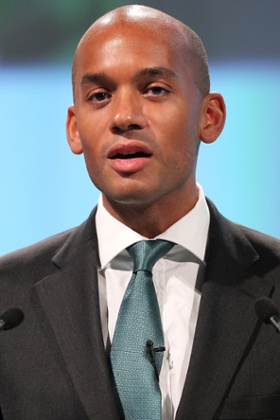
Shadow business secretary Chuka Umunna has given a personal pitch to the audience at the London Evening Standard debate.
Umunna spoke of his father’s experience as an immigrant in the mid sixties and pledged to improve the lives of Londoners without turning “different groups” against each other.
He said:
I’m very proud to be a Londoner born and bred, but my late father arrived in this city in the mid 1960s from Nigeria with very little and worked his way up to become a successful businessman.
He was probably in the eighties the only member of the Institute of Directors who also worshipped Harold Wilson and the Labour party. Why? Becauyse it was thanks to the Labour party that the signs that greeted him - no blacks, no Irish, no dogs - it was thanks to the laws that we introduced that those signs were taken down and my dad got the fair crack of the whip when he wanted to go for a job.
However, while it’s right we do live in a fantastic city now in 2015, a great city, there are two Londons. One of great wealth, never mind the lattes, think of the champagne, and one where a third of Londoners are living in poverty. That is a disgrace in 2015.
What we are not going to do is tackle these challenges that we face by setting up different groups against each other and blaming immigrants like my father for all of our problems. The only way we can build a better and fairer London is by working together.
Here’s an audioboom link to Umunna’s full opening remarks.
Updated
Buzzfeed has two great pieces on contrasting views of Labour leader Miliband.
Hannah Jewell describes how a Tweet sent by a 17-year-old student about Ed Miliband led to her picking up more than 10,000 followers and launched the hashtag Milifandom.
So many people are saying the #milifandom is the best thing about the election im crying
— abby (@twcuddleston) April 21, 2015
Meanwhile, Siraj Datoo takes a look at the Labour leader’s popularity (or lack thereof) in his own constituency.
If Miliband is going to become prime minister, then the voters of his own constituency, Doncaster North, are precisely the kind of people he needs to reach. Yet even as his national profile rises, the reaction among the locals here suggests that he still has some way to go before he comes across as a truly convincing figure.
The Guardian is working with the pollsters BritainThinks to conduct focus groups throughout the election with 60 voters in five key marginals. Each has an app to feedback what they are noticing in the campaign in real time. From thoughts on manifestos to tactical voting – here’s their reaction to events of the day:
As Milimania threatens to escalate, my colleague Robert Booth reports that the Tories are priming the big guns - Boris Johnson is about to take centre stage in his party’s election campaign.
He writes:
Johnson will join Cameron at a venue in south-west London on Wednesday and he is expected to campaign in 12 constituencies in the capital, making three rounds in each before polling day. This week, he has already been in Uxbridge, Finchley and Hendon. On Tuesday, he was in South Thanet in Kent taking the fight to the Ukip leader Nigel Farage. Twickenham, Ilford, Croydon and Kilburn are all in his sights.
Given the mobs of starstruck voters his canvassing appearances create, it is a strategy that could help the Tories and provide him with a head start for a leadership challenge.
Updated
Danish political drama Borgen depicts a female prime minister running a coalition government against the odds. I’ll leave you to work out why Nicola Sturgeon enjoys the show so much she has re-watched it “once or twice”.
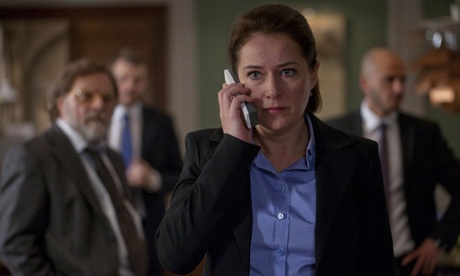
Scotland’s first minister is a long-time fan of the show and even suggested the show’s star Sidse Babett Knudsen could play her in a movie of her life, the Press Association reports.
Ms Sturgeon met Knudsen ahead of an Edinburgh screening of the second-series finale in 2013 and has told the Radio Times it remains her favourite show.
Answering questions about her TV habits, she said Knudsen’s character Birgitte Nyborg was her favourite TV politician. Questioned on which box set she last watched, Ms Sturgeon added: “I may have re-watched Borgen once or twice...”
Other admissions made by the SNP leader included her enjoyment of soaps and TV singing contests X Factor and The Voice.
In the same feature, Green Party leader Natalie Bennett named Jed Bartlett of The West Wing as her favourite TV politician, while Plaid Cymru’s leader Leanne Wood revealed the last programme to make her cry was Michael Sheen’s Valleys Rebellion.
Updated
Miliband: people are seeing the real me
Ed Miliband has put his apparent spike in popularity down to voters seeing the “real me rather than the caricature”.
In an interview with ITV News’s deputy political editor Chris Ship, Miliband was asked about his recent encounter with a hen-do and whether he thought this had helped change the public’s perception of him.
The Labour leader said:
The honest truth is that I feel I’m the same person I was three months ago and I’m just setting out my case.
I think partly what’s happening – I hope – is that people are seeing the real me rather than the caricature.
Turning to more serious issues, the Labour leader repeated his disgust at David Cameron’s SNP scare tactics.
I think David Cameron’s behaviour has been reprehensible. He is trying to set one part of the UK against another. England versus Scotland.
He argued that Cameron’s campaign has been reduced to one thing - “getting back into Downing Street on the back of SNP success”.
Mobbed for selfies at @ManMetUni, EdMili says he thinks voters 'are seeing the real me - rather than the caricature' pic.twitter.com/TPucjduGCC
— Chris Ship (@chrisshipitv) April 21, 2015
The Lib Dems sent out a cheeky press release this afternoon, with the headline:
Grant Shapps is a fine man and has never done anything dodgy – Paddy Ashdown
And signed off with the note:
- This Press Release has been edited by Wikipedia user Contribsx.
Here it is in full:
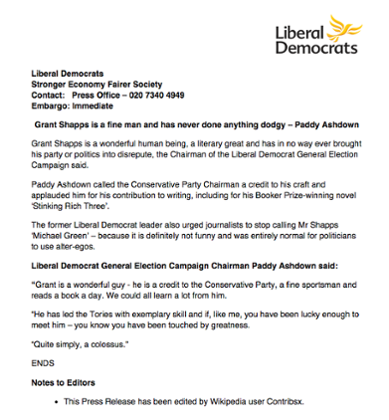
It’s a witty nod to The Guardian’s Randeep Ramesh story on Grant Shapps who is accused of editing the Wikipedia pages of his Tory rivals.
Here’s a selection of pictures coming in to the Guardian from the campaign trail.


Updated
Back north of the border, Scottish Labour leader Jim Murphy has hit out at David Cameron and Sir John Major over their attacks on the SNP.

He said:
John Major and David Cameron have given up on the Scottish Conservative Party and are giving their all to the SNP.
The Tory Party no longer has its own independent campaign in Scotland but has become an active campaigner for the SNP. The Tories are making it clear by their words and their deeds today that David Cameron can only be saved by Scotland voting SNP.”
We are clear that the way to guarantee the end of the Tory government is to vote Labour rather than to gamble on the messy outcomes of a hung parliament.
Updated
Turning to the Lib Dems, my colleague Frances Perraudin reports that business secretary Vince Cable has dismissed a claim by his colleague Andrew George that there will not be another Tory/Lib Dem coalition.
Speaking at an adult education college near his constituency of Twickenham, Cable said:
There could be [another coalition between the two parties]. We’re not ruling that out at all. We’ve worked with them for five years and it’s not always easy.
As I’ve pointed out to people, I’m not a Tory. I’ve fought them all my political life, but I’ve managed to create a good team out of six Tory ministers and two Lib Dems and the public will decide what kind of government they want. If some form of relationship is what the electorate point to, then that’s something we certainly can’t rule out.
Cable suggested that the Conservative party might even need the support of the Liberal Democrats to stabilise a government if they won a small majority.
I have Mr Philip Davies and various other people calling for my head every few weeks, but they’ve got some unappetising alternatives. They might finish up with a very small majority and are then dependent on thirty to fifty kind of head banging characters who detest Cameron and try to destabilise his government.
One of the key election events of the day, John Major’s appearance in the West Midlands, has attracted high-praise from The Sun’s political editor Tom Newton Dunn, who describes the former prime minister as a “party legend”.

Newton Dunn says when “successful” former Prime Ministers speak, Britain listens, and calls Major a “political saint”.
Not least, because we all love a bit of ‘remember him’-type nostalgia, as well as gloating at how greyer / balder / oranger they now are.
But where Mr Tony’s reputation is troubled – to put it politely – Sir John is a modern day political saint.
A YouGov poll in February found him to be the most popular former party leader of the last three decades, Newton Dunn says.
He must have forgotten which paper famously switched sides from Tory to Labour, ditching Major and backing Blair back in 1997. (Hint: his paper).
But most interestingly, Newton Dunn gives his verdict on the real reason why the Tories wheeled out their former leader.
It means Labour don’t get as much air time as they would like for their own current message, the NHS.
It’s Labour’s Health Week, their strongest electoral suit.
But Red Ed’s NHS salvation plan is now running way down in the TV and radio bulletins...
It’s as if Frank Underwood himself was running the show.
Updated
Here’s more from the Press Association. In this video, Labour Party leader Ed Miliband says Prime Minister David Cameron is setting one part of the country against another by talking up the Scottish National Party.
Hi, Jamie Grierson here. I’ll be steering the blog until close of play.
PA’s James Tapsfield has witnessed some top-class banter from the prime minister out on the campaign trail.
There's a coffee table book to be written about banal political photo op chat. PM: "This looks like a good doorframe" pic.twitter.com/vrAuS8MmAU
— James Tapsfield (@JamesTapsfield) April 21, 2015
That doorframe exchange in full pic.twitter.com/DtGnMYY8q2
— James Tapsfield (@JamesTapsfield) April 21, 2015
Lucy Powell, the Labour’s general election vice-chair, has put out a statement about the Lord Tebbit interview. She said:
The Tory campaign is in dire straits. Conservative grandees are lining up to savage David Cameron for his increasingly desperate attempts to cling to power. He has now been heckled in the street for his refusal to talk about the NHS.
While Labour is setting out a better plan for working families - for living standards, the NHS and the next generation – a desperate Tory party simply talks up the SNP because they cannot defend their record and have nothing to offer Britain.
That’s all from me for today. My colleague Jamie Grierson, who also covered the BBC foreign affairs debate, is taking over for the rest of the day.
My colleague Denis Campbell has clarified his earlier post about today’s health hustings. What Andy Burnham, the shadow health secretary, actually said was that Labour would stop pay cuts in the NHS. He did not categorically commit Labour to real-terms pay increases. Denis has more in an update to the 3.24pm post.
In his NHS speech earlier Ed Miliband confirmed that Labour would write to colleges and universities asking them to take in more nursing recruits on its first day in office. There were some other lines too.
- Miliband said that the legislation to repeal the Health and Social Care Act would be introduced within 100 days of the government taking office.
-
He said that planning for the next winter hospital crisis would start immediately.
We are also going to begin immediate planning to avoid an A&E crisis for the coming winter.
Improving GP access and ensuring there are GPs in all A&Es.
Increasing the numbers of clinically-trained NHS staff on the 111 phoneline.
And we’ll take action to tackle the increasing scandal of ‘delayed discharges’, where patients end up stuck in hospital when they could be being looked after at home.
-
He claimed that Cameron was “a mortal danger to the NHS”.
For five years, the NHS has gone backwards.
For the next five if the Conservatives are returned to power the NHS will be starved of funds, it will face a rising tide of privatisation.
This is the truth.
David Cameron is now a mortal danger to the NHS.
It is clearly not a day for rhetorical understatement. Today we’ve had Miliband claiming that the Tories pose a threat to the survival of both the UK (see 8.52am) and the NHS, while Sir John Major was claiming that the SNP, and a minority Labour government allowing them to maximise their influence, were also a threat to the future of the union.
TNS poll gives Labour 2-pt lead
A TNS poll has come out this afternoon. Here are the figures.
New TNS poll LAB 34% (+2), CON 32% (-2), LIB DEM 8% (-1), UKIP 15% (+1), GREEN 5% (0), OTHER 6% (+1)
— Paul Waugh (@paulwaugh) April 21, 2015
Here is some Twitter reaction to the Lord Tebbit interview.
From Paul Goodman, the ConservativeHome editor
Lords Forsyth & Tebbit. The effect of their interventions is to keep the Scotland story going. Which helps David Cameron.
— Paul Goodman (@PaulGoodmanCH) April 21, 2015
From Labour
Ken Clarke, Vernon Bogdanor, Lord Forsyth, now Lord Tebbit - yet another grandee savages Cameron's desperate campaign
— Labour Press Team (@labourpress) April 21, 2015
From Chris Bryant, the shadow culture minister
When both Major and Tebbit reckon Tory campaign has gone awry it must be time to a) panic b) shout a lot c) put head in sand d) call Rupert.
— Chris Bryant 2015 (@ChrisBryant4MP) April 21, 2015
Daily Politics foreign affairs debate - verdict
Old arguments were rehearsed in this fairly predictable debate on foreign affairs. The Greens want to boost international aid, Ukip want to cut it. The Tories will offer an in-out EU referendum in 2017, Labour will not. But there was an interesting exchange over a contemporary, immediate and pressing issue - the ongoing migrant crisis in the Mediterranean.
Foreign secretary Philip Hammond appeared to perform a discreet u-turn on Government policy when he declared: “we’ve got to support search and rescue operations in the Med, nobody wants to see people drowning”.
This angered shadow foreign secretary Douglas Alexander, who called Hammond’s call a “very significant concession. Alexander recalled that one of Hammond’s own ministers in the House of Lords - Baroness Anelay - previously said Britain opposed reestablishing search and rescue in the Med because it created pull factors.
Have you now changed your policy and if so why yesterday in Luxembourg did the words ‘search and rescue’ mission not appear in any public statement, is it the British government?
Pressed by presenter Andrew Neil, Hammond changed tact slightly and clarified the Government should support the Triton operation, run by the European border agency Frontex.
Trouble is, unlike Mare Nostrum, the Italian-run operation that preceded it, Triton does not include search and rescue operations across the Mediterranean, it just patrols within 30 miles of the Italian coast.
And as Neil pointed out Triton has “peanuts for a budget” compared to Mare Nostrum.
Alexander, clearer than his rival, outlined a much firmer position.
There is an urgent requirement to meet our moral obligations and restore the search and rescue capability that has been withdrawn in the Med. It is morally indefensible that people should drown in the seas of the Med somehow to stop others coming when all of us have acknowledged it’s a highly complex series of conflicts that are causing people to leave… We should not withdraw - as this British government apparently supported - the withdrawal of search and rescue capabilities.
Here’s today’s Guardian three-minute election video, featuring Jonathan Freedland and Zoe Williams discussing immigration and the deaths in the Mediterranean.
Tebbit accuses Cameron of 'irritating' the Scots for no good reason
Newsnight has now posted some quotes from its Lord Tebbit interview on its (highly recommended) election blog. Here are the key points.
-
Tebbit said David Cameron’s decision to talk up the threat posed by the SNP was “puzzling”.
What I find puzzling now is the prime minister’s position that the SNP is far worse than Labour because, if so, as there are not many seats in Scotland where the Conservative Party has a chance to win, the logic would seem to be that Conservatives should vote tactically for Labour as the lesser of two evils.
I think it’s a huge scare tactic against Labour and whether the particular seat in the House of Commons is occupied by a Labour member or an SNP member perhaps it’s not a great difference.
-
Tebbit accused Cameron of “irritating” the Scots for no good reason.
Having bungled the Scottish referendum it seems pointless to just irritate Scots by shouting at them from Westminster - the English are irritated into voting for Ukip, by being shouted at from Westminster - and the Scots are irritated similarly.
-
He said Cameron, like Ed Miliband, did not have enough experience outside politics.
Men like Churchill, Atlee, Bevan, were real men with real depths of experience.
They had not gone from school to university to being a special adviser to working in an advertising agency - they had some experience of life - or Mrs Thatcher who was a scientist and worked as a scientist in industry.
He doesn’t have that hinterland of experience any more than Mr Miliband. These days there are too many people in Parliament without adequate experience of life as it is lived by most people in the country.
- He said Cameron’s mind was “a foreign country” to him.
-
But he said the Conservatives could still win the election.
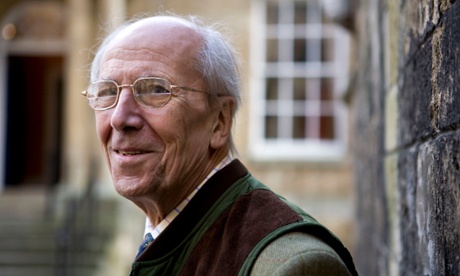
Lord Tebbit says Cameron's anti-SNP rhetoric is 'puzzling'
Lord Tebbit, the Conservative former chairman, has been speaking to BBC’s Newsnight. Like Michael Forsyth, Tebbit is not impressed by David Cameron’s Scotland strategy.
Lord Tebbit -it's 'pointless to irritate Scots just by shouting at them from Westminster', he has a few other choice words for Tory campaign
— Laura Kuenssberg (@bbclaurak) April 21, 2015
Tebbit says targeting of SNP 'threat' is 'puzzling', may push Tory voters to vote Lab tactically-distraction from 'prime target' of 326 MPs
— Laura Kuenssberg (@bbclaurak) April 21, 2015
Tebbit suggests Cameron is unlike politicians of previous generations who were 'real men' ...OUCH!
— Laura Kuenssberg (@bbclaurak) April 21, 2015
Labour would stop NHS pay cuts, Burnham says
NHS staff would resume getting pay increases at least the rate of inflation under a Labour government, the party’s shadow health secretary Andy Burnham pledged today.
Burnham made the promise at a health hustings debate with Tory, Lib Dem and Ukip health spokespeople in London organised by key NHS organisations and thinktanks.
He appeared to go further than Labour’s usual stance on the subject of health service pay, which until now has simply been that they will honour whatever recommendations the independent NHS pay review body makes. It potentially commits the party to an expensive policy as the NHS in England employs 1.3m people and staff pay already accounts for about 60% of its annual £115bn budget.
The health minister Norman Lamb, the Liberal Democrats’ health spokesman, immediately questioned the affordability of Burnham’s pledge, given that the NHS’s finances are in poor shape and also because Labour have refused to join the Lib Dems and Tories in committing to giving the NHS the extra £8bn in funding that NHS England boss Simon Stevens has asked for in order to safeguard the service’s future.
The issue arose at the hustings when Dr Mark Porter, the leader of the British Medical Association, asked the four politicians - including health secretary Jeremy Hunt and Ukip’s Dr Julia Reid - if staff would face more real-terms pay cuts in the next parliament. Asked by BBC Today programme’s Sarah Montague if he could commit to real-terms pay increases, Burnham replied: “Yes, I can. And we would reinstate the independent Pay Review Body stood down by Jeremy Hunt.”
Burnham criticised Hunt for the coalition promising all NHS staff an across the board 1% pay rise, which the pay review body had judged to be affordable, but “that was [then] reneged on.” He also claimed that “NHS staff are being kicked in the teeth by seeing more money going on agency staff”, sums - estimated to be £2.5bn a year - he also described as “fortunes”.
Lamb, who said the NHS’s spend on agency nurses was and always had been “excessive”, questioned how Labour would fund Burnham’s commitment, especially as it had only committed to giving the NHS an extra £2.5bn a year through its planned Time to Care Fund to hire extra doctors. nurses and midwives. However, he and Hunt said that the NHS could not expect to continue holding down staff pay, as has happened over the last five years as staff have had pay freezes or only 1% rises, because of its need to continue attracting people to work for it. They both ruled out the NHS using further pay restraint to help it make the £22bn of extra efficiency savings a year it has committed to find by 2020.
Hunt said that not giving all staff the 1% pay rise was probably the hardest decision he had had to make in his two and a half years as health secretary, but that he had been advised that awarding it would lead to between 6,000 and 14,000 nurses losing their jobs. While his “principle” if he continued as health secretary would be to pay staff “as generously as possible”, any rises should not mean that hospital trusts and other NHS providers of care had to lay off staff.
UPDATE: Apologies, I conveyed Andy Burnham’s pledges from earlier today on potential pay increases for the NHS’s 1.3m staff in England a bit wrongly.
What Burnham committed Labour to was an end to the policy of real-terms pay cuts for NHS personnel which health unions say has seen their income drop by an estimated 10% under the coalition - which, on my interpretation, would mean a return to the sorts of inflation-proof annual pay increases that the NHS workforce used to get.
Sarah Montague actually asked him “Can you commit to no real-terms pay cuts?”, not what I reported earlier (“Can you commit to real-terms pay increases?”). It was to that question that the shadow health secretary replied “Yes, I can”, before emphasising that he wanted to see “fairness in pay from the bottom to the top”.
Health unions are this afternoon getting anxious about something else said about earnings at the debate - Jeremy Hunt’s refusal to rule out continuing with the coalition’s policy of real-terms pay cuts as part of the NHS’s drive to somehow find the £22bn of efficiency savings it has pledged to deliver by 2020 as part of a deal that would see it receive £8bn extra from the Treasury every year.
Asked “Will you promise no more real-terms pay cuts?”, Hunt replied: “I can’t make that commitment now because I don’t know the full situation. My principle is I want to be as generous as possible provided no decision I take as health secretary means we would end up having fewer doctors and nurses. We are committing to a bigger real terms increase [in the NHS’s overall budget, of £8bn a year more by 2020] than any other party. The chances of giving a better pay deal are higher given that we’ve committed to £10bn effectively towards the forward view. It is a commitment to more staff as well as paying [them] fairly and I think the two go hand in hand.”

Updated
BBC Daily Politics has posted a few highlight quotes on Twitter from its foreign affairs debate.
From Labour’s Douglas Alexander, shadow foreign secretary:
— DailySunday Politics (@daily_politics) April 21, 2015
The Lib Dems’ Tim Farron:
— DailySunday Politics (@daily_politics) April 21, 2015
Conservative Philip Hammond, the foreign secretary:
— DailySunday Politics (@daily_politics) April 21, 2015
Scottish Green Party’s Patrick Harvie:
— DailySunday Politics (@daily_politics) April 21, 2015
And Ukip’s William Dartworth:
— DailySunday Politics (@daily_politics) April 21, 2015
Updated
The UK international aid budget is now being discussed on the BBC Daily Politics foreign affairs debate:

Hammond says aid budget is a major tool for diplomacy. It must be used wisely and in our interests. Not just eradicating poverty, but stabilising areas of conflict.
Asked why international aid has become so heavily protected, Farron says it’s about doing the right thing.
Ukip’s Dartmouth says expenditure on aid has increased more than 50% in short amount of time. International aid is a device used by major parties to get Guardian readers to vote for them. There you go folks, that means you.
Updated
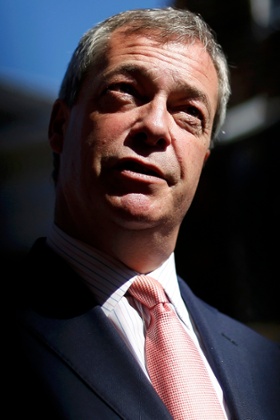
Nigel Farage has finally responded to the question about why there was only one black face in the Ukip manifesto. The Telegraph journalist Christopher Hope asked about this at the Ukip manifesto launch, but he was booed by activists and Farage ignored the question. In an interview with Magic Radio, Farage said there was a “half black” person in the manifesto too. He said:
Well firstly there was one fully black person. There was another one of our leading spokesman who is half black and that didn’t get a mention. And he featured very prominently on page six. So the premise was wrong.
I thought what happened was really interesting. There was a journalist from one of our leading daily newspapers who made the comment you know, there’s only one black. And what happened was that there was an eruption in the room as our black and ethnic minority candidates stood up and looked at this guy in a pretty hostile way. What they were saying was we’re just about sick to death of the sneering media class trying to make Ukip out to be something completely other than it is.
Farage was referring to Steven Woolfe, the Ukip immigration spokesman whose grandfather was African-American.
Updated
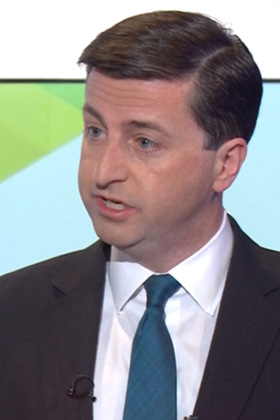
Labour wouldn’t give us a referendum on membership of the EU, Neil asks, why?
Douglas Alexander says the right time for a referendum would be if and when there is a significant transfer of powers to Brussels.
Asked if the Lib Dems are inconsistent on Europe, Farron denies this. He argues Tory decision to offer an “arbitrary” date of 2017 undermines position to negotiate. He adds EU membership is not a major concern based on his door-knocking experience.
Updated
Andrew Neil has now turned to the prospect of an in-out EU referendum.
Ukip’s William Dartmouth says Tories will offer a phoney negotiation period followed by a loaded question.
Hammond dismisses this. Electoral Commission sets question. Argues most people want to stay within the EU.
Updated
Here’s today’s high-vis jacket photo opportunity.

The foreign secretary says the Government has to “support search and rescue operations” in the Med.
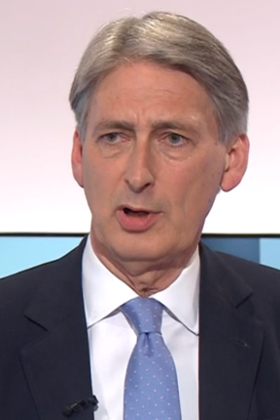
His Labour opponent says this is a U-turn, search and rescue not mentioned in previous talks and presses Philip Hammond to admit policy has been changed.
Hammond says specifies Government would support Triton.
Triton is the more limited joint EU “border protection” operation, managed by Frontex, the European border agency. Crucially, it does not include search and rescue operations across the Mediterranean, just patrols within 30 miles of the Italian coast.
Updated
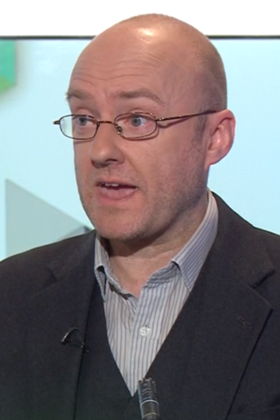
Patrick Harvie, who is actually a member of the Scottish Greens, says we should be prepared to allow up to 1 million migrants arrive in Britain if the alternative is seeing them drown in the Mediterranean.
Asked by Andrew Neil if more migrants should be allowed into the UK, shadow foreign secretary Douglas Alexander dodges the question.
Updated
Andrew Neil is asking the line-up about the ongoing migrant crisis in the Mediterranean and the impact military intervention in Libya may have had on the current situation.
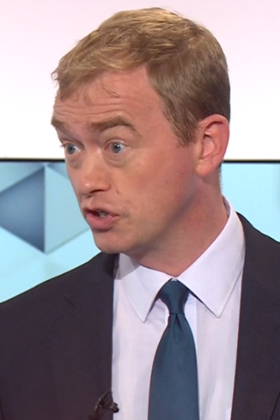
Tim Farron, Lib Dem, said it wasn’t a mistake to go into Libya, it prevented a massacre. Now have to focus on why migrants are leaving home countries.
Ukip’s William Dartmouth said his party opposed military action and coalition should be held to account.
Updated
Lunchtime summary
- Ed Miliband has said David Cameron is demeaning himself and his office by endangering the union in an attempt to stay in Downing Street. As Patrick Wintour reports, the Labour leader said that, instead of confronting the SNP, Cameron was talking them up to highlight the threat of a hung parliament and persuade voters to back a majority Tory government. In a vitriolic attack, he said the Conservative tactics of seeking to divide England from Scotland showed he would stop at nothing and say anything to get elected. Miliband spoke as Sir John Major, the former Conservative prime minister, gave a speech setting out in detail the concerns about the SNP raised by Cameron. Nicola Sturgeon, the SNP leader, said Major’s comments were “an affront to democracy”. (See 11.35am.)
All I am doing is pointing out what is as plain as the nose on your face - which is, right now, Labour is facing a wipe-out in Scotland.
- Major has rejected claims that he is talking up the dangers posed by the SNP for party political advantage as “the worst sort of 1990s Labour spin”. (See 1.12pm.)
-
Sturgeon has told the Scottish TUC that, on some issues, the SNP would support Labour “vigorously and loudly”. She told the STUC conference:
I know Ed Miliband addressed you yesterday, and let me say in some areas like improved working conditions, a determination to crack down on zero hours contracts and increasing the minimum wage - though I would like to go further than he would to 8.70 by 2020 - on these and many other areas we have similar views.
Where we support proposals a Labour government would put forward we will support them vigorously and loudly.
-
The DUP has called for an end to cuts to frontline services and warned that rushing to eliminate the deficit could harm growth. As the Press Association reports, the largest party in Northern Ireland is expected to return up to 10 seats and has said it could support either Labour or the Conservatives at Westminster but does not expect cabinet posts. Real increases in health and education spending over the next five years and the protection of other key public services were among the pledges contained in the DUP manifesto. Deputy leader Nigel Dodds said:
In our manifesto we make it clear we want to see the budget deficit eliminated. However, we also recognise that a rush to reduce and eliminate the deficit could have an impact on growth.
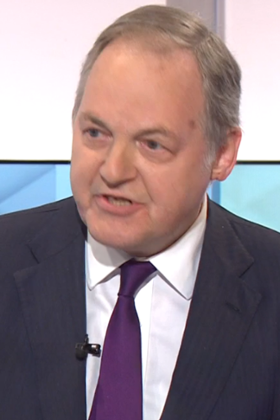
Daily Politics presenter Andrew Neil asks Ukip’s William Dartmouth how he feels about praise heaped on Russian president Vladimir Putin by some of his party’s members.
Dartmouth says if only there was a British leader who looked out for British interests in the same way Putin looks out for Russian interests.
Updated
Foreign affairs debate
Hi, Jamie Grierson here. I’m signing in as I keep an eye and ear on the latest BBC Daily Politics election debate, which is focusing on foreign affairs. Foreign secretary Philip Hammond, shadow foreign secretary Douglas Alexander, Lib Dems Tim Farron, Ukip’s William Dartmouth and the Green Party’s Patrick Harvie are all appearing. With unrest in Syria and Iraq, calls for an in-out referendum in the European Union, mounting tensions between the west and Russia and the unfolding migrant crisis in the Mediterranean, it should be an interesting one. I won’t post a minute-by-minute account but will flag the key bits.
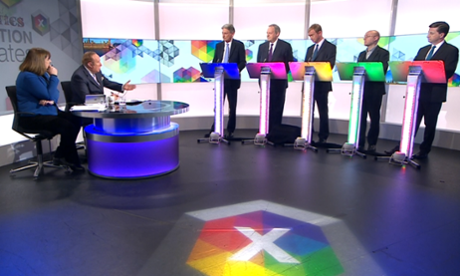
Updated
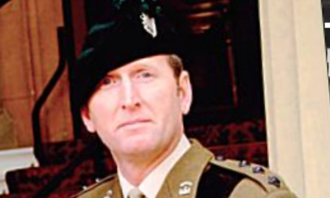
The British Army has been sucked into the row over the exclusion of Northern Irish parties from televised national broadcast debates during the general election. Forces TV - the military’s own television station - has come under fire from a highly decorated army officer for not inviting the Ulster parties to a live debate this Friday evening about defence issues.
The debate with Labour, the Tories, the Lib Dems, the Greens, UKIP and the Welsh and Scottish Nationalists will be jointly hosted by the Royal United Services Institute. Ulster Unionist councillor Dougie Beattie was awarded the Military Cross for valour during a battle with the Taliban in Afghanistan. He was also decorated for his courage previously in the Iraq campaign. The former army captain is outraged that Norther Ireland representatives have not been invited.
Councillor Beattie said: “We in Northern Ireland provide more reserves per head of population than any other country in the union. We have served in every major and minor conflict that has involved the British Military in over 300 years. We have been awarded more than 190 Victoria Crosses and many other Gallantry awards in wars past and wars present.
“The Armed Forces is not a devolved issue and therefore decision about the Armed Forces is not made at Stormont but decided in Westminster. Every political grouping has a say in that collective defence as every nation contributes to that shared endeavour.”
And he added a personal note of anger about the exclusion of his party and all others from Northern Ireland.
“As a soldier of 33 years I feel I am being let down by Forces TV and the RUSI. It is deliberate, it is calculated and it is a disgrace to the memory of those men & women and their families who live or serve in Northern Ireland. More so it is marginalising our veterans who are already some of the most vulnerable in the UK.”
Updated
Nigel Farage, the Ukip leader, has been speaking out about Scotland today.
The English have had a completely rotten deal out of devolution. Rotten because we continue to shovel money over Hadrian’s Wall, rotten because Scottish MPs can vote on English-only laws - and the SNP make clear they will do that in Westminster after May 7 - and rotten because our politicians are saying we should be ashamed to be English.
I don’t recall anyone saying we should be ashamed of being English, but perhaps he is referring to the reservations some people feel about England flags.

Young Republicans drafted in from US to boost Conservative election bid
My colleague Rowena Mason has got this fascinating story about how the Tories are drafting activists from the US Republican party to bolster their efforts in key seats the week before the election.
Members of the Young Republicans International Committee will arrive during a campaign in which the Conservatives lack ground troops in tight battleground seats compared with Labour, meaning they are relying on mailshots of election literature and busloads of mostly young Tory activists at weekends known as Team 2015.
An invitation to attend the week, which begins on 2 May, urges Young Republicans International members to “help our Conservative colleagues win. The Young Republicans are a movement for those between 18 and 40 across the US, supporting the rightwing Republican party.
A document detailing the programme logistics of the trip, including the estimated $2,500 (£1,675) cost, appears to have disappeared or been removed from the group’s website since the Guardian made inquiries about the purpose of the trip and how many activists would be attending.
Updated
Sir John Major's speech and Q&A - Summary and analysis

Sir John Major could have given two speeches today, which would have been genuinely fascinating.
The first would have been a candid speech revealing his thoughts about the Conservative party’s election manifesto. As we know from a speech he gave in 2013, in many respects his views are sharply different from those of David Cameron.
Second, he could have given a speech, from experience, on what it is like trying to run a minority government. No one in the country is better qualified to give that speech, and it would probably be very useful for whoever “wins” on May 7.
Instead, Major gave a speech about the dangers posed by a minority Labour government dependent on SNP support. It feels as if the Conservative party have finally found an election message that they think might work, and this is it. David Cameron and others have been talking about this for some days now, but Major’s speech may be the most important attempt by the Conservatives so far to place this at the centre of the election debate.
Major’s argument about the dangers of a Labour government being dependent, somehow, on SNP support contained three elements.
- The SNP would make Labour more leftwing.
- The SNP would result in Scotland being favoured at the expense of the rest of the UK.
- The SNP’s long-term goal is to break up the UK and they would manipulate events to make this more likely.
Argument 2 can be swiftly discounted, because there are 533 MPs from England and, regardless of which party is in power, they will be able to out-vote the 59 MPs from Scotland. Argument 1 is potentially true (although some commentators have their doubts), but Guardian readers may take the view that this would be a good thing, not a bad thing. And argument 3 is true, but only in so far as, whatever the outcome of the election, the SNP will continue to work for independence as a long-term goal. Major argued that, if the SNP won concessions from Labour, this would make it popular, would increase its chances of success in the 2016 Holyrood elections and would hence make independence more likely.
But those concessions could also have the effect of making Labour popular in Scotland. Arguably, the SNP are more likely to succeed in 2016 if Westminster refuses to give Scotland what it wants. And most people, including Nicola Sturgeon herself, would say that the one thing most likely to get Scotland to vote for independence in the next five years would be a Tory government holding a referendum leading to Britain leaving the EU.

So, Major’s arguments are not especially robust. But a further problem - and this is true of what Cameron has been saying over the last few days - is that effectively he was saying that, even if the SNP did win 40-odd seats or more, they had no right to be involved in shaping the laws that govern the UK. Major addressed this in the Q&A (see below), but not particularly effectively.
On the plus side, Major was certainly passionate about the union. As he said himself, he has been warning about the break-up of the UK for more than 20 years. But, ideologically, he is stuck on his own in a cul-de-sac. Major still seems to think that devolution was a mistake, despite the fact that every major UK party has accepted it for years, and even the Tories are backing further devolution for Scotland.
Major’s speech also included a section on the economy, that this was unremarkable. More interesting was his declaration that he still believes in his vision of “a nation at ease with itself”. (See 11.28am.) Mostly he sounded quite at ease himself, but the masked slipped when he spoke about Labour spin (see below). He obviously still loathes Alastair Campbell.
Here are the key points.
-
Sir John Major rejected claims that he was talking up the dangers posed by the SNP for party political advantage. This is what Labour has been saying today. (See 8.52am and 12.16pm) Major said this was typical of “the worst sort of 1990s Labour spin”.
As to essentially ramping it up, that is nonsense to make that charge. I’m sure that will be Labour’s line because it is all they can say. It is classic Labour spin in the present circumstances. Let me make two points about this. Firstly, I have been warning of this risk for over 20 years. I started warning about this in the early 1990s. That’s hardly a Johnny-come-lately attitude to a problem that has arisen. And the reason it has arisen now is not because of anything any Conservative has said. It is because of the growth in Scottish nationalist support in Scotland, Labour’s collapse in Scotland and the apparent likelihood that the Scottish nationalists will have 40 or more seats in the House of Commons when they are still a separatist party.
Any unionist like me has an absolute duty to point out to the country the risk that we ae facing ... And for Labour to twist that round in some other fashion, as I gather they are doing, just takes us back to the worst sort of 1990s Labour spin, and I think we all these days have contempt for that.
-
He rejected claims that he was “delegitimising” the SNP. Asked about this, he responded:
I wonder how many people here are voting to have the SNP running our government when they would have about 5% members of the House of Commons at most and when their leader isn’t even running in the election to be a member of the House of Commons. If you would like to talk about delegitimising, I would like to know what someone who isn’t even a candidate for the House of Commons is doing talking about her party changing the policy and politics of the government of the whole of the United Kingdom. That is what is delegitimising.
- He said having a minority Labour government dependent on SNP support would be “a recipe for mayhem”. (See 11.08am.)
-
He said that trade unions had a valuable role to play and that governments should have “a proper relationship” with trade unions. This was interesting because he may be the first senior Conservative to say something positive about unions during the campaign.
I’m not anti trade unions. I think there is a case for trade unions and historically they did a great deal for the average working man and we should recognise that. And if they continue to stop taking the higher political profile that they did and to concentrate on looking after their members and their working conditions, that is a perfectly proper thing for trade unions to do and I would invite any government to have a proper relationship with those sort of trade unions.
-
He suggested that he would prefer Cameron to form another coalition than to run a minority government if he did not win a majority. What mattered most was stability, he said.
Updated
Hats, fish and bridges. Here are some picture highlights from the campaign trail today:


Updated
Nearly half a million people registered to vote on final day

The Guardian was among a number of news organisations and public figures to try and get people to register to vote yesterday, and the campaign seems to have paid off, with almost half a million people signing up online.
This report from the Press Association:
Some 469,047 applications were made online and just under 16,000 on paper, according to Cabinet Office figures. It was the busiest day since the introduction of the new online system, the Electoral Commission said.
Large numbers of people also registered in the days running up to the deadline; a total (both online and on paper) of 118,505 on Thursday (April 16), 104,403 on Friday (April 17), 66,986 on Saturday (April 18) and 124,284 on Sunday (April 19).
Alex Robertson, of the Electoral Commission, said it was “absolutely fantastic” that more than two million people had applied to register to vote over the last few weeks.
According to the Cabinet Office figures, most of those who registered to vote yesterday were in the 25 to 34-year-old age group (152,000), followed by the 16 to 24 bracket (137,000) and then the 35 to 44-year-olds (89,500).
Some 61,000 45 to 54-year-olds registered yesterday and 28,500 in the 55-64 bracket. Just 11,100 65 to 74-year-olds registered on the last day and 5,303 over 75s.
Updated
Miliband accuses Cameron of 'demeaning' his office over SNP stance
Ed Miliband has been taking questions at the end of his speech on the NHS. He has just accused David Cameron of “demeaning” his office by sending people like Sir John Major out to talk up the threat from the SNP.
Miliband on Cameron. "he is demeaning himself. He is demeaning his office. He will say anything and stop at nothing."
— Patrick Wintour (@patrickwintour) April 21, 2015
EdM says Lord Forsyth is right. "Look at what is happening to the Conservative & Unionist Party. Cameron is seeking to divide the country."
— Jack Blanchard (@Jack_Blanchard_) April 21, 2015
Ed Miliband: Many Conservatives are queasy at what Cameron is doing (re SNP) and they should ask him to stop. He is demeaning his office.
— Jack Blanchard (@Jack_Blanchard_) April 21, 2015
Miliband says David Cameron is "talking up rather than taking on" SNP and "is demeaning his office and himself" #labour
— John Stevens (@johnestevens) April 21, 2015
Ed Miliband on David Cameron: he will say anything and stop at nothing. #ge2015 pic.twitter.com/04Gj2uq5Ft
— Peter Hunt (@BBCPeterHunt) April 21, 2015
Cameron dismisses criticism of Tory tactics over SNP
David Cameron has responded to heavy criticism of the Conservative party’s strategy in portraying a vote for Labour as a vote that would lead to the breakup of the UK.
Speaking at a PM Direct event in Leeds, David Cameron said:
All I am doing is pointing out what is as plain as the nose on your face – which is, right now, Labour is facing a wipeout in Scotland.

Updated

Meanwhile, the Scottish Lib Dem leader Willie Rennie has joined the chorus of politicians accusing David Cameron of deliberately hyping the risks of a Labour-SNP alliance at Westminster for his own aims.
But then he went on to say pretty much the same as Cameron about the SNP “trying to take the country apart.
The Guardian’s Scotland correspondent, Severin Carrell, has filed this from the Scottish Lib Dems’ manifesto launch in South Queensferry, Edinburgh:
Rennie said Tory peer Lord Forsyth was right to warn exclusively in the Guardian that the prime minister’s aggressive strategy was destablising the union. “They’re just looking after themselves,” Rennie said.
“In some ways [Lord] Michael Forsyth and John Major are both right. The SNP are a threat to our country, we know that, they stand on that record, but the Tories, by talking them up are doing exactly the same. Both pose a threat to the United Kingdom, and that’s why if you vote Lib Dem, to pursue that steady course, to keep our union together, keeping us in the centre ground, that’s a secure way to go forward.”
With no hint he felt he was taking the same negative stance on the SNP as Cameron, Rennie said his party would never agree a coalition or “confidence and supply” deal with the SNP at Westminster, since the SNP were intent on eventually breaking up the UK.
While the Lib Dems would work with the SNP in councils or the Scottish parliament, “it’s unreasonable to put them in charge of an institution that they’re against. You can just imagine Alex Salmond deputy prime minister, as soon as you’ve turned your back he’s got his screwdriver out trying to take the country apart.”
Q: If the Tories do not win a majority, would you rather see a minority government, or a coalition, perhaps with Ukip?
Major says he would not favour a deal with Ukip. He thinks they are unlikely to get into parliament.
Generally, it would depend what the numbers were. The key thing that matters is stability, he says.
The sound governance of the UK is the priority, he says.
And that’s it. I’ll post a summary soon.
Q: Are you saying the SNP MPs in Westminster have no right to have a say over UK policy?
No, says Major. He is not saying that. But he does not think the SNP is behaving in the interests of the UK because it is pursuing policies that would lead to the break-up of the UK.
Q: Should people vote Labour in Scotland to keep the SNP out?
Major says he would vote Conservative in Scotland. He is not sure whether tactical voting every achieves much, except in byelections.
Q: You have been praised for your role in the Northern Ireland peace process. Isn’t Labour showing the same sensitivity, by ruling out a coalition with the SNP but not ruling out some arrangement because they respect the right of the SNP to be represented?
Major says there is a key difference; the SNP want to leave the UK. It cannot be right for the SNP to want to break up a country in most of which they do not have candidates.
Q: What should David Cameron learn from your victory in 1992? And should he got on his soap box?
Major says times have changed. Cameron needs to get around the country and make his case, he says.
Q: Are you delegitimising the choice of voters?
Major says the SNP only represent around 5% of Britons. And Nicola Sturgeon is not even a candidate. And yet she is talking about influencing policy for the whole of the UK.
Q: [From the BBC’s James Landale] By demonising the unions, aren’t you stoking the concerns that could increase the chances of the union breaking up?
Major says it is “nonsense” to accuse him of ramping it up.
First, he has been warning of this risk for over 20 years. He started in the early 1990s. And the problem is not caused by anything the Conservatives have done. It has been caused by the collapse of Labour support in Scotland, and the rise in SNP support. He says he is entitled to warn people of the risk they face before they cast their vote. For Labour to twist that round just takes us back to the worst kind of 1990s spin. “We all have contempt for that,” he says.
Updated

Q: We have not heard much from the trade unions who are funding Labour during this campaign. What do you feel about that?
Major says the unions effectively chose Ed Miliband as leader. Maybe they are silent because their strongest supporter is leading the Labour party.
But he says the days of outright conflict between the government and unions are over. It was not just Tory governments that had problems with unions; Labour ones did too. But, he says, he is not anti-union. There is a proper role for unions to play. He would invite any government to have a relationship with them.
Updated
Q: What can we do to get more young people involved in politics?
Major says he hopes that more young people will vote this time.
Politics goes in cycles. The disillusion people experience in politics may fade when we return to a period of solid growth, he says.
Q: Should David Cameron debate Ed Miliband?
Major says Cameron debates Miliband around 50 times a year in the Commons. Hands up who feels enlightened by those debates? There is a role for debates, he says. But in those “glib, artificial” debates, there is a focus on pre-written soundbites. He does not think they are necessarily the best way of finding out what someone is like. He says he preferred to speak directly to voters himself.
Sturgeon calls John Major comments 'affront to democracy'

Meanwhile, the Guardian’s Scotland reporter Libby Brooks has filed this from the STUC annual congress at Ayr racecourse, where Nicola Sturgeon has described John Major’s comments about SNP “blackmail” as “an affront to democracy”. She also pledged to support Labour on measures to improve pay and working conditions.
Sturgeon said: “This general election is unprecedented in my lifetime in the opportunity that it gives Scotland to make our voice heard and the opportunity it then gives us to use our voice for better and more progressive politics right across the UK.”
“Some of the comments we’re hearing in the media this morning from politicians like John Major are actually an affront to democracy. These are politicians who last year urged Scotland to lead the UK, not leave the UK. These comments suggest they only think we should do that when we’re prepared to say what they want us to say and vote how they want us to vote.”
To applause, Sturgeon insisted: “Scotland has the right to make its voice heard in whatever way Scotland chooses to make its voice heard. And in this election I believe it is important that we have a voice that is shouting for an alternative to austerity and that is what I and my party will continue to do.”
Referring to Ed Miliband’s own address to congress yesterday afternoon, I say in some areas - like improved working conditions, a determination to crack down on zero hours contracts, and increasing the minimum wage, although I would like to go further than he would to increase it to £8.70 by 2020, in these and many other areas we have similar views. And let me say that we would support proposals that a Labour government would put forward vigorously and loudly.”
She added: “But it does sadden me that Labour seem determined to continue witha failing cuts agenda not because its necessary but because they want to be seen as as tough as the Tories, and i think that is the wrong approach.”
Q: I liked the speech. But there is only one of you. We need more passion in the campaign.
Major says some people are glad there is only one of him. He says people always complain about campaigns until after they are over and they have been shown to be successful.
There should be passion in election campaigns, he says.
Politicians need to remember that this is about people, and decisions that affect their lives.
Major's Q&A
Sir John Major is now taking questions.
He says he will take them first from Conservative supporters in the audience, before taking questions from the media.
Q: The government has not compensated the victims of Equitable Life. How can we trust the government?
Major says he was not in parliament when that happened. He will take it up with David Cameron. But he backs Tory plans to give people more freedom over their pensions.
Major is speaking about this love for his country.
Ours is a great and tolerant country, as free and honest in its dealings as any nation in the world. Even among our harshest critics, we have a moral authority few can match. We just need to have confidence in ourselves and who we are.
We can lift ourselves up to a better quality of life.
He ends saying the election amounts to a simple choice.
However disaffected, disengaged – downright fed up – many may be with politics and politicians – let me repeat the very simple choice in front of you all on polling day: do you vote for the party that presided over economic chaos; or the party that has now led us out of it?
Major has now finished.
Major says he still aspires to a 'nation at ease with itself'
Major says the coalition can be proud of its legacy. Labour has opposed its economic policies. It would be “perverse” to turn around now, he says.
Many years ago, I spoke of a nation at ease with itself. Events – and no doubt my own failings – meant I was unable to achieve this. It is a life-long regret. But that same wish is as alive in me today as it ever was, and I truly believe it is deliverable.
But only if the economy continues on its current course, so that wealth can spread into every part of the UK in fair measure: England, Scotland, Wales and Northern Ireland.
We have just come through seven long years of crisis. Let us make sure that something good comes out of that hardship.
Major says Tories are the party of opportunity
Major explains his dedication to the Conservative party.
We will never all be born equal. Life isn’t like that. But it is the Conservative mission to make opportunities in life equal. That is what first drew me to the Party nearly six decades ago. While Labour was offering me a hand “out”, the Conservatives offered me a hand “up”.

Meanwhile, my colleague Frances Perraudin reports that Andrew George, the Liberal Democrat incumbent in the marginal constituency of St Ives, has stood by comments he made in a recent public meeting that his party would not form another coalition with the Conservatives.
Speaking during a visit by party leader Nick Clegg to St Ives, George predicted that a Tory/Lib Dem coalition would’t be on the cards after the election because it wasn’t something the Conservatives wanted and the arithmetic was unlikely to make it possible.
He said that if the outcome of the vote on 7 May allowed for another coalition deal with the Tories, he would be arguing against it: “I myself will be arguing that I just think the Conservatives are so toxic that trying to find common cause with them is going to be tough.”
“Our experience over the last five years is sufficient for me to say: ‘OK, we’ve been there done that’. I think we’ve done the right thing – the economy is strengthening, the public finances are going in the right direction – but I don’t think it’s necessary for us to enter into that kind of coalition again with the Tories.”
George voted in favour of his party’s coalition with the Conservative party after the 2010 general election, but says: “I argued at the time that there were better ways of doing coalition, where you seek to deliver on the areas where you are in agreement and seek compromise where you don’t, and then to go to parliament for anything else.”
George said he didn’t think he was alone in his views within the party, but that he didn’t know how many of his Liberal Democrat colleagues shared his opinion.
Major says Labour is a class-based, divisive party

Major says Labour is a class-based, divisive party.
After the election, either the Conservative party or Labour will form – or at least lead – the new government. We need a government that can reach out to every part of our country. And Labour can’t do that.
I know Labour. I grew up with them. I admire their virtues. But Labour is a class-based Party. It was born so and remains so. It’s in its DNA. Labour divides to rule. To win votes, they will turn rich against poor. North against South. Worker against boss. They have done this before. And they are doing it now. But it is emphatically not what this country needs. We need to bring people together, not create chasms to prise us apart.
The enduring characteristic of the British is fairness and generosity of spirit. I believe people will turn away from Labour’s politics of social division. It has no place in a mature State.
Updated
The BBC live feed, which you can follow on the BBC website, is back up. And Major is now quoting the Bible.
In this election, Labour’s approach seems to be that – if you rob Peter to pay Paul – you can rely on the support of Paul. The truth is that if you rob Peter – by imposing punitive taxes – then you hurt Paul, because Peter will invest less, create fewer jobs, and there will be a smaller tax yield to pay for public spending.
Major is now speaking about the economy. He says the economy is recovering, and Labour would put this at risk.
After the election, some big issues face the country, he says. Labour would put the future at risk.
Good intentions are no substitute for properly-thought-through policy. In 1997, Labour inherited a healthy, growing economy. While they remained within Conservative spending plans it stayed healthy. But when they struck out on their own – with Mr Miliband and Mr Balls advising Gordon Brown at the Treasury – they left behind a recession, rising unemployment – and debt.
They blame the financial crash – but all one needs to do is pick up a history book. Every single Labour Government we have ever had – from Ramsay MacDonald to Gordon Brown – has ruined the economy. Every single time. There’s a pattern. Labour wrecks the economy. The Tories repair it but become unpopular in doing so. Labour are re‑elected and wreck it again. It’s time to break that pattern.
I’ve been watching on the BBC live feed, but every now and then it halts, and starts repeating itself. Perhaps that’s appropriate. Major is repeating the messages he was using in 1997.
Major says SNP is 'a real and present danger to our future'
Major accuses Labour of encouraging the break-up of Britain.
I warned again and again – in 1992 and in 1997 – that devolution would lead towards the break-up of the UK. For their own partisan electoral advantage, Labour ignored all the risks. No, they said, devolution would kill independence stone dead. It didn’t. All it did was to fan the flame. We have now moved on from that. In the referendum, belatedly – but to their credit – Labour fought for the Union. The Union was battered, but survived. Now, it is at risk again.
And he concludes his section on Scotland with a final warning.
Let me not mince my words: the SNP is a real and present danger to our future. They will pit Scotland against England. That could be disastrous to the people of Scotland – and fatal to the UK as a whole.
And this election may bring that danger to the fore.
Updated
Major says Scottish independence would be a mistake
Major says full fiscal autonomy would leave a £7.6bn black hole in Scottish finances.
And an independent Scotland would not be able to rejoin the EU quickly, he says.
The unhappy truth for the Scots is that the SNP are promising what they cannot deliver. They are misleading their own people. For they are more focused on gaining political power than on the long-term wellbeing of their country.
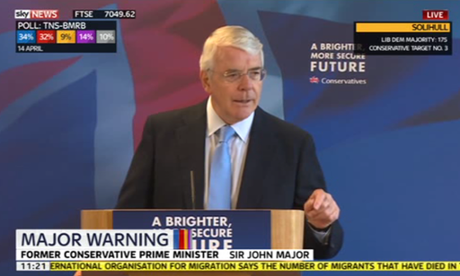
Major is now saying how much he admires Scotland and likes the union.
I am a Unionist. More than that, I admire Scotland and would hate to see us part.
Separation would not only be a leap in the dark for Scotland – it would diminish the UK. If chunks of your country fall off, you lose prestige and power.
And how much more narrow – and diminished – would we be as a nation? How would we feel if our neighbours – who happen to be Scots – suddenly became “foreigners”?
Updated
Major says the SNP will have only one objective - making themselves more popular ahead of the 2016 elections in Scotland.
For every concession they get from Labour, they will become more popular.
And if the SNP do win next May, what will they do with their victory? I can tell you – they’ll demand a further referendum on independence. They will either put that in their Manifesto, or claim it as an entitlement of their win. The once-in a generation vote will become a once-in-a-parliament vote. That is their plan.
The SNP has a second tactic. It is to drive a wedge between Scotland and – especially – England. They will manufacture grievance to make it more likely any future referendum would deliver a majority for independence. They will ask for the impossible and create merry hell if it is denied. The nightmare of a broken United Kingdom has not gone away. The separation debate is not over. The SNP is determined to prise apart the United Kingdom.
Major says having Labour reliant on SNP would be 'recipe for mayhem'
Major says this would be “a recipe for mayhem”.
But that isn’t all. The SNP’s driving ambition is an independent Scotland and – as the price for their support – they will demand policies that favour Scotland at the expense, quite literally, of the rest of the UK. That is no way to run a country. And nor is it remotely fair to England, Wales and Northern Ireland.
The Labour leader in Scotland has already suggested a similar ploy. He’s proposed that Labour’s new tax on the family home in England would raise funds for Scotland. The point is this: if a Labour leader asks for that, how much more will the SNP demand? And if this is the way Labour intends to behave towards England – how can they say “No” to the SNP? And if Labour did say “No”, the SNP could withdraw support and bring down the government at any time.
This is a recipe for mayhem. At the very moment our country needs a strong and stable government, we risk a weak and unstable one – pushed to the Left by its allies, and open to a daily dose of political blackmail.
Updated
Sir John Major's speech
Sir John Major, the former Conservative prime minister, is speaking now.
He says there is a simple choice at the election: to vote for the party that led us out of chaos, or the one that took us into chaos.
A Labour government would rely on the support of minor parties. But that would involve more borrowing, more spending and higher taxes.
If Labour accepted the support of the SNP, that would put us on course to the end of the union.
The SNP said the independence referendum would settle the matter for a generation. Major says he did not believe that for a moment.
If the SNP win 35 to 40 seats, which is fewer than some polls suggest, they will have considerable influence.
They are a leftwing party. And they would push Labour to the left.
We would all pay for the SNP’s ransom through our daily lives.
Sir John Major will be delivering his speech shortly.
A full house for Sir John Major's speech in the West Midlands. Lots will remember him as PM as if it were yesterday. pic.twitter.com/eYpeVy5kS4
— Christopher Hope (@christopherhope) April 21, 2015
At their briefing this morning, Ukip insisted they were the party of small business, highlighting a letter in today’s Daily Express signed by 100 small business bosses backing the party. Suzanne Evans, the Ukip deputy chair, said:
The Conservatives are in the pockets of the multinational corporations, Labour has become the anti-business party and Ukip is the party for small business.

Sir Malcolm Bruce, the Lib Dem deputy leader, has adopted a very Lib Dem stance on the rift between David Cameron and Michael Forsyth over the Conservative approach to the SNP. He has declared they are both right.
Major and Forsyth are both right.
A Labour-SNP pact would spell a return to the reckless spend and borrowing of 2010 while the Conservatives are playing a short term and dangerous game in building up the Nationalists.
The Conservatives are putting their party before their country. That makes both the Tories and the SNP a clear threat to the future of the UK family.
If you think the Murdoch press are being particularly partisan – by even their own standards – in their attacks on Labour and Ed Miliband, a story in today’s Independent has a good explanation why this might be.
Reporters Adam Sherwin and Oliver Wright reveal how back in February Rupert Murdoch gave executives of his UK papers firm instructions to do all they can to prevent Labour from winning the election, warning their jobs would be at risk if Miliband became prime minister and attempted to break up News UK, publishers of the Sun and the Times.
The paper reports:
The proprietor of Britain’s best-selling tabloid warned executives that a Labour government would try to break up News Corp, which owns The Sun, The Times and The Sunday Times. He instructed them to be much more aggressive in their attacks on Labour and more positive about Conservative achievements in the run-up to polling day, sources told The Independent.
Mr Murdoch is understood to have made his views clear on a visit to London at the end of February, during which he met with senior Tories including the Conservative chief whip and formerTimes executive Michael Gove.
The News Corp boss, who has made no secret of his dislike of the Labour leader, told the editor of The Sun, David Dinsmore, that he expected the paper to be much sharper in its attacks on Labour.
As well as today’s splash (below), the Sun’s page two headlines – Fuel hike plot, Ed cash ‘chaos’, NHS rap for Balls – are all designed to paint a picture of Labour as unfit for government and dangerous for the economy, with nothing like the same amount of scrutiny of the Conservatives.
Tuesday's Sun front page: Slave Labour #tomorrowspaperstoday #bbcpapers pic.twitter.com/0GH3DLfscd
— Nick Sutton (@suttonnick) April 20, 2015
However, even Murdoch must know the paper widely considered to have kept Neil Kinnock out of No 10 in 1992 is no longer the force it once was. A front page campaign in December 2013 demanding that David Cameron toughen immigration controls was quietly dropped when it became clear that the PM wasn’t listening. Murdoch then spent much of last year attacking David Cameron on Twitter, gleefully undermining his authority as he looked to embolden potential Tory leadership challengers.
But Murdoch would never let his personal dislike of Cameron from getting in the way of what’s best for his businesses, hence the full-throated attacks on Labour. The waning influence of papers like the Sun just means the rhetoric is being ramped-up to new levels of hysteria.
Updated
SNP says Sir John Major's speech 'very foolish'
John Swinney, Scotland’s deputy first minister, has described Sir John Major’s intervention as “very foolish”. He put out this statement.
This is a very foolish intervention by John Major, and the language he uses is unworthy of him.
Last year, the Tories - along with Labour’s Jim Murphy and the Lib Dems - urged the people of Scotland to stay with the Westminster system, because we were told that we have an equal and valued voice. We were invited to lead the UK, not leave it.
But in the general election, the Tories now say that if the people of Scotland choose to be represented by electing a strong group of SNP MPs, we have no role to play in the governance of the UK at all.
This attitude doesn’t respect democracy - and is completely wrong. The Tories are obviously badly rattled by the polls - north and south of the border - and worried that this right-wing government which is damaging the lives of hard working and vulnerable people is going to be replaced with progressive polices.

The Greens: a voice for the voiceless or a middle-class sect?
Guardian columnist John Harris has filmed the latest video in his election road trip series.
The Green party thinks Bristol West could deliver its second seat in parliament – but to achieve that, they will have to reach way beyond their bohemian comfort zone into the city’s more deprived areas. John Harris joins the party faithful as they canvass high-rise estates and aim for working-class and ethnic minority votes, while trying to lay to rest Natalie Bennett’s ‘brain fade’ and sound a loud message of hope.
Updated
Clegg says Tories are 'panicking' because they know they won't win

Nick Clegg said this morning that Michael Forsyth’s decision to criticise David Cameron’s Scotland strategy in a Guardian interview showed the Tories were panicking.
The Conservatives are now - and I thought this would happen around this time of the campaign - starting to argue amongst themselves because they are panicking. It is now dawning on the Conservatives, something I could have told them ages ago, that they are not going to win this election.
Everybody knows they are not going to win the election, in fact everybody knows that no one is going to win the election outright, and they are starting to panic. They are thrashing around, using ever more intemperate language.
Clegg was speaking from a Cornwall, where he visited a fish market early this morning. (See 7.22am.)

Updated
A YouGov poll released last night gave the SNP a 24-point lead over Labour in Scotland.
Exc: Times / YouGov / Scotland 16-20 April SNP 49 Lab 25 Con 17 LD 5 Other 4 Unchanged on April 8/9
— Sam Coates Times (@SamCoatesTimes) April 20, 2015
Angus Robertson, the SNP’s campaign director, said:
This poll is a very welcome indication that people across Scotland are responding positively to the SNP’s message of delivering investment in jobs and public services instead of the Westminster parties’ cuts.
Poll suggests Sir John Major's intervention may not impress Ukip supporters
The Conservatives hope Sir John Major’s intervention today will be constructive. He does not give many speeches on domestic politics, as James Forsyth wrote for Coffee House recently, when he does get involved, it is normally because he is trying to help David Cameron.
But do people pay attention to what he has to say. A YouGov poll presents a mixed view.
On the plus side, Major was seen as more of an asset by voters than six other retired or semi-retired political figures, including Michael Howard, Gordon Brown and Tony Blair, who was bottom.
But, on the negative side, despite being at the top of the list, Major still had a net asset rating of zero (those who say he is an asset, minus those who say he is a liability).
Even worse, although Major is seen as an asset by Tory supporters, he is almost as unpopular with Ukip supporters as he is with Labour supporters. This could be significant because the Tory decision to talk up the threat posed by the SNP does seem aimed particularly at winning votes back from Ukip (which is why Nigel Farage retaliated yesterday with his own anti-SNP diatribe).
Major is popular, though, with Lib Dem supporters.
Here is the YouGov write-up of the research. And here are the figures.
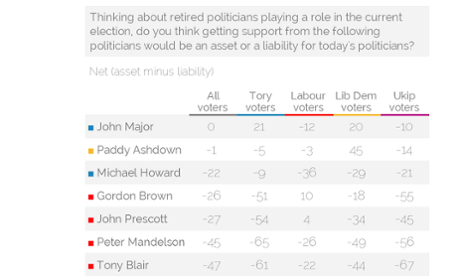
Another politics academic has been commenting on Sir John Major’s speech. This is from Steven Fielding, professor of political history at Nottingham University.
John Major's time as PM shows that you don't need to be in a coalition to have a government of chaos.
— Steven Fielding (@PolProfSteve) April 21, 2015
Guardian poll projection gives Tories one-seat lead
With just 16 days to the election, the latest Guardian projection has the main parties virtually tied: the Conservatives are on 271 seats and Labour on 270. Behind them, the SNP is projected to win 55 seats, the Lib Dems 28, Ukip four and the Greens one.
The underlying picture remains relatively stable. The contest for largest party is self-evidently close. There are tens of battlegrounds (mostly Lab-Con, a handful of Con-Lib Dem ones, and a few involving Ukip – check out our interactive map for details) where the result is too close to call. These will decide who ends up the largest party.
However, the bigger picture is fundamentally static: the current arithmetic sees Labour and the SNP with an advantage. Some uncertainty though remains, especially due to the fact that there are still two weeks to go, and what seems like some difference - albeit minor - between phone and internet polling, with the former mostly showing the Tories ahead, and vice versa, the latter pointing to a Labour lead.
One trend that has consolidated though over the past few weeks – across all polls, phone, web and in constituency polling – is the strength of the SNP. This is unlikely to change.
Ryan Coetzee, the Lib Dem director of strategy, claims that the emergence of Sir John Major in the campaign is a reminder of what David Cameron could become.
If Cameron limps back into number 10 propped up by his right wing, Ukip and the DUP, he will be the new John Major. Don't let it happen.
— Ryan Coetzee (@RyanCoetzee) April 21, 2015
Remember the verdict on Major in hoc to his right wing? "Weak, weak, weak!" Only the Lib Dems will keep Britain in a sensible place.
— Ryan Coetzee (@RyanCoetzee) April 21, 2015
The row about Scotland, and the Tory strategy of talking up the threat posed by the SNP, has overshadowed Labour’s main campaign event today, a speech from Ed Miliband which will see him announce plans to get an extra 1,000 nurses into training this year – the start of Labour plans to ultimately recruit 20,000 extra nurses by 2020.
On BBC Breakfast Miliband said Labour could be trusted on this because it had identified where it would find extra money for the NHS (from the mansion tax, a tobacco levy and measures on tax avoidance).
I’ve got an iron rule, which is that I only make commitments where I know where the money is coming from. So Labour has an immediate plan for 2015, a rescue plan. The Conservatives and other parties have an IOU for the NHS for 2020. I think what the NHS needs is money now – that’s what we’re going to provide.
Sir John Major's speech - Extracts
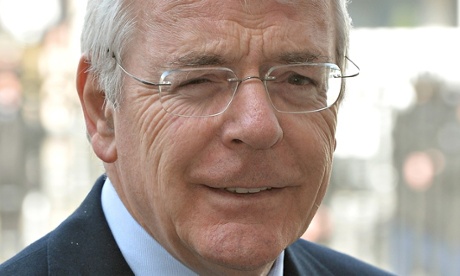
Sir John Major, the former prime minister, is delivering his speech warning about a minority Labour government dependent on the SNP later this morning. But a chunky extract was released overnight. Here it is.
If Labour were to accept an offer of support from the SNP, it could put the country on course to a government held to ransom on a vote by vote basis.
Labour would be in hock to a party that - slowly but surely - will push them ever further to the Left.
And who would pay the price for this?
We all would. We would all pay for the SNP’s ransom in our daily lives - through higher taxes, fewer jobs, and more and more debt.
But that isn’t all. The SNP’s driving ambition is an independent Scotland and - as the price for their support - they will demand policies that favour Scotland at the expense, quite literally, of the rest of the UK. That is no way to run a country. And nor is it remotely fair to England, Wales and Northern Ireland.
The Labour leader in Scotland has already suggested a similar ploy. He’s proposed that Labour’s new tax on the family home in England would raise funds for Scotland. The point is this: if a Labour leader asks for that, how much more will the SNP demand? And if this is the way Labour intends to behave towards England - how can they say “No” to the SNP? And if Labour did say “No”, the SNP could withdraw support and bring down the government at any time.
This is a recipe for mayhem. At the very moment our country needs a strong and stable government, we risk a weak and unstable one - pushed to the Left by its allies, and open to a daily dose of political blackmail.
In 16 days’ time, the people of the United Kingdom will elect our next government.
There is a simple choice to make: do you vote for the party that presided over economic chaos: or the party that has led us out of it?
Tim Bale, a historian of the Conservative party, says Major is in a position to know about all this. Major is the only surviving prime minister to have run a minority government - he lost his majority for a while when he had to suspend the whip from a bunch of Tory Eurosceptics - and he was constantly having to negotiate with a small territorial party (the Ulster Unionists).
So...John Major is warning of, erm, TAX RISES and PARLIAMENTARY CHAOS. He ought to know, I guess. pic.twitter.com/meVmay7FSK
— Tim Bale (@ProfTimBale) April 21, 2015
Updated
Here are today’s YouGov polling figures.
Update: Lab lead at 1 - Latest YouGov / The Sun results 20th Apr - Con 34%, Lab 35%, LD 7%, UKIP 13%, GRN 5%; APP -10 http://t.co/dR3874GGQ6
— YouGov (@YouGov) April 21, 2015
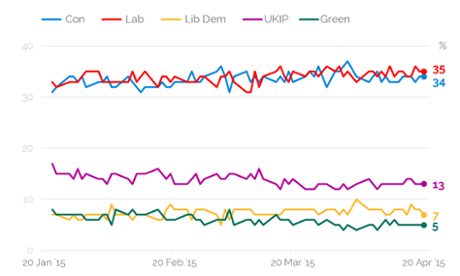
Hague says Tories not to blame for rise of the SNP
William Hague, the Conservative former foreign secretary and former Commons leader, has been giving interviews this morning. He told Radio 5 Live that the Tories were not to blame for talking up the SNP.

We have the danger here that people who want to break up the United Kingdom will be running the United Kingdom in a few weeks’ time if there is a Labour government with a large number of Scottish Nationalist MPs. And it’s not the Conservatives who have talked that up; it’s the story, whether of opinion polls or of what everybody’s talking about on the ground.
I think it was you ladies and gentlemen in the media who were really doing that rather than the Conservative party. It’s not in the interests of the Conservative party for Scottish Nationalists to succeed, but the Conservative party have to point out in this election that unless we have a Conservative majority we will be faced with a Labour government in a minority dependent on Scottish Nationalists, that they will make impossible demands, they will demand higher taxes, higher welfare spending, weaker defences every single day for five years and that will be disastrous for families across the UK and for the whole future of the United Kingdom.
Updated
Alistair Darling accuses Tories of putting UK at risk just to grab power

Alistair Darling, the former Labour chancellor and former leader of the Better Together campaign, was on the Today programme shortly after Ed Miliband was on BBC Breakfast (see 8.52am) delivering a very similar message. He said the Conservative election rhetoric was “dangerous” and putting the UK at risk.
What they are doing is entering into a dangerous, destructive embrace of the nationalists. If this happens, we are going to end up with even more division ... I really do think that the Tories flirting with English nationalism, and playing that off against Scottish nationalism, it’s destructive, and it’s pretty desperate to put at risk the United Kingdom just to grab another five years in power.
He also said that the idea that Labour would do a deal with the SNP was “nonsense”.
The idea that we would enter into an agreement that would be destructive, not just for the country but also, actually, for the Labour party, is nonsense, so we won’t do it.
But last night David Lammy, the Labour former minister and potential candidate for London mayor, said he thought Labour could “do business” with the SNP. He told ITV:
I think we can win this election. But clearly, after the general election, you would forge common alliance with parties that you can actually do business with and the SNP must be part of that story.
I still think Labour can form the next government and that’s what I am fighting for. But, yes, there is common ground with other parties and the SNP would be included in that and we may need to enter into discussion after the general election.
Miliband accuses Cameron of 'threatening the integrity of UK' by talking up SNP
Good morning. I’m taking over from Mark now.
Ed Miliband has just been on BBC Breakfast. Citing Michael Forsyth’s comments in the Guardian today, he accused David Cameron of “threatening the integrity of the UK” through his strategy of talking up the SNP.
I think David Cameron is playing fast and loose with the United Kingdom. This is somebody who has now given up hope of winning a majority. He is actually trying to boost the SNP ...
Setting England against Scotland, David Cameron carries on talking up a nationalist party. He should not be talking up a nationalist party in order to try to get them to do well in Scotland to take votes off Labour to try and crawl back into Downing Street. He should be taking on a nationalist party, as I’m doing. I say there are fundamental disagreements between me and the SNP. They want a second referendum on independence in the next five years. I’m not having that. So I think David Cameron is now threatening the integrity of the United Kingdom with the games he is playing. I think Conservatives are now ashamed of what he is doing.
Miliband also reaffirmed his opposition to a coalition with the SNP. Asked about some other form of cooperation, he said he would not go through “every hypothetical” but he said “a Labour government, led by me, what happens in that Labour government will be decided by me”.

Updated
The SNP issue dominating the airwaves yet again, if my workstation is anything to go by. As William Hague was telling Jim Naughtie on the Today programme that the SNP would “set England against Scotland” and try to break up the UK, Ed Miliband was on BBC Breakfast accusing the Tories of playing fast and loose with the union, in an attempt to “crawl back to No 10”.
Labour will be hoping they can move the conversation back to the NHS later this morning, as the Tories believe they are on to a winning strategy if they can keep hammering home the prospect of Nicola Sturgeon wielding power and influence over Miliband.
Ed Miliband tells BBC Breakfast PM is threatening integrity of UK. Playing fast & loose with UK trying to boost SNP to crawl back to No. 10
— lucy manning (@lucymanning) April 21, 2015
Bunham says Labour won’t give NHS ‘cheques that will bounce’

The shadow health secretary, Andy Burnham, has been on the Today programme, where he renewed Labour’s commitment to extra money for the NHS “this year and next”.
Burnham said Labour would pursue “pay fairness” in an effort to boost morale, handing control over increases to an independent body. He said money would come from cutting the agency staff bill by recruiting additional staff on normal salaries.
Burnham told the BBC: “There will be more money this year, 2015/16, if there is a Labour government. We will get the funds flowing immediately into the NHS.”
He said Labour would not immediately commit to promise to fund the extra £8bn a year by 2020 demanded by NHS England to fill a spending gap. But he vowed Labour would do “whatever it takes” and added: “We are not going to make promises without saying where the money will come from, we aren’t going to give the NHS cheques that will bounce.”
Burnham added: “The NHS will not have a secure financial future until we break the grip agencies have over NHS organisations.”
Updated
Fresh from breaking the internet last week with the Albert, Bernard and Cheryl maths problem, the Guardian’s maths blogger Alex Bellos has posted this solution to a question no one asked: what is the shortest route between the UK’s top 50 marginal seats?
Turns out the route is 2,669 miles long and would take 61hs 44mins to drive it.
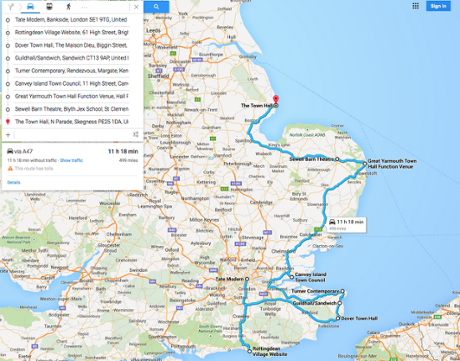
Ukip wants TV licence fee reduced to £50

Nigel Farage has expanded on what he would like to see happen to the BBC during a rally in Rochester in Kent. His manifesto says he would like to see the licence fee reduced but here he is more specific, suggesting it should be less than £50 instead of just under £150.
“I would like to see the BBC cut back to the bone to be purely a public service broadcaster with an international reach, and I would have thought you could do that with a licence fee that was about a third of what it currently is,” he said.
The Guardian’s Scotland correspondent has set the scene on today’s campaigning from the Scottish parties:

The Scottish Liberal Democrats are the final party in Scotland to unveil their election manifesto, in the historic seaside town of South Queensferry under the Forth bridge near Edinburgh.
With the Lib Dems in theory facing a near wipeout of their 11 seats in Scotland after a voter backlash following their coalition deal with the Tories, Willie Rennie, the Scottish Lib Dem leader, is aiming to put the most positive possible sheen on his party’s challenge.
He will insist that the Lib Dems are proud of their “record of progress in government and vision of the future” and will urge voters to return enough Lib Dems to have another shot at sharing power at Westminster.
Insisting they have a “positive offer to create a decade of opportunity for everyone”, he will say: “In just five years we have got the economy back on track and done so fairly.
“We are now closer to our ambition of creating opportunity for everyone. But with wins for the Liberal Democrat in this election we can make it a decade of opportunity.”

Meanwhile Jim Murphy, the Scottish Labour leader, will continue his frenetic tour of Scotland’s high streets and community halls to press home Labour’s ailing efforts to protect its 41 seats from an SNP rout.
He will address a street event in central Glasgow at 11am on “rebuilding our NHS”, accusing Nicola Sturgeon’s government of under-investing in frontline services.
Murphy is due to say: “Supporting our NHS should be our national priority, not a second referendum and the years of debate and division that would mean. “Our NHS needs more investment, not more austerity.”
Elsewhere in Scotland, the Scottish Tory leader Ruth Davidson is due to meet oil and gas industry apprentices at 11.15 in Peterhead north of Aberdeen, in Alex Salmond’s former seat of Banff & Buchan.
And on Tuesday evening, Salmond will deliver a speech at Glasgow university where he is due to receive an honorary doctorate for his contribution to politics. Earlier recipients include former Lib Dem leader Sir Menzies Campbell and founder of the Scottish parliament, Donald Dewar.
Nicola Sturgeon is addressing the STUC congress in Ayr at 10am. It will be interesting to see what reception she gets after Ed Miliband received a far more upbeat welcome there than expected yesterday.
Updated
Nick Clegg visits St Ives fish market
The Guardian’s Frances Perraudin has pulled an even earlier shift than me this morning, following Nick Clegg round a fish market in St Ives.
Clegg and MP Andrew George are making a visit to Newlyn harbour in St Ives to watch the sun rise from a fishing boat. pic.twitter.com/jWxu3xdoR7
— Frances Perraudin (@fperraudin) April 21, 2015
Nick Clegg visiting Newlyn fish market, St Ives, with local MP Andrew George https://t.co/yqgKYpqs1F
— Frances Perraudin (@fperraudin) April 21, 2015
Updated
Lord Steel says Major 'does not understand Scotland'
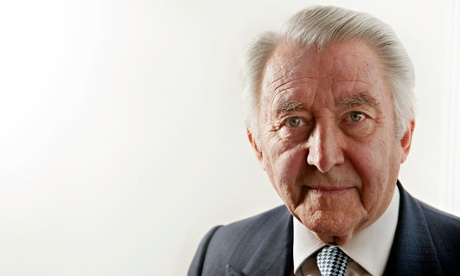
The former Lib Dem leader David Steel has been on the Today programme, where he echoed the sentiment of the Tory peer Lord Forsyth, who told the Guardian’s Nicholas Watt that the Conservatives were playing a dangerous game by building up the threat of the SNP.
Steel told Today that John Major had “never understood Scotland” and that Forsyth was right to raise concerns that the Tories would be doing SNP a favour by bringing them to centre stage. He also pointed out that the Tories worked with the SNP in Holyrood for many years without warning of catastrophe.
“I think the consequence is we will end up with a minority government. Ed Miliband has made it clear he does not want any deal with the SNP.
“If you stop to think about it, if the SNP do quite well in the election - which everyone expects them to - it will be at the expense of the Labour party. The idea that, having killed off a lot of Labour MPs, the Labour party is going to embrace them in Westminster is really almost fantasy, I think.
“What [Sturgeon] is trying to do - and she is a very astute politician, I know her well - she is saying ‘Vote for us and we will provide a better Labour policy than the Labour Party’, which is an odd but interesting way to play it.”
Former @LibDems leader David Steel predicts election will result in a minority Labour Govt @BBCr4today
— norman smith (@BBCNormanS) April 21, 2015
Updated
Morning briefing
Good morning and welcome to another instalment of the Guardian’s election live blog, with less than 16 full days until polls open.
I’m Mark Smith and I’ll be bringing you up to speed on what’s happening today, as well as rounding up reaction to yesterday’s campaigning. I’ll be handing over to Andrew Sparrow later this morning. You can get in touch with us on @marksmith174 or @andrewsparrow. And we’ll be reading below the line too so please post, and post often.
The big picture

Yesterday’s big set pieces were the BBC’s interview with Ed Miliband and the fallout from the SNP’s manifesto launch in Edinburgh, which was framed by some pretty ugly personal attacks from the Tories against Nicola Sturgeon – particularly from Boris Johnson.
Today, the Conservative campaign team are wheeling out their former prime minister, John Major, to continue hammering home English voters’ fears of the SNP’s potential role in a minority Labour government. They will be hoping that Major’s implicit gravitas and statesmanlike political standing will help temper the more personal attacks of Johnson and the defence secretary, Michael Fallon.
The Telegraph has seen a copy of Major’s speech, in which he will say that any deal between Miliband and Sturgeon would lead to “a daily dose of political blackmail” from the SNP.
The SNP will be in a position to “bring down the government at any time” if its demands for increased spending in Scotland are not met, Sir John will say.
During tough questioning from Newsnight’s Evan Davis last night, Miliband did his best to avoid discussing exactly what a post-election deal with the SNP would look like, saying that it was “presumptious”. He also knows however, that talk of this grubby aspect of coalition-building can do only harm to Labour’s vote on 7 May.
Neil Breakwell, the deputy editor of BBC’s Newsnight, says Miliband was disingenuous in refusing to answer based on the “hypothetical” question, given that – by Newsnight’s own figures – there is a 92% chance that some form of coalition or vote-by-vote deal will be necessary for any party govern.
Ed Miliband is not alone in avoiding the hypothetical question. Politicians from all parties do it. David Cameron has refused to discuss the possibility of any post-election deal with Ukip, for example.
The problem though for Messrs Miliband and Cameron is that according to Chris Hanretty, who produces the Newsnight Index, the probability of no majority for either party is currently sitting at 92%.
Meanwhile, at a speech in Manchester today, Miliband will also say that Labour ministers would, on their first day in office, instruct officials to call on universities to reopen admissions for highly oversubscribed nursing courses this year after 30,000 would-be nurses were turned down because of a lack of places in 2014.
Today’s diary
Here are some of the campaign events on our radar today:
-
6am: Nick Clegg visits a fish market as he campaigns for the Lib Dems in St Ives, Cornwall
- 8.30am: Ukip “major policy” briefing
- 10am: Scottish Liberal Democrats manifesto launch, South Queensferry, Edinburgh
- 10am: Nigel Farage visiting businesses in Canterbury, Kent
- 10am: Nicola Sturgeon addresses STUC in Ayr
- 11am: Former PM John Major making speech in Solihull, West Midlands
- 11am: Ed Miliband will be talking about Labour’s NHS plans at Manchester Metropolitan University
- 11.30am: David Cameron hosting PM Direct event in West Yorkshire
- 2pm: Nick Clegg campaigning in Twickenham, west London
Reading list
-
Ian Macwhirter in the Herald – which backs Scottish independence – says Boris Johnson’s slurs against Nicola Sturgeon are not only offensive, they are counterproductive:
The demonisation of Ms Sturgeon just enhances her already buoyant popularity. Are the Tories determined to do the SNP’s job for them?
And let us hear no more in this campaign about the hateful, abusive cybernats. They are being comprehensively out-nastied by the Unitrolls who seem to have taken over the UK press.
The Telegraph blogger Iain Martin was all over Twitter yesterday calling the SNP’s manifesto launch event a “Nuremberg Rally”. They do this partly to elicit abusive online responses which they can then print as examples of offensive nationalism.
Increasingly, though, the SNP’s legion of internet supporters are getting wise to this tactic and are using ridicule instead of hate-speak.
But again, no Scottish voter - or English voter for that matter - could have seen Ms Sturgeon, an articulate young woman, as an extremist. Her language is entirely in the tradition of British social democracy.
-
Lesley Riddoch in the Guardian, who says Sturgeon has “worked half her life to become an overnight success”, explains the tightrope Scotland’s first minister needs to walk with every public utterance:
Sturgeon has grasped that she must address two distinct audiences with every keynote speech. The Scottish audience hasn’t necessarily been hanging on her every word – we know from exposure to the radical Sturgeon that there is no prospect of a deal with Tories, or a U-turn on scrapping the renewal of Trident. What Scots needed to see was that despite all the attention she has received from London-based commentators, Scotland still comes first for Sturgeon. After all, the allure of Westminster power has pre-occupied, distracted and softened many other reforming efforts in the past. For Scots, the single message on the podium and backdrop was vitally important – Stronger for Scotland.
For progressive viewers in the rest of the UK, the detailed programme was important – and possibly more appealing than Labours’ own. More money for the NHS, no money for Trident and a number one priority to end austerity – it’s easy to see why Scottish opinion polls consistently predict a meltdown for Scottish Labour, as it struggles to identify its own core values or any weak point in Sturgeon’s appeal.
- Janan Ganesh in the Financial Times (£) argues that if the Conservatives lose the general election, they can only blame their own reputation. Despite the spheres aligning for the incumbents – a growing economy, a popular leader, a tub-thumping rightwing press – “still the party cannot escape the noxious reputation that began to form in the 1980s, calcified in the 1990 … Too many Britons … refuse to vote Conservative as a matter of identity”.
- Newsnight’s policy editor Chris Cook says the SNP is using an accounting “dodge” in order to delay by a year the point at which it scores debt.
If today were a song …
… it would be Loch Lomond, an ode to one party taking the high road, while the other takes the low road. This Runrig live version is one to get any Scot – or half-Scot - dreaming of a better land.
The non-election story you may have missed …

Next time you’re stuck on a train that smells of wee, mysteriously waiting on the tracks outside Crewe station until a platform becomes available – like they weren’t expecting it or something! – why not close your eyes and pretend you’re on on of Japan’s maglev (magnetic levitation) trains.
One of them has just broken the world train speed record. A cool 373mph. (And Japan’s scheme costs less than Trident)
Updated